
 3 min read
 5
 Linkedin
 Threads
 Facebook
 X

One of America's most remarkable maritime achievements has reached its final destination, but its story is far from over.
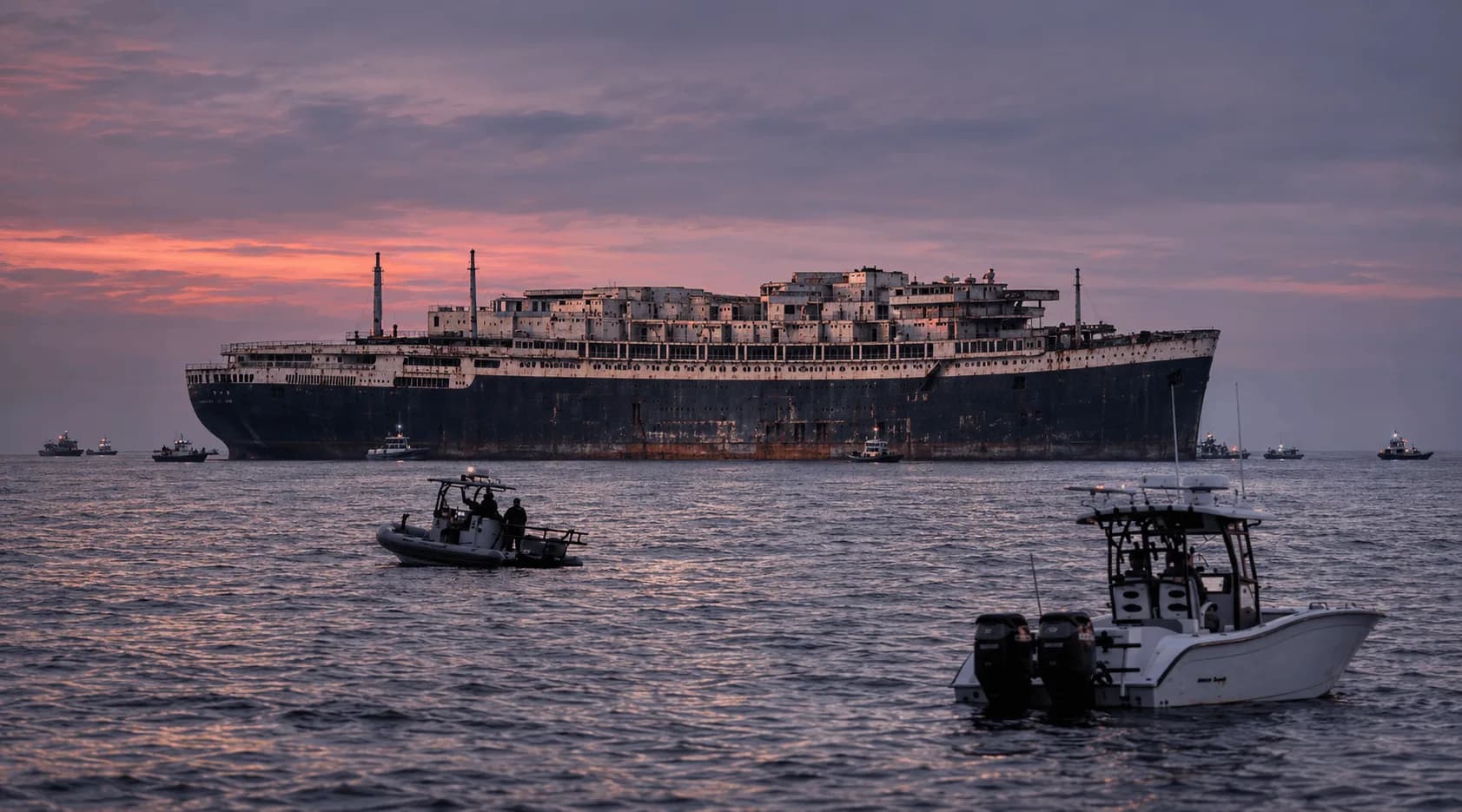
The SS United States was deliberately sunk approximately 22 nautical miles southwest of Destin-Fort Walton Beach, Florida, in a carefully controlled operation designed to transform the historic ocean liner into an artificial reef.
The sinking was completed Wednesday evening after several hours of flooding the vessel.
The nearly 1,000-foot ship now rests on the Gulf floor, beginning a new role as an underwater habitat and diving destination.
For generations, the SS United States represented American engineering, speed, and industrial ambition. Its new purpose connects that history with marine conservation, scientific research, and economic development along Florida's Gulf Coast.
What once carried passengers across the Atlantic will now help support life beneath the ocean, while bringing a new generation of visitors to America's coastal communities.
The Ship That Showed the World What America Could Build
The SS United States entered service in 1952, during a period when American industry was demonstrating its strength following World War II.
Designed by renowned naval architect William Francis Gibbs, the vessel was developed through a partnership between the U.S. government and United States Lines.
It was more than a luxury passenger liner.
Its design incorporated advanced engineering and security considerations because the ship was intended to serve as a potential military transport during an emergency.
The vessel could reportedly be converted into a troopship capable of carrying approximately 14,000 military personnel across 10,000 miles without refueling.
Its lightweight construction, powerful propulsion system, and streamlined design made it one of the most advanced American ships of its era.
On its maiden voyage in 1952, the SS United States established the Blue Riband record for the fastest transatlantic crossing by an ocean liner.
That record still stands.
The ship completed the crossing in approximately three days, 10 hours, and 40 minutes, reaching speeds exceeding 38 knots during its sea trials.
It carried more than a million passengers during its operating years, including presidents, international leaders, entertainers, and influential figures.
Among its famous passengers were Marilyn Monroe, Walt Disney, John Wayne, and four American presidents: Harry Truman, Dwight Eisenhower, John F. Kennedy, and Bill Clinton.
Why the Historic Vessel Was Sunk
The rise of commercial aviation dramatically changed international passenger transportation.
By the late 1960s, flying across the Atlantic had become faster and increasingly accessible, reducing demand for expensive ocean liner travel.
The SS United States was retired in 1969.
After changing ownership several times, the ship arrived in Philadelphia in 1996, where it remained docked for nearly three decades.
Preservation groups spent years attempting to secure a permanent future for the vessel, including proposals for redevelopment as a museum, hotel, or entertainment destination.
The financial challenge proved enormous.
Maintaining a ship of this size required substantial investment, while viable redevelopment proposals failed to secure the necessary funding.
In 2024, Okaloosa County, Florida, purchased the vessel from the SS United States Conservancy for approximately $1 million.
The county developed a different plan: transforming the historic liner into an artificial reef that could benefit the marine environment while creating a major attraction for the region.
More Than a Year of Preparation
Sinking a historic ocean liner requires far more preparation than simply opening its hull to the sea.
Before deployment, the vessel underwent an extensive environmental remediation process at a shipyard in Mobile, Alabama.
Crews removed fuel, hazardous materials, wiring, nonmetal components, and other materials that could potentially contaminate surrounding waters.
The preparation was conducted in coordination with federal and state environmental authorities, including the Environmental Protection Agency and the Florida Department of Environmental Protection.
Contractors also strategically cut openings throughout the hull and internal structure to allow water to enter in a controlled manner.
The objective was to ensure the ship descended safely and settled in an upright position.
The operation was conducted without explosives.
Its funnels, radar mast, and other important historical components were removed before deployment and preserved for a planned land-based museum.
The approximately $13 million preparation and deployment project was funded through county tourism revenue and partner contributions.
A New Home for Marine Life
Artificial reefs provide underwater structures where marine organisms can attach, shelter, feed, and reproduce.
Over time, the ship's steel surfaces are expected to attract algae, sponges, corals, and other organisms, creating habitats for fish and additional marine species.
The Gulf waters surrounding the Florida Panhandle already support important commercial and recreational fisheries.
The new reef could provide additional habitat for species such as snapper, grouper, amberjack, mackerel, and tuna.
For recreational divers, the ship offers something extraordinary: the opportunity to explore an almost 1,000-foot ocean liner beneath the Gulf.
The vessel rests in approximately 180 to 200 feet of water, with its upper sections roughly 55 to 60 feet below the surface.
This makes portions of the structure accessible to appropriately certified recreational divers, while deeper exploration requires more advanced training.
The county expects the wreck to become one of the region's most recognizable diving destinations.
Scientists Will Study an Entire Ecosystem Forming From Scratch
The project is also creating an unusual scientific opportunity.
Researchers from the Woods Hole Oceanographic Institution are beginning a long-term study of how marine ecosystems develop on large artificial structures.
Unlike older shipwrecks that scientists discover after marine life has already colonized them, the SS United States provides an opportunity to observe the process from its beginning.
Researchers plan to monitor water chemistry, microbial activity, and the development of biological communities.
Their work will include collecting water samples from 132 locations around the vessel to measure elements released as the steel structure gradually corrodes.
Scientists hope the findings will improve understanding of artificial reefs and help inform the design of future marine habitats.
The research is supported by NOAA and Woods Hole Oceanographic Institution.
Florida Expects a New Economic Attraction
For Okaloosa County, the project represents an investment in the future of coastal tourism.
The Destin-Fort Walton Beach area already maintains one of America's most active artificial reef programs, with approximately 580 reefs along its coastline.
The SS United States adds an attraction unlike any other in the region.
Dive operators, charter boats, hotels, restaurants, equipment suppliers, and tourism businesses could benefit from visitors traveling specifically to explore the wreck.
The planned land-based museum will provide another opportunity to preserve the vessel's history and educate visitors about its engineering achievements.
The county is effectively connecting two economic assets: its maritime heritage and its natural environment.
The result could support tourism throughout the year rather than relying exclusively on traditional beach seasons.
An American Icon's Second Chapter
The SS United States was built during a time when American engineering demonstrated that the country could compete with the world's most advanced maritime powers.
Its transatlantic speed record became a lasting symbol of that achievement.
Its final transformation offers a different kind of legacy.
The vessel is now positioned to contribute to marine habitat, scientific discovery, recreational tourism, and the economic vitality of Florida's Gulf Coast.
The ship's original purpose may have ended decades ago, but its historical significance will continue through the preserved artifacts, the planned museum, and the new underwater destination.
The SS United States once demonstrated America's ability to build a ship that could outrun the world. Now, its transformation demonstrates how an American community can give a historic engineering achievement a new purpose, connecting national heritage, scientific discovery, environmental stewardship, and economic opportunity beneath the waves.