


 3 min read
 5
 Linkedin
 Threads
 Facebook
 X

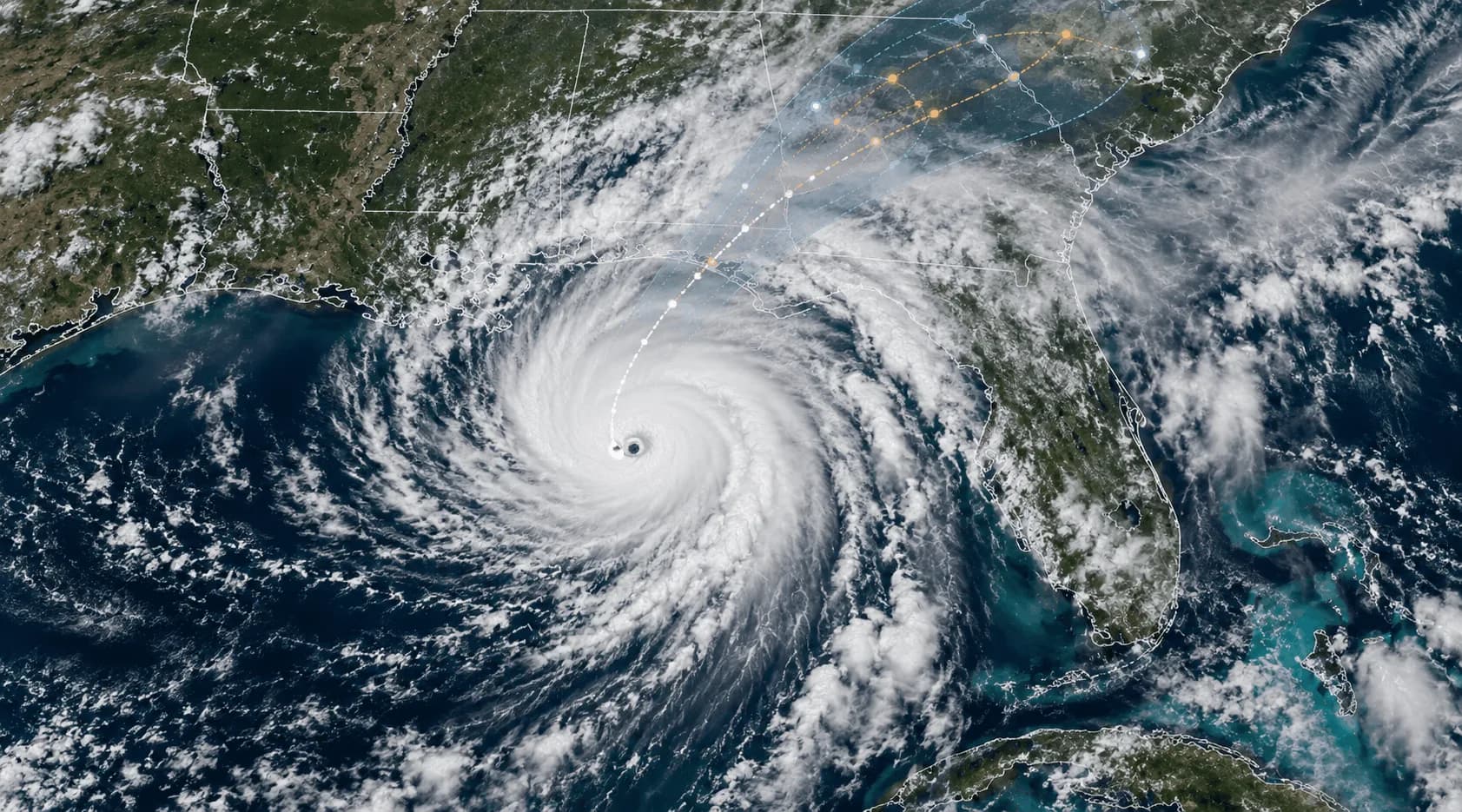
When Hurricane Isaias approached the Gulf Coast in early October, meteorologists faced an important forecasting disagreement.
Several established computer models predicted the storm would move farther west, toward southeastern Louisiana and Mississippi.
Google DeepMind's artificial intelligence model pointed in a different direction: the western Florida Panhandle.
When Isaias made landfall near Destin, Florida, on October 9, the AI model's track prediction proved remarkably accurate.
The storm arrived as a Category 2 hurricane, with sustained winds of approximately 105 mph at landfall.
The event provided an important real-world demonstration of how artificial intelligence is changing hurricane forecasting.
According to meteorologists, Google DeepMind's model has quickly become one of the most effective systems for predicting hurricane paths.
The significance extends beyond technology. More accurate forecasts can give families, emergency responders, and businesses additional time to prepare before dangerous weather arrives.
How AI Is Changing the Science of Weather Forecasting
Traditional hurricane forecasting relies on complex mathematical equations describing atmospheric physics.
Meteorologists collect information from satellites, aircraft, ocean measurements, and weather stations.
These systems measure temperature, humidity, atmospheric pressure, wind speed, and other conditions.
Supercomputers then process that information to calculate how a storm might develop and where it could travel.
Artificial intelligence approaches the problem differently.
Google DeepMind's model analyzes enormous collections of historical weather observations and past storms to identify patterns associated with atmospheric changes.
Using neural networks, it learns relationships between weather conditions and subsequent storm behavior.
Instead of relying primarily on equations describing atmospheric physics, the model uses patterns learned from historical data to generate predictions.
This allows AI systems to produce forecasts rapidly and explore multiple possible storm scenarios.
Google's WeatherNext research has demonstrated how machine learning can improve predictions involving cyclone tracks, intensity, and wind structure.
Hurricane Isaias Put the Technology to the Test
The October storm presented a particularly revealing experiment.
Traditional models initially favored a western trajectory, placing Louisiana and Mississippi closer to the projected landfall area.
Google DeepMind consistently favored a more eastern path toward Florida.
As the hurricane approached the Gulf Coast, the National Hurricane Center increasingly incorporated the AI guidance into its official forecast.
The decision proved important.
Isaias ultimately struck near Destin, validating the eastern track favored by Google DeepMind.
Meteorologist Michael Lowry, a hurricane specialist who has advised FEMA and the National Hurricane Center, described Google's model as exceptionally strong.
He explained that its performance over recent hurricane seasons has established it as one of the most capable forecasting systems available.
This is particularly impressive because traditional forecasting models have benefited from decades of development.
AI systems are advancing much faster, with researchers able to update and improve models over weeks or months rather than waiting for annual development cycles.
Better Predictions Could Save Lives
For people living along the Gulf Coast and Atlantic shoreline, the practical value of improved forecasting is enormous.
Hurricane preparation involves decisions that cannot always be made at the last minute.
Families may need to evacuate, secure their homes, protect important documents, arrange transportation, or obtain medications.
Emergency managers must determine where to position rescue teams, supplies, medical personnel, and evacuation resources.
Businesses need time to protect equipment, inventory, and employees.
Even a few additional hours of reliable warning can influence those decisions.
Google DeepMind has also published research indicating that its WeatherNext technology can provide tropical cyclone forecasts with substantial improvements in accuracy.
Its August 2026 research, published in Nature, reported that the system could provide up to an additional day of warning for certain cyclone developments.
That additional time could become especially valuable for communities vulnerable to rapidly developing storms.
Why Meteorologists Still Matter
Despite the impressive results, artificial intelligence is not replacing human forecasters.
The National Hurricane Center combines information from multiple systems, including traditional physics-based models and AI predictions.
Its director, Michael Brennan, explained that different storms present different forecasting challenges.
That is why meteorologists use a blended approach rather than depending on a single computer model.
Isaias demonstrated this distinction.
Google DeepMind performed exceptionally well at predicting the storm's track, but the National Hurricane Center's combined forecast performed better at predicting its intensity.
In other words, knowing where a hurricane will travel and knowing how powerful it will become are two different scientific challenges.
Meteorologists must also interpret changing forecasts and communicate what those predictions mean for actual communities.
An AI model might generate several possible storm paths, but people still need clear guidance about evacuation decisions, expected rainfall, flooding, and dangerous winds.
Human expertise remains essential to translating complex predictions into information families can act upon.
The Next Breakthrough Is Predicting More Than a Storm's Path
Google DeepMind's work represents part of a much larger transformation in scientific computing.
Artificial intelligence is increasingly being used to analyze complicated systems that previously required enormous computing resources and specialized expertise.
Weather forecasting is particularly promising because scientists have accumulated decades of satellite observations, atmospheric measurements, and historical storm data.
Researchers can use that information to train systems capable of identifying patterns that might otherwise be difficult to detect.
The technology could eventually improve predictions involving rapid intensification, rainfall distribution, dangerous wind patterns, and other storm-related hazards.
Better forecasting could also benefit agriculture, aviation, shipping, energy companies, insurance providers, and emergency management organizations.
For businesses, more reliable weather information can help reduce operational disruptions and protect valuable equipment.
For families, it can mean better preparation and fewer surprises when severe weather approaches.
A New Era of Weather Intelligence
Hurricane Isaias demonstrated that artificial intelligence is no longer simply an experimental addition to meteorology.
It is becoming an important tool used by professional forecasters to make decisions affecting millions of people.
Google DeepMind's performance showed how historical data and advanced computing can challenge forecasting methods developed over decades.
The next stage will involve improving the models, understanding their limitations, and integrating their predictions with traditional scientific expertise.
America has an opportunity to apply its strengths in artificial intelligence, satellite technology, computing, and scientific research to one of the most important public-safety challenges facing coastal communities.
The future of hurricane forecasting will not depend on artificial intelligence replacing meteorologists. It will depend on combining human expertise with increasingly powerful technology to see dangerous storms earlier, understand them better, and give American families more time to protect what matters most.