
 3 min read
 5
 Linkedin
 Threads
 Facebook
 X
Every generation produces politicians. Only occasionally does history produce a statesman whose experience, responsibilities, and personal story converge at precisely the right moment.
Marco Rubio may be approaching such a moment.
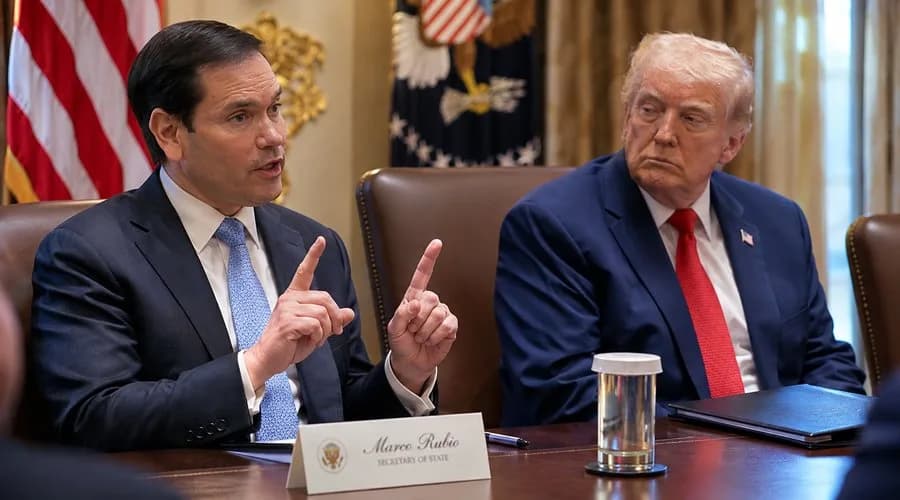
In September 2026, President Donald Trump formalized Rubio's appointment as national security adviser, making permanent a responsibility he had carried since May 2025.
Rubio now holds two of the most influential positions in American foreign policy: secretary of state and national security adviser.
Only one other American has simultaneously occupied both offices: Henry Kissinger.
We are watching a rare chapter of American history unfold in real time.
From Henry Kissinger to Marco Rubio
Henry Kissinger, born in Germany in 1923, fled Nazi persecution with his family and eventually became one of the most influential diplomatic figures of the twentieth century.
As national security adviser and secretary of state, Kissinger helped shape America's opening to China, pursued negotiations with the Soviet Union, and influenced diplomacy during the Cold War.
His legacy remains controversial, particularly regarding American actions in Cambodia and Latin America. But his influence on American foreign policy is undeniable.
Kissinger died in 2023 at the age of 100.
Now another son of an immigrant family occupies those same two offices.
Marco Rubio's story is different, but the historical symbolism is extraordinary.
Rubio was born in Miami to Cuban immigrants. His parents worked ordinary jobs, and his family experienced firsthand the political consequences of communism in Cuba.
He became a Florida legislator, speaker of the Florida House, United States senator, and eventually America's chief diplomat.
Kissinger arrived in America seeking refuge from European tyranny. Rubio inherited the memory of a family seeking freedom from Cuban communism.
Both stories remind us that America's influence has often been strengthened by people who understand what freedom means because their families knew what it meant to lose it.
The Man Trump Trusts With Difficult Conversations
Foreign policy is not a televised debate.
It requires navigating competing national interests, hostile governments, military risks, economic consequences, and negotiations in which a poorly chosen sentence can have international repercussions.
Rubio's years in the Senate gave him experience with intelligence, foreign affairs, sanctions, and national security.
His current responsibilities have placed him closer to the machinery of presidential decision-making.
President Trump has publicly praised Rubio's ability to solve problems.
That trust matters.
A secretary of state represents American diplomacy abroad. A national security adviser helps coordinate the information and recommendations reaching the president.
Holding both offices creates an unusual concentration of responsibility.
It also creates an unusually demanding test of judgment.
The question is not simply whether Rubio can speak persuasively. It is whether he can translate presidential objectives into coherent national strategy.
That is the difference between a skilled politician and a consequential statesman.
A Rare 99–0 Vote: When America Came Before Party
On January 20, 2025, Marco Rubio was confirmed as the 72nd United States secretary of state by an extraordinary 99–0 vote in the U.S. Senate. Not a single senator voted against his confirmation. In a political era defined by division, Republicans and Democrats came together to recognize his qualifications for one of the nation's most consequential offices. These were senators who had disagreed with Rubio on policy, challenged his positions, and stood on opposite sides of political battles. Yet when the moment arrived to entrust him with representing the United States before the world, they voted unanimously. That moment deserves a place in American political history—not merely as a testament to Rubio's experience and the confidence his colleagues placed in him, but as a reminder of what the Senate can be at its finest: an institution where disagreement does not have to become hostility, where political opponents can recognize one another's qualifications, and where service to the country we dearly love can rise above partisan differences. It was a remarkable display of institutional respect, and a moment of unity that Americans deserve to witness more often.
His Faith Revealed Another Dimension
At Charlie Kirk's memorial in September 2025, Rubio delivered a speech that moved beyond conventional political remarks.
He spoke about the meaning of Christian faith, the resurrection of Jesus Christ, and the promise of eternal life.
Rubio described God taking human form and entering human history.
For Christians, this reflects the doctrine of the Incarnation: Jesus Christ is fully divine and fully human.
Rubio is Catholic, and Catholic teaching affirms the Trinity—one God in three distinct persons: Father, Son, and Holy Spirit.
His memorial remarks should not be interpreted as a rejection of that doctrine.
What made the speech notable was its directness.
Before a national audience, one of America's most senior officials spoke openly about Christian hope without reducing it to a political slogan.
He also emphasized the importance of discussing differences peacefully and respectfully.
For a country increasingly exhausted by political hostility, that combination of conviction and restraint deserves attention.
Joseph, Moses, and the Responsibility of Leadership
History sometimes becomes easier to understand through biblical parallels.
Consider Joseph.
Born among the Hebrews, Joseph eventually rose to extraordinary authority in Egypt. His wisdom allowed him to interpret Pharaoh's dreams and prepare the nation for famine.
Joseph did not abandon his origins when he entered the highest levels of Egyptian government.
He used his position to serve the country entrusted to him while preserving his connection to his people.
Moses offers a different parallel.
Raised within Egyptian royalty, Moses understood the language and institutions of Egypt while remaining connected to the Hebrew people.
These are spiritual and literary comparisons, not claims that Rubio possesses a biblical calling.
But they illuminate an important quality of leadership: the ability to understand more than one world without losing one's identity.
Rubio is thoroughly American. He is also the son of Cuban immigrants and speaks fluent Spanish.
He understands the political language of Washington and the historical experiences of families shaped by Latin America's struggles over freedom and authoritarianism.
His heritage does not divide his American identity. It helps explain it.
The Presidential Question
Looking toward 2028, Rubio possesses a résumé that deserves serious consideration.
Few potential candidates can claim experience as a state legislative leader, United States senator, secretary of state, and national security adviser.
On the Democratic side, California Governor Gavin Newsom brings substantial executive experience and national visibility.
Other Democrats, including Alexandria Ocasio-Cortez and former Vice President Kamala Harris, represent different political backgrounds and constituencies.
Their qualifications cannot be reduced to a simple ranking.
Rubio's distinction lies in the breadth of his legislative and foreign-policy experience.
Yet presidential readiness requires more than an impressive résumé.
It requires demonstrated executive judgment, domestic economic leadership, the ability to build public trust, and a convincing vision for the country's future.
Rubio's performance in his current offices will be central to any serious evaluation.
The Question Democrats and Republicans Both Face
The Democratic Party contains competing ideological traditions, from centrism and liberalism to democratic socialism and progressive activism.
Those differences create genuine disagreements about the direction of the country.
Republicans face their own challenge: deciding how to translate the political coalition built around Donald Trump into a durable governing philosophy.
Rubio represents an interesting possibility within that discussion.
His family's history gives him a personal connection to the consequences of communist authoritarianism.
His career demonstrates fluency in American constitutional politics.
His diplomatic responsibilities require him to engage with foreign governments whose interests may sharply conflict with America's.
And his bilingual background enables him to communicate across cultural and linguistic boundaries without treating American identity as something that must be diluted.
That combination deserves serious attention.
The American Dream Is Not an Ethnicity
Perhaps the most important part of Rubio's story is not his ancestry or his official titles.
It is the journey.
The son of immigrants became a United States senator.
The senator became secretary of state.
The secretary of state became one of the president's principal national security advisers.
That is an extraordinary American story.
The American Dream is not the promise that every immigrant's child will become powerful.
It is the promise that a person's origins do not have to determine the limits of their future.
Rubio's rise illustrates that principle.
The Lesson of Kissinger—and the Test Ahead
Kissinger's extraordinary influence did not make him infallible.
His career demonstrates that concentrating diplomatic authority in one person can produce consequential achievements while also creating serious risks.
Rubio should be evaluated with that lesson in mind.
His dual appointment is historically remarkable, but history will ultimately judge the decisions he makes, the crises he helps resolve, and the interests he protects.
There is a difference between occupying the offices Kissinger once held and achieving a comparable diplomatic legacy.
Rubio has reached the first milestone.
The second remains unwritten.
Perhaps that is what makes this moment so compelling: America is watching a former senator, the son of Cuban immigrants, carry responsibilities once entrusted to one of the twentieth century's most powerful diplomats.
His story has already become part of American history.
What he accomplishes next will determine its significance.