3 min read
 102

 Linkedin
 Threads
 Facebook
 X

Texas has experienced one of the most dramatic political reversals in its modern history. Republican Governor Greg Abbott lost to Democrat Gina Hinojosa, ending more than three decades of Republican control of the governor's office.
But behind the headlines lies a numerical question that deserves examination.
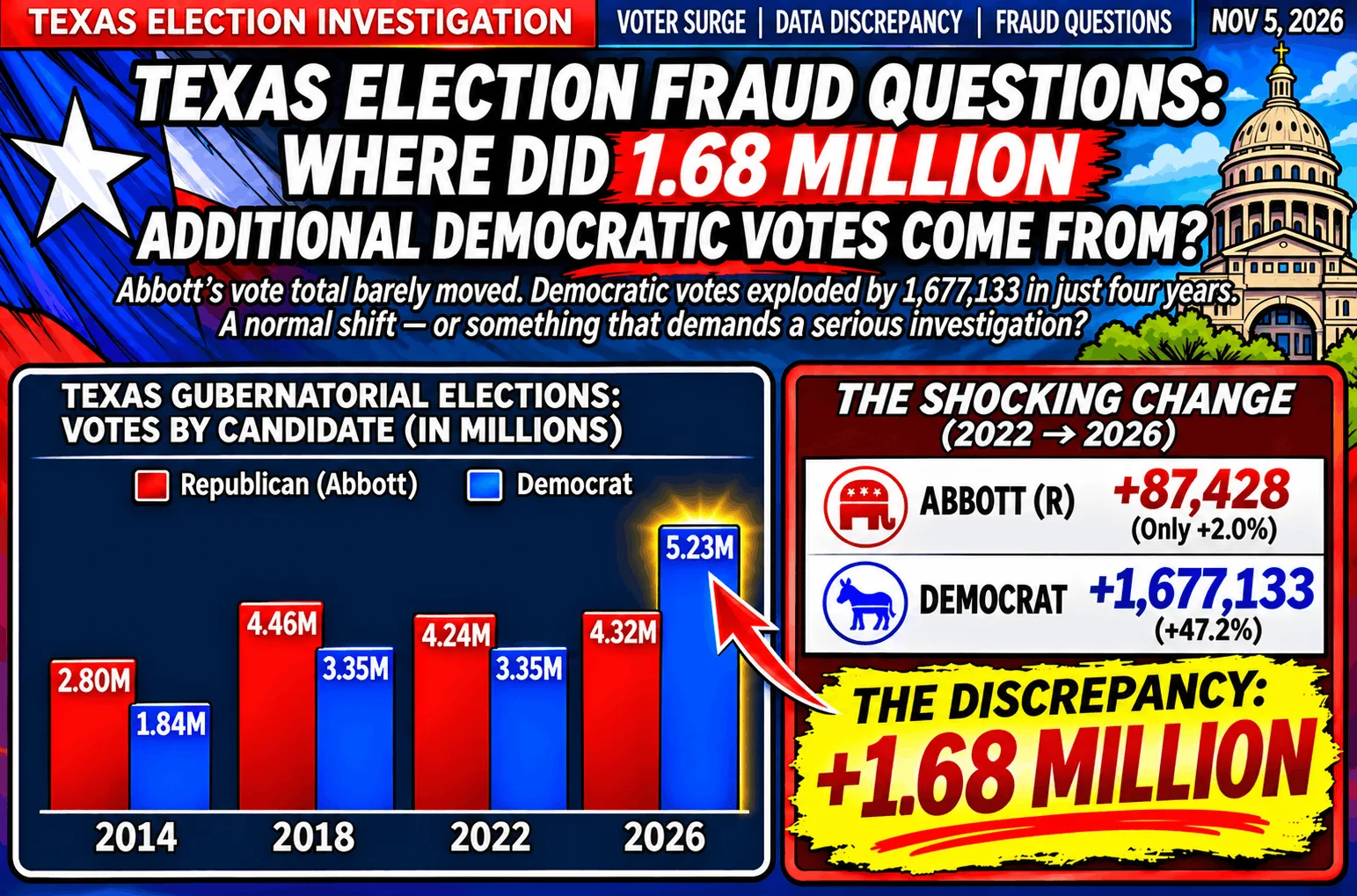
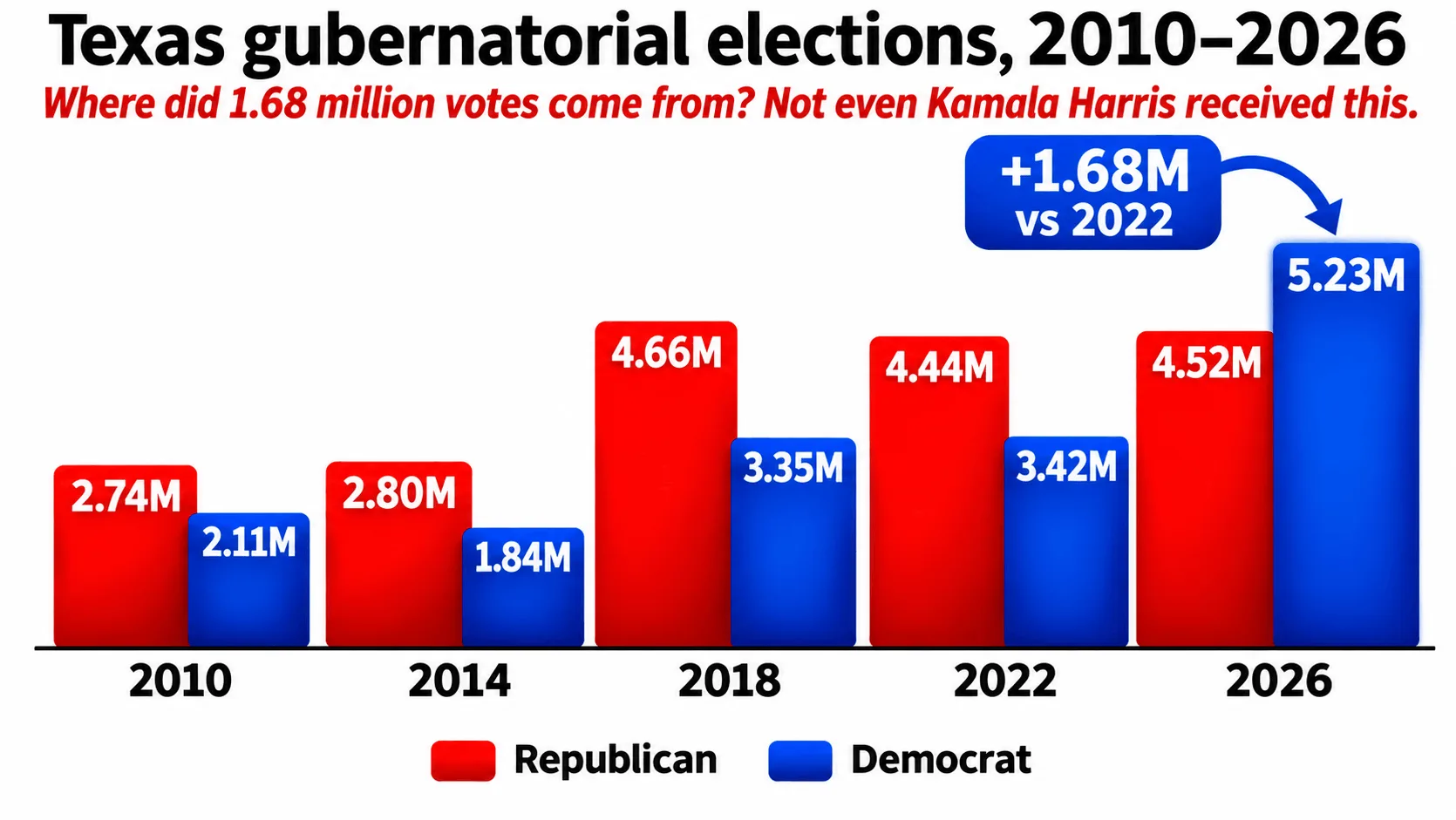
How did Democratic gubernatorial candidates receive approximately 3.55 million votes in both 2018 and 2022, only for that total to jump to 5.23 million in 2026?
The unofficial 2026 results published by the Texas Secretary of State confirm Hinojosa received 5,230,789 votes against Abbott's 4,524,527.
The numbers that started the controversy
Texas gubernatorial elections, 2014–2026
Millions of votes by major-party candidate. 2026 results are unofficial.
In the 2024 presidential election, Donald Trump received 6,393,597 Texas votes, compared with Harris's 4,835,250.
Hinojosa's 2026 total exceeded Harris's by approximately 396,000 votes.
How is that possible?
That deserves analysis, particularly because gubernatorial elections have historically attracted fewer voters than presidential contests.
What about voter-registration allegations?
Reports of increased voter-registration anomaly activity, including drives organized by Muslim community organizations, have raised additional questions.
Furthermore, registration does not equal voting, and participation by Muslim Americans is not evidence of wrongdoing.
Texas also has voter-identification requirements, including legally authorized alternatives for qualifying voters.
The relevant investigation must establish whether registrations were lawful, whether voters were eligible citizens, and whether ballots were properly counted.
The Narrative That Republicans Abandoned Abbott Doesn't Match the Vote Totals
One explanation circulating after the election is that Republican voters failed to show up for Governor Greg Abbott.
But the actual vote totals challenge that narrative.
In 2022, Abbott received 4,437,099 votes. In 2026, he received 4,524,527.
Abbott gained 87,428 votes. He did not experience a decline in his total support compared with the previous election.
Now Examine the Other Side
In 2018, Democratic candidate Lupe Valdez received approximately 3.55 million votes. In 2022, Beto O'Rourke received approximately 3.55 million votes.
For two consecutive gubernatorial elections, the Democratic vote remained remarkably consistent.
Meanwhile, Republican gubernatorial candidates received between 4.44 million and 4.66 million votes in 2018, 2022, and 2026.
For three consecutive gubernatorial elections, Republican vote totals also remained remarkably consistent.
BUT WHAT HAPPENED IN 2026? SERIOUSLY!
Democratic candidates in the previous two Texas gubernatorial elections attracted an average of approximately 3.5 million votes.
Now consider the 2024 presidential election.
Kamala Harris ran an emotionally charged, nationally televised campaign against Donald Trump. Democrats portrayed the election as an existential battle for American democracy, with some comparing Trump to Hitler. Millions of dollars were spent, celebrities mobilized, and voters were repeatedly told that the future of the country depended on their participation.
Yet Harris received approximately 4.84 million votes in Texas.
Now, are we seriously expected to believe that Gina Hinojosa, a relatively unknown candidate across Texas, with virtually no visible street advertising or billboards, minimal local media coverage, limited social media exposure, and campaign rallies that attracted nowhere near the attention of a presidential campaign, somehow managed to outperform the Democratic presidential nominee?
Gina Hinojosa received 5,230,789 votes—395,539 more than Kamala Harris in 2024 and an extraordinary 1,677,133 more than Beto O'Rourke in 2022, despite O'Rourke having enjoyed extensive media attention, statewide recognition, and a highly visible campaign.
Let's be absolutely clear.
Hinojosa did not have the national profile, celebrity endorsements, nonstop television coverage, or presidential-level campaign machinery that Harris enjoyed. Her campaign was far less visible to the average Texas voter.
Yet she reportedly attracted more votes than Harris did in Texas during one of the most emotionally charged presidential elections in modern American history. This needs a serious investigation.
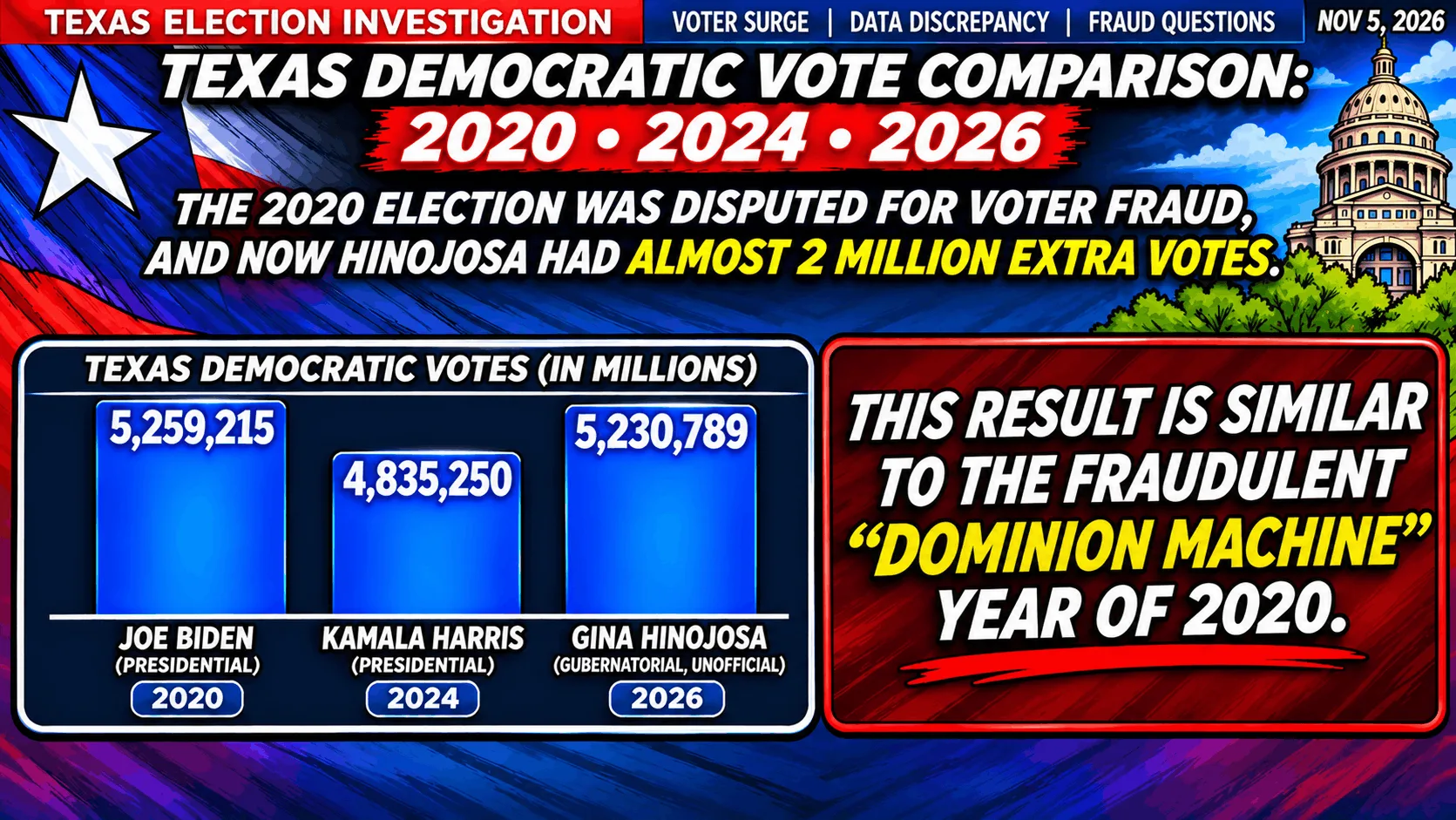
How did a comparatively low-profile gubernatorial candidate accomplish what a nationally recognized Democratic presidential nominee could not?
The combined Republican and Democratic vote in each of the 2018 and 2022 gubernatorial elections was approximately 8 million. In 2026, the governor's race approached 9.91 million votes across all candidates.
That represents approximately 1.8 million additional votes compared with 2022.
And here is the detail that challenges the prevailing explanation:
Abbott actually gained 87,428 votes compared with 2022. His statewide vote total did not collapse. The Democratic candidate gained nearly 1.7 million votes, while overall participation expanded dramatically.
This does not support the simplistic narrative that Abbott lost because Republicans simply failed to show up. Nor does it establish that Republican voters switched parties in sufficient numbers to explain the outcome.
The real story is the extraordinary expansion of the Democratic vote.
And that changes the question entirely.
Instead of blaming Republican voters for staying home, we should be asking why gubernatorial turnout increased so sharply, which counties produced the additional votes, how many participants were first-time or returning voters, and whether voter registration records, ballot counts, and reported results reconcile.
A dramatic increase in turnout is not, by itself, evidence of fraud. But an increase of this magnitude deserves a detailed, transparent, county-by-county examination.
Nearly 1.8 million additional votes in a single gubernatorial election. Where did they come from, and what explains the extraordinary change?
Higher turnout can result from legitimate mobilization, demographic changes, or voters returning after skipping previous elections. The increase alone does not prove fraud. But it does provide a concrete set of numbers for election officials and independent investigators to examine.
The question isn't just why Abbott lost. It's how Texas went from roughly 8 million votes in consecutive gubernatorial elections to nearly 10 million in 2026—and what the voter records reveal about that increase.