5 min read
 35
 Linkedin
 Threads
 Facebook
 X

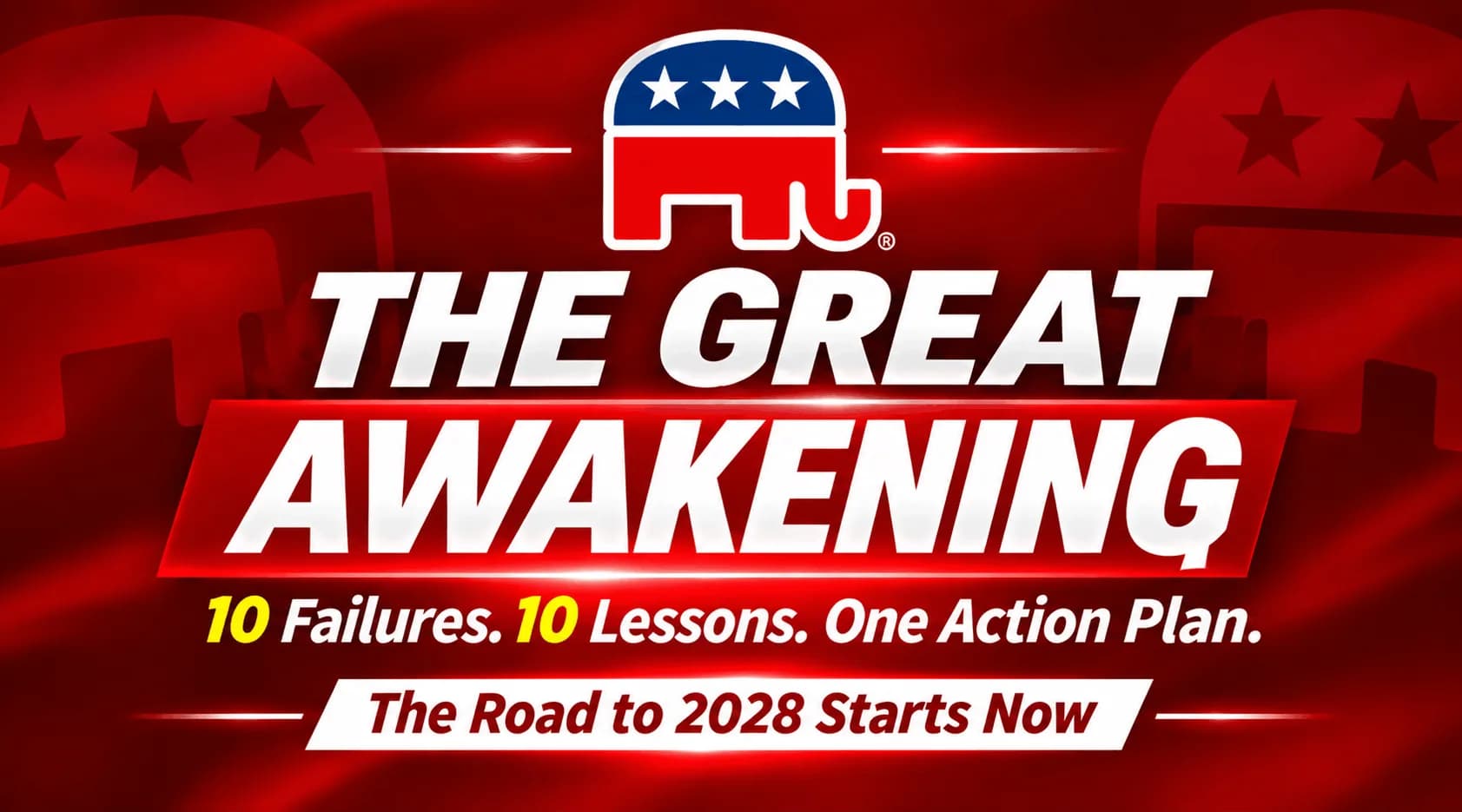
THE GREAT AWAKENING
10 Failures. 10 Lessons. One Action Plan.
The Road to 2028 Starts Now
Republicans, we need to have a serious conversation. Not tomorrow. Today.
On November 3, we lost more than an election. We lost the governorship of Texas after three decades of Republican leadership. We lost a U.S. Senate seat in a state many of us believed was safely Republican. And nationally, Democrats captured both chambers of Congress.
Let that sink in.
Ken Paxton lost to James Talarico. Greg Abbott lost to Gina Hinojosa. Across America, Republican candidates suffered defeats that should force us to question not our conservative principles, but the decisions, strategies, and political culture surrounding them.
I support President Donald Trump. I believe in the conservative movement. And precisely because I believe in it, I refuse to pretend that everything was done correctly.
Loyalty should never require silence.
This is not about pointing fingers or finding someone to humiliate. It is about understanding what happened, what could have been avoided, and what must change before 2028.
The results are now in front of us.
1. We Became Complacent. We Confused Presidential Loyalty With Candidate Quality.
This is where our examination must begin.
We became too comfortable. Too confident. Too willing to assume that President Trump's endorsement could carry a candidate across the finish line.
In Texas, Ken Paxton was the Republican nominee. But was he the strongest candidate we could have presented to the people of Texas?
I don't believe he was.
And the results demand that we ask why.
Where was the powerful statewide communication campaign? Why didn't voters see a more visible advertising presence? Where were the billboards, the persuasive direct-mail campaigns, and the aggressive outreach to undecided voters?
I live in Houston, and I personally did not see the billboard presence I would have expected from a serious statewide campaign.
Why wasn't there a direct debate between Paxton and Talarico that would allow voters to compare their positions face-to-face?
These are basic campaign questions. We are not discussing advanced political science.
We are discussing the fundamentals of winning an election.
We cannot blame voters when our own candidates fail to communicate effectively.
And we cannot continue treating presidential loyalty as the highest qualification for public office.
Our constitutional government is built on independent institutions and divided powers. The Republican Party should demonstrate a similar commitment to independent judgment in selecting candidates.
In many political organizations around the world, a defeat of this magnitude would trigger serious leadership reviews. Why should we be different?
What could have been avoided: Entering a critical election without demanding clear evidence that our nominee, campaign organization, and communication strategy were capable of winning.
Action Plan: Establish independent candidate evaluations, competitive primaries, measurable campaign benchmarks, transparent spending reviews, and mandatory post-election assessments. Presidential endorsements should matter, but they should never replace political judgment.
2. We Failed to Renew Our Leadership. Even Great Leaders Must Prepare Successors.
I admire Greg Abbott.
I believe he has done extraordinary work for Texas in economic development, infrastructure, business investment, and attracting companies and jobs.
But admiration does not eliminate political reality.
Twelve years in office, followed by a campaign for a fourth term, was a difficult proposition to explain to voters who wanted something new.
There is nothing wrong with experience. There is something wrong with failing to prepare the next generation.
Four years ago, Abbott should have been mentoring potential successors. He should have been developing new Republican leaders capable of continuing his achievements while bringing fresh energy to the office.
Instead, we asked voters to extend the same leadership yet again.
And voters rejected that proposition.
The Republican Party cannot become a party with an expiration date.
We cannot complain about aging leadership among Democrats while failing to renew our own.
Where are the young conservatives? Where are the emerging Hispanic leaders? Where are the entrepreneurs, educators, veterans, and community organizers who could become the next generation of Republican leadership?
Why are so many talented people watching politics from the sidelines instead of being developed for public service?
What could have been avoided: Making the future of an entire political movement depend on the continued popularity of a handful of familiar leaders.
Action Plan: Create leadership-development programs, recruit qualified candidates early, establish mentorship networks, and begin succession planning years before major elections. No elected official should leave the party without a credible generation ready to follow.
3. We Neglected the Cost of Living. Voters Were Telling Us, and We Weren't Listening.
This failure was devastating because it touched nearly every household.
Americans were talking about groceries, rent, insurance, gasoline, and the cost of raising children.
And what were we talking about?
Faith. Transgender. Islamization. The fall of the Republic.
A single mother doesn't calculate macroeconomic indicators before going to vote.
A father filling his vehicle with expensive gasoline doesn't stop to analyze international energy markets.
He knows what he paid yesterday. He knows what he is paying today. And he knows how much money is left for his family.
That is political reality for the regular citizen.
When gasoline approaches or exceeds four dollars in a community, the frustration is immediate. Even where prices are lower, families still feel the cumulative effects of rising costs.
Tariffs may have strategic purposes, but they can also raise costs for American businesses and consumers. Those consequences require explanation, mitigation, and accountability.
We allowed Democrats to make affordability their argument while too many Republican communicators remained focused on defending the administration instead of explaining how families would experience relief.
You cannot win an economic argument by telling struggling families that the economy is wonderful.
You must demonstrate why tomorrow will be better than today.
What could have been avoided: Allowing household frustration to grow without a visible, coordinated response from Republican leadership.
Action Plan: Make affordability a central priority. Explain policies through household budgets, publish measurable progress, confront the consumer effects of tariffs, and require economic advisers to communicate directly with families rather than only with financial audiences.
4. The War With Iran: A Foreign-Policy Decision With Domestic Consequences.
I believe the war with Iran was an unnecessary political and economic burden at a particularly damaging moment.
I understand the security concerns surrounding Iran. I understand that presidents must sometimes make difficult military decisions.
But that does not mean every confrontation must become a war, or that timing and consequences should escape scrutiny.
War affects energy markets. It affects investor confidence. It creates uncertainty. And when families are already worried about prices, that uncertainty becomes politically dangerous.
Republicans needed to explain the objectives, costs, and anticipated outcomes of the conflict far more convincingly.
Was there a realistic alternative? Was the timing necessary? Were the economic consequences fully considered?
Those are not anti-American questions.
They are questions responsible citizens should ask.
The president has a responsibility to protect national security. Congress has a responsibility to exercise oversight.
And political leaders have a responsibility to understand that decisions made overseas can shape elections at home.
What could have been avoided: Allowing a major military conflict to proceed without sufficiently preparing the public for its economic and political consequences, or push that military operation after the midterms.
Action Plan: Demand clear objectives, congressional oversight, transparent cost assessments, an energy-market contingency strategy, and an understandable explanation of how military decisions serve American interests.
5. The Church Must Rise: Biblical Citizenship, Christian Schools, and the Next Generation
The Church cannot remain a spectator while the future of our children and our nation is being decided.
Every church participating in FlashPoint Army Chapters should begin offering monthly Biblical Citizenship classes, in person and online. The lessons are already available inside our FlashPoint Chapters Command Center. We have the resources. Now we must mobilize!
But education alone is not enough.
Just as Muslim communities have established schools to preserve their religious traditions, Christian churches must expand Christian education and church-based daycare programs. Imagine the transformation: affordable childcare for working families, schools that reflect Christian values, and a new generation raised knowing Jesus Christ, understanding the Constitution, and loving their country.
This is not about the next election. This is about the next generation!
And we must take this mission to Washington. Not simply to take pictures, have tea, or pray inside the White House, but to meet with senators and representatives and demand serious bipartisan discussions about parental choice, childcare funding, and lawful opportunities for Christian educational institutions.
We should organize hundreds of thousands of citizens across states to advocate for legislation that expands educational opportunities while respecting constitutional protections and equal access.
What could have been avoided: Leaving churches disconnected from a national effort to strengthen Christian education, civic responsibility, and family support.
Action Plan: Launch monthly Biblical Citizenship classes through FlashPoint Chapters, expand online participation, begin establishing church-based daycares and Christian schools, and organize meetings with elected officials to advance bipartisan educational and childcare initiatives.
We have the churches. We have the people. We have the resources. Now we must act—before another generation passes us by. Let's lobby for the Lord.
We must also establish Federally Qualified Health Centers (FQHCs)—community medical centers that provide primary care, preventive services, and affordable healthcare to underserved families.
Imagine churches becoming centers of faith, education, childcare, and healthcare, creating jobs, generating sustainable operating revenue, and serving entire communities.
These centers can qualify for federal funding and reimbursement, but they require independent governance, clinical oversight, and compliance with federal healthcare regulations. Funding is not automatically available to churches.
Action Plan: Organize a nationwide initiative to explore Christian schools, church-based daycares, and federally supported community health centers. Immediately begin contacting all 100 U.S. senators and 435 House representatives to request bipartisan meetings, identify available funding programs, and develop legislation that expands access to education, childcare, and healthcare.
We cannot wait for Washington to come to our churches. We must bring practical proposals to Washington.
6. Our Communication Has Been Terrible. And It Is a Leadership Problem.
This may be one of the most avoidable failures of all.
The Republican Party has policies, accomplishments, experienced leaders, and access to modern communication technology.
So why do we so often struggle to communicate effectively?
Why are we allowing political opponents to define our policies before we explain them ourselves?
Why does a controversial statement sometimes dominate the news for days while a substantive achievement receives little attention?
The White House communications operation deserves a serious review.
I have been disappointed with the quality and effectiveness of its public messaging. And this cannot be reduced to whether one press secretary performs well or poorly.
The problem is larger.
Who is recruiting the best communication professionals?
Where is the coordinated team of experienced writers, researchers, digital producers, policy explainers, and media strategists?
Where is the disciplined operation capable of communicating important information every day?
Elon Musk understood the commercial value of experienced advertising leadership when he recruited former NBCUniversal executive Linda Yaccarino to lead Twitter, later renamed X.
The principle is straightforward: communication requires professional talent.
A political movement should not confuse media attention with persuasive communication.
Being loud is not the same as being effective.
Democrats have demonstrated that repeated, coordinated messages can influence public debate.
Republicans must learn to explain their policies with the same consistency, without sacrificing accuracy.
And President Trump should recognize that some statements create controversies that distract from the very accomplishments he wants Americans to recognize.
What could have been avoided: Losing control of our own message through poor coordination, reactive communication, and unnecessary controversies.
Action Plan: Commission an independent communications audit, recruit proven professionals, establish clear standards for factual messaging, publish regular explanations of policy outcomes, and evaluate communications performance using measurable public understanding—not merely impressions or social-media engagement.
7. Immigration Enforcement: We Defended the Border but Failed to Defend Our Humanity.
This is difficult to write, but it must be said.
I support secure borders.
I believe the United States has the right and responsibility to enforce immigration law.
And many Hispanic Americans agree.
But supporting the law does not require applauding every enforcement tactic.
We allowed scenes of aggressive arrests, distressed families, and children witnessing confrontations to become defining images of immigration enforcement.
Some Americans watched videos of people being forced to the ground, families separated, and confrontations that raised serious questions about proportionality and due process.
Whether every viral video was presented accurately must be examined case by case.
But the broader political damage was real.
The administration gave its opponents powerful images that could be used to portray Republicans as indifferent to human suffering.
Why?
Why did enforcement sometimes appear designed to intimidate rather than simply accomplish a lawful objective?
Why did political communication so often emphasize fear instead of explaining procedures, priorities, and safeguards?
I am not arguing against deportations.
I am arguing against unnecessarily humiliating people in the process.
Previous Democratic administrations also carried out large-scale immigration enforcement. Their records should be compared using consistent definitions rather than exaggerated numerical claims.
The lesson is not that enforcement should become invisible or escape scrutiny.
The lesson is that enforcement must be professional, accountable, and humane.
We cannot claim to defend families while appearing indifferent to the suffering of families.
That contradiction damaged our credibility.
What could have been avoided: Allowing avoidable confrontations, poor public explanations, and allegations of excessive force to undermine support for lawful border security.
Action Plan: Establish clearer enforcement priorities, strengthen de-escalation training, protect due process, independently investigate deaths and serious injuries, improve family-sensitive procedures, and communicate enforcement results without turning human suffering into political theater.
8. We Took Latino Voters for Granted. That Was a Historic Mistake.
Republicans should study the Latino vote with urgency.
In 2024, Donald Trump made substantial gains among Hispanic voters conquering an unprecedented 65%.
That was an extraordinary political opportunity.
But an opportunity is not a permanent entitlement.
In 2026, the electorate moved sharply in the opposite direction. In the Texas Senate race, approximately seven in ten Hispanic American voters supported Talarico, according to the AP Voter Poll.
That should alarm every Republican leader now.
Latino Americans are not a monolithic community. They come from different countries, generations, economic circumstances, and political traditions.
But their growing presence in the electorate is undeniable. They represent about 70 Million in the country and about 40 Million are verified voters. Come on!
And they deserve meaningful representation.
Look at our party leadership events, youth conventions, and political organizations.
Do they consistently reflect the diversity of the Americans we hope to represent?
Are talented Hispanic conservatives being invited into leadership, or merely appearing in photographs during election season?
Are we listening to their concerns about business ownership, education, faith, public safety, immigration, and opportunity?
Or are we assuming that support earned in one election will automatically continue into the next?
I believe Marco Rubio has the potential to be an important national leader. But no candidate should be selected simply because of ethnicity.
The Republican Party must offer leadership opportunities based on competence, ideas, and the ability to earn public trust.
What could have been avoided: Mistaking temporary electoral gains for a lasting relationship with a diverse and politically independent electorate.
Action Plan: Conduct serious voter research, expand leadership recruitment, include qualified Hispanic Americans in policy development, build lasting community relationships, and evaluate whether the party's priorities address the concerns voters actually express.
9. Democrats Won. Now Hold Them Accountable for Their Promises.
The election is over.
Democrats won the congressional majorities.
Now comes the difficult part: governing.
They campaigned on affordability, healthcare, housing, taxes, and changing the direction of the country.
Fine.
Let's examine their proposals.
How will they reduce the cost of living?
What legislation will they introduce to make housing more affordable?
How will they address healthcare expenses?
What will they do about immigration reform?
Republicans should not simply wait for Democrats to fail.
We should demand specific proposals, realistic budgets, legislative timelines, and measurable outcomes.
Immigration reform is one opportunity for substantive cooperation.
In 1986, President Ronald Reagan signed legislation that provided legalization to millions of qualifying undocumented immigrants.
That history deserves attention.
Today, Republican Representative María Elvira Salazar has supported the Dignity Act, a proposal intended to address long-term undocumented residents through a combination of legal-status provisions and enforcement measures.
Why not examine whether a workable bipartisan agreement is possible?
Why not address the circumstances of people who have lived in the United States for a decade or longer, while maintaining border security and lawful requirements?
A successful reform would need to address eligibility, criminal-history screening, taxes, employment, and legal status.
I believe Rubio could contribute meaningfully to that conversation.
But this cannot be treated as a transaction in which immigrant families are promised legal status in exchange for permanent party loyalty.
Citizens are free to support whichever party they believe best represents them.
The goal should be sound public policy, not political dependency.
What could have been avoided: Allowing Democrats to campaign on major promises without requiring detailed explanations of how those promises would become law.
Action Plan: Establish public accountability scorecards, track campaign commitments against introduced legislation, organize substantive policy hearings, publish independent cost estimates, and support workable bipartisan solutions when they benefit the country.
10. We Neglected School Boards. Local Government Is Where the Future Is Shaped.
Many Americans pay attention to presidential elections while knowing almost nothing about the people serving on their local school boards.
That is a mistake.
School boards oversee budgets, district policies, superintendent performance, and important educational decisions.
Their curriculum authority varies by state, but their influence on local education is substantial.
Yet how many parents know the names of their school-board representatives?
How many have attended a meeting?
How many have reviewed the district budget?
How many understand the procedures for raising concerns about educational materials or student safety?
Democracy does not operate only in Washington.
It operates in neighborhoods, school districts, city councils, and county governments.
We need citizens who understand these institutions and are prepared to participate.
That includes parents, educators, business owners, church members, and residents with different political views.
School boards should serve all children, not function as instruments of any political or religious organization.
What could have been avoided: Allowing local education decisions to be in charge of democrats allover the country, proceed with insufficient public awareness, oversight, and participation.
Action Plan: Encourage parents, church members and residents to attend school-board meetings, learn how district policies are established, review publicly available budgets, participate in elections, and consider serving on boards when qualified.
THE GREAT AWAKENING BEGINS WITH ACCOUNTABILITY
Let me be clear.
I am not abandoning President Trump or conservative principles.
And I am certainly not suggesting that Democrats have suddenly discovered every answer to America's problems.
But we lost.
We lost important races. We lost the ability to amplify our voice. We lost voters who previously supported us. We lost the opportunity to maintain control of Congress.
And some of those losses were avoidable.
We became complacent. We failed to renew leadership. We underestimated household economic pain. We communicated poorly. We mishandled the public perception of immigration enforcement. And we took important communities for granted.
The response cannot be another round of slogans.
It must be action.
The Immediate Action Plan
First 30 days: Demand independent campaign reviews, examine candidate-selection failures, evaluate communications operations, and begin public discussions about what went wrong and write solutions.
Next 90 days: Develop a measurable affordability agenda, identify emerging leaders, expand nonpartisan civic education, and begin structured discussions on immigration and educational reform.
Next 12 months: We need to know who is going to be the Presidential candidate ASAP. Build a stronger leadership pipeline, evaluate local civic participation, publish legislative accountability reports, and prepare a serious policy platform for the next national election.
Before 2028: Select candidates through credible competitive processes, establish effective campaign organizations, and present Americans with a practical vision supported by measurable commitments.
Citizens do not need permission from political leaders to begin participating.
Join FlashPoint Chapters and start Biblical Citizenship. https://app.fparmychapters.com/login
Do not wait for someone in Washington to decide that your community matters.
The Republican Party must also understand something fundamental:
A political movement cannot demand loyalty from voters while refusing accountability from its own leaders.
If we want Americans to trust us again, we must demonstrate that we have learned.
If we want to lead, we must listen.
And if we want to win in 2028, the work cannot begin in 2028.
November 3 was the defeat. November 4 must become the beginning of renewal.
THE GREAT AWAKENING STARTS NOW.