


 3 min read
 5
 Linkedin
 Threads
 Facebook
 X

Tomorrow is the day.
November 3, 2026.
For months, television networks, political analysts, campaign strategists, and polling organizations have been telling Texans how close this election has become.
Some surveys show James Talarico ahead. Others show Ken Paxton gaining ground. One of the latest surveys even places Paxton narrowly in front.
But there is one question that deserves considerably more attention:
Are the polls capturing the Texans who will actually decide this election?
Walk through conservative communities, talk to Republican voters, or observe the political conversations taking place across social media, and the confidence many express in a Republican victory can seem strikingly different from the national headlines.
That raises a legitimate question about turnout.
Who has already voted? Who is still planning to vote tomorrow? And are the surveys accurately estimating how many voters from each political coalition will participate?
Pollsters do not interview everyone, and social media is not a representative sample either.
The October 30 RealClearPolling average showed Talarico leading by approximately 1.8 points. But a Quantus Insights survey conducted October 26–28 placed Paxton ahead, 48.7% to 47.6%.
Both results illustrate a race within the range of ordinary polling uncertainty.
The University of Houston found particularly strong Republican support in rural Texas, where Paxton led Talarico 65% to 27%. Meanwhile, surveys showed Talarico performing better among independent, Latino, and younger voters.
The question is not whether polls are automatically fake. It is whether their assumptions about who will show up tomorrow match the electorate that actually arrives.
And Texas has a history of reminding national observers that a statewide election cannot be decided by political commentary alone.
Why Does Talarico Believe He Can Win Texas?
For a Democrat seeking statewide office in Texas, the historical challenge is enormous.
The state has not elected a Democrat to the U.S. Senate since Lloyd Bentsen in 1988.
Republicans have held every statewide elected office since the mid-1990s.
Donald Trump carried Texas by approximately 13.6 percentage points in 2024.
So why does James Talarico believe he can break that history?
The answer is MONEY.
An extraordinary amount of money.
Federal Election Commission records through October 14 show Talarico's campaign reporting approximately $146.3 million in total receipts, compared with approximately $22.3 million for Paxton's campaign.
Talarico has attracted donations from liberals and Democrats across the country, including substantial contributions originating outside Texas.
Democratic donors and political organizations see the race as an opportunity to capture the jewel in the crown—a Republican-held Senate seat—and potentially change the destiny of the state and transform it into California 2.0.
But the complete financial picture reveals an important contradiction.
While Talarico has dramatically outraised Paxton through their respective campaign committees, Republican-aligned outside groups have spent substantially more than Democratic-aligned groups on independent advertising and electioneering to defend Texas.
By October 29, reported general-election outside spending favored Paxton by roughly $314 million to $103 million. This is not Paxton winning. This is Texans positioning themselves to protect the state they love.
Both national political coalitions recognize that Texas is too consequential to ignore.
For Democrats, victory would represent a historic breakthrough and a potentially decisive seat in the battle for Senate control.
For Republicans, retaining the seat would preserve the origins of the Constitution, the defense of life, justice, and opportunity for all who believe in this nation. Protecting the seat represents preserving a political stronghold that has shaped national conservative politics for decades.
The money explains how seriously the candidates and their supporters take the contest.
It does not determine how Texans will vote.
If Texas Falls, What Happens to America?
For many conservative Texans, the possibility of losing a Senate seat carries a significance that goes far beyond Washington.
You need to understand the importance of Texas in the Union. Texas is not simply another state on an electoral map.
It has a distinct political history, a powerful culture of independence, a major military presence, an enormous energy industry, and a deeply rooted tradition of religious expression.
Its economic identity has long been associated with entrepreneurship, domestic energy production, ranching, manufacturing, and personal independence.
Its communities include generations of families who have served in the United States Armed Forces.
There is a particular kind of pride associated with the word Texas.
At military gatherings and among service members, the state's name can inspire a remarkable sense of identity and belonging.
Texas pride is not evidence that its soldiers outnumber those from every other state. It is something more personal: a powerful attachment to home, family, service, and country.
For many Christian Texans, that identity also includes church, faith in Jesus Christ, and the belief that families should have substantial authority over how children are raised.
Those convictions help explain why some voters regard this election as a cultural turning point.
But losing one Senate seat would not end the American republic, abolish Texas law, or erase its constitutional protections.
It would, however, represent a major political realignment and give a Democrat who wants to transition children a powerful voice in Washington on issues that divide the state's electorate.
That is a consequential possibility—and one that deserves a serious debate about policy rather than slogans.
The Real Duel Is Bigger Than Paxton and Talarico
Ken Paxton is not a politician without controversy.
He was impeached by the Texas House in 2023 and acquitted by the state Senate. A long-running securities-fraud case ended through a 2024 agreement involving restitution and other requirements, without a trial or conviction on those charges.
Those matters are part of his record.
James Talarico, meanwhile, is living off his mom's bank account. He called parents aggressive if they don't allow their children to be transsexual, called God nonbinary, and claimed there are six genders—all under the umbrella of being a faithful Christian.
The two candidates have controversies, but they represent sharply different positions on abortion, parental authority, immigration, religious expression, and the federal government's role in American life.
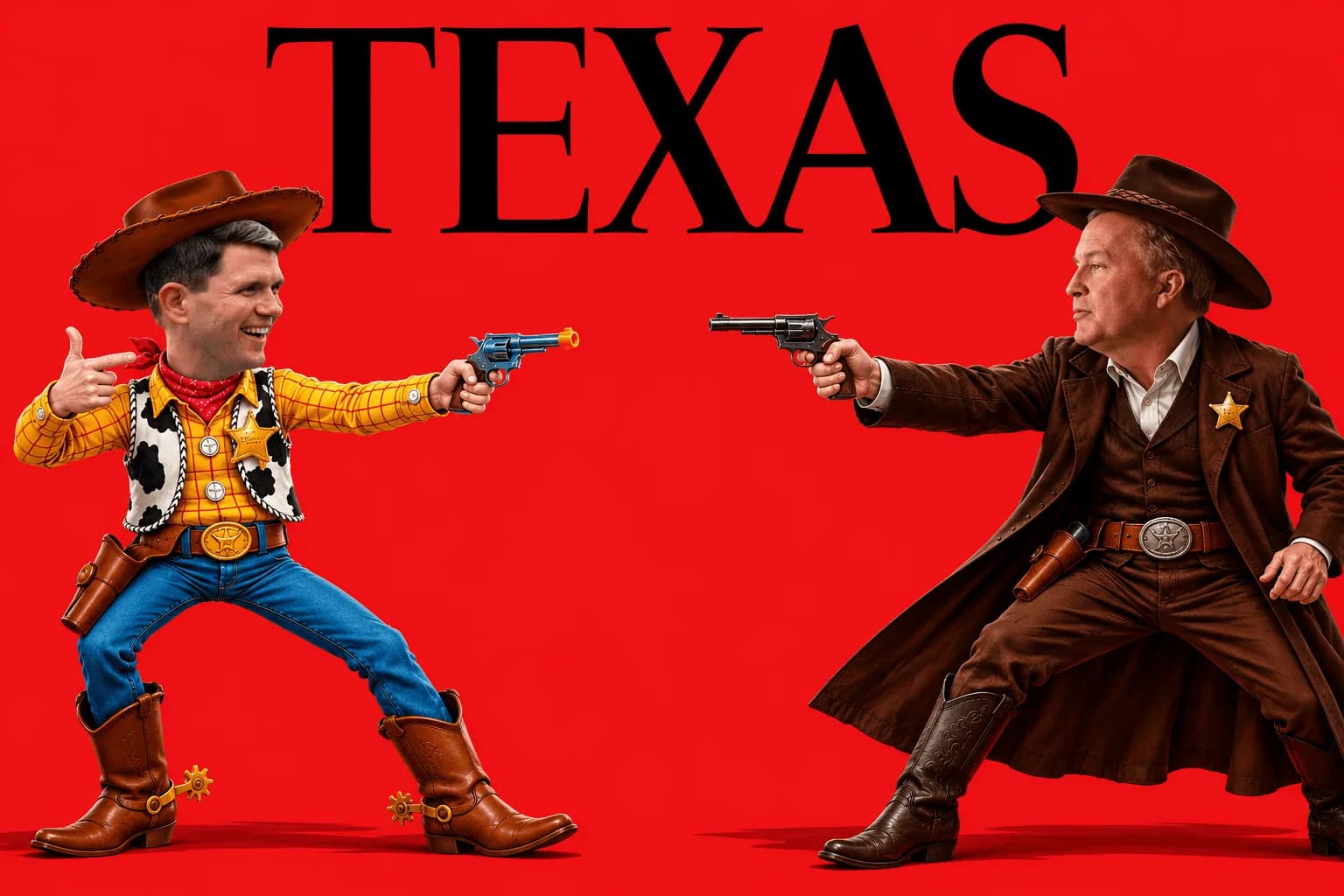
Those disagreements should not disappear beneath campaign personalities, and actually, that is the real duel of this campaign.
For many Texans, the central conflict is not whether Paxton is personally likable or whether Talarico can deliver an appealing speech. It is about the platforms each would support.
Paxton advocates stronger immigration enforcement, expanded domestic energy production, tax reductions, protections for unborn children, parental authority, and restrictions on transgender participation in girls' sports.
Talarico supports restoring federal abortion protections, expanding access to health care for illegal immigrants, protecting LGBTQ rights, investing in transition surgeries for children, forcing public education instead of school choice, and combining border enforcement with pathways to legal immigration status for certain undocumented residents.
These are genuine disagreements, not interchangeable campaign messages.
And for voters whose political convictions are grounded in Christian teachings, some of them carry profound moral weight.
When Christianity Becomes Part of the Political Battlefield
Talarico has repeatedly invoked Christianity during his political career.
He is a Presbyterian seminarian who argues that his understanding of Jesus' teachings supports his positions on social justice, public policy, and inclusion.
But several of his earlier statements have generated sharp disagreement among conservative Christians.
In 2021, Talarico declared that God was nonbinary while debating legislation concerning transgender participation in school sports.
He also claimed there were six biological sexes, a statement he subsequently acknowledged was incorrect.
Those remarks have become central to Republican criticism of his theology and judgment.
Conservative Christian critics argue that his interpretation conflicts with their understanding of biblical teachings about creation, marriage, sexuality, and the family.
Talarico maintains that his faith informs his political positions and rejects suggestions that disagreement makes him less Christian.
No political campaign can establish the sincerity of another person's relationship with God. But a politician's public theological arguments and legislative decisions are entirely appropriate subjects for examination.
The same standard must apply to candidates who invoke the name of Jesus while pursuing policies affecting families, children, religious institutions, and individual freedoms.
Religious liberty protects the right to disagree.
It also protects the right to examine those disagreements openly.
“Come and Take It.” Does It Still Mean Something in 2026?
In October 1835, Texian settlers at Gonzales resisted an attempt by Mexican authorities to reclaim a cannon.
The confrontation became the opening battle of the Texas Revolution.
The words associated with that moment became one of the most recognizable expressions of Texas identity:
COME AND TAKE IT.
Nearly two centuries later, the phrase remains visible on flags, bumper stickers, clothing, and signs across the state.
But what does it mean in 2026?
Does it signify independence of thought?
A determination to protect constitutional freedoms?
A commitment to family, property, faith, and local self-government?
Or has it become merely a historical slogan?
Those questions are especially relevant as Texas confronts disputes over taxation, education, parental rights, and the balance between state and federal power.
Consider the governor's race.
Democratic candidate Gina Hinojosa has been criticized for remarks she made in 2016 describing an income tax as a missing component of Texas's tax structure.
In 2019, she voted against HJR 38, the constitutional amendment that strengthened Texas's prohibition on individual income taxes.
Hinojosa now says she opposes a state income tax.
Her earlier statements, her legislative vote, and her current position all contradict one another.
Nevertheless, the controversy illustrates how disputes about the future of Texas extend across multiple offices on tomorrow's ballot.
The meaning of “Come and Take It” cannot be reduced to one party or candidate. But the principle behind it—the right of Texans to determine their future through constitutional self-government—remains central to this election.
Three Scenarios for Tomorrow
Texas could enter a very different political chapter depending on how the final ballots are counted.
Scenario One: Paxton wins.
Republicans retain the Senate seat and preserve their decades-long winning streak in Texas Senate elections.
The result would show that, despite competitive polling, national spending, and the controversies surrounding Paxton, enough Texas voters preferred the Republican nominee.
It would also deny Democrats one of their most significant opportunities to gain a Republican-held Senate seat.
Scenario Two: Talarico wins.
Texas elects its first Democratic U.S. senator since 1988.
The result would represent a major breakthrough for Democrats, energize them to establish a greater political presence, and raise questions about the durability of Republican statewide dominance.
It could also affect which party controls the U.S. Senate, depending on election results in other states.
But the outcome would not automatically change Texas's governor, Legislature, state tax system, or constitution.
Scenario Three: The election is extraordinarily close.
The Libertarian candidate, Ted Brown, attracts a relatively small but potentially consequential share of the vote.
Uncounted mail ballots, provisional ballots, or late-reporting precincts could leave the outcome unresolved on election night.
The result would need to be determined through lawful counting and certification—not competing declarations on social media.
All three scenarios demonstrate why tomorrow's result must be treated seriously.
Tomorrow, Texas Answers
There is a difference between loving the political idea of Texas and understanding the decisions that will shape its future.
For some voters, the greatest concern is preserving traditional family values, religious liberty, border enforcement, lower taxes, and the independence that has become synonymous with the Lone Star State.
For others, the priorities include health care, abortion rights, educational investment, economic affordability, and government accountability.
Those priorities are not identical, and their differences have real legislative consequences.
The responsibility of voters is to examine the records, distinguish policy from personality, and decide which candidate should exercise the powers of a United States senator.
Tomorrow is not a referendum on whether someone is sufficiently Texan. It is an election in which Texans with deeply different convictions will decide their political representation.
The national headlines have had their say.
The pollsters have published their numbers.
The donors have invested their millions.
And the candidates have made their arguments.
Now comes the only judgment that determines the result.
The ballots.
On November 3, Texas will answer a question no political advertisement, national television network, or forecasting model can settle in advance.
What kind of future do its voters choose—and what will that decision mean for the country?