


 3 min read
 12
 Linkedin
 Threads
 Facebook
 X

The numbers are striking.
According to Americans for Prosperity, 56% of approximately 10,000 swing voters contacted expressed an unfavorable view of socialism.
Another 59% believed the Democratic Party was controlled by its far-left wing.
These findings come from conversations conducted by a conservative advocacy organization, not a randomized national poll. But they raise a question that Democratic leaders cannot simply dismiss.
Is the party moving further left at precisely the moment when Americans are demanding more economic stability, affordability, and accountability?
AOC Is Building a Movement. But Who Is It Actually Reaching?
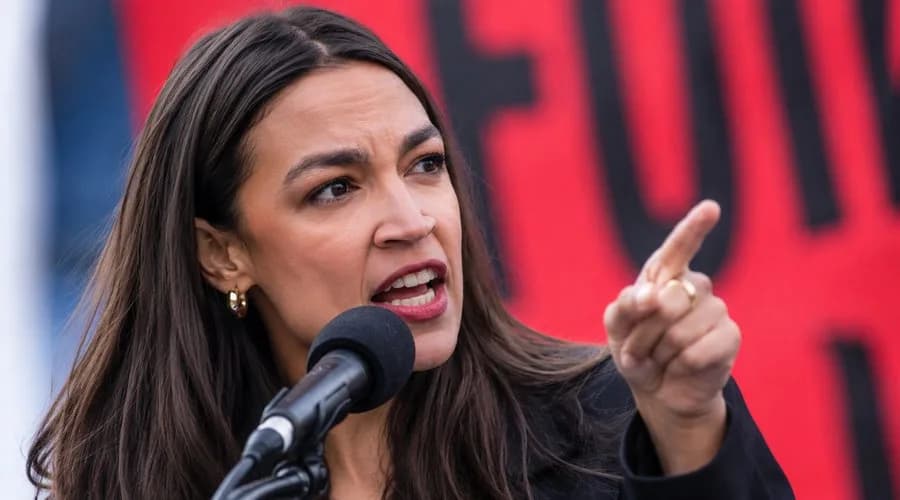
Ocasio-Cortez has become one of the country's most influential advocates for democratic socialism that supports islamic presence in the party.
Her political allies are organizing, winning primaries, and attempting to expand their congressional presence.
The Democratic Socialists of America has endorsed 10 House candidates in the 2026 election cycle, along with hundreds of candidates and ballot initiatives at other levels of government.
That demonstrates organizational strength.
But there is a difference between building power within a political party and understanding the essence of America; the reason of the American Dream; and convincing working families that your policies to support open borders, islam, more taxes, transsexual surgeries for children will improve their lives.
In September, Axios reported that many Democratic candidates in competitive districts were distancing themselves from Ocasio-Cortez, with certain campaigns declining her involvement or removing her endorsement from campaign materials.
That is a remarkable contradiction.
The political figure helping energize the party's progressive base is also someone some Democratic candidates would rather not have standing beside them in November.
For a movement seeking national influence, that tension deserves serious examination.
Working Americans Want the American Dream, Not Another Tax Increase
Across the country, families are confronting the same economic pressures.
Housing. Groceries. Insurance. Utilities. Transportation.
For someone working long hours to support a family, those expenses determine whether the American Dream feels achievable or increasingly distant.
And in states such as California, New York, New Jersey, Oregon, and Michigan, debates over taxes and government spending have intensified frustration over affordability.
The question facing politicians who propose expanded government programs is straightforward:
How much more should working Americans be expected to pay, and what measurable improvement will they receive in return?
AOC and other democratic socialists argue that higher taxes on wealthy individuals and corporations can finance broader public benefits.
Their critics argue that higher taxes and expanded government intervention can discourage investment, increase operating costs, and weaken economic growth.
The economic effects depend on the specific proposals. But the political challenge is immediate.
A family trying to buy its first home does not live inside a campaign slogan.
A small-business owner trying to make payroll cannot pay employees with promises.
And a worker hoping to build retirement savings wants to know whether government policies will leave more opportunity for personal advancement.
The American Dream is not simply a promise of government assistance. It is the opportunity to work, build wealth, own property, and create something lasting for the next generation.
Any political movement claiming to represent working Americans must explain how it will deliver those opportunities.
Trump and Musk Changed the Conversation About Government Spending
President Donald Trump has placed tax reductions, deregulation, and government efficiency at the center of his economic agenda.
Elon Musk's work with the Department of Government Efficiency brought federal contracts, administrative spending, and potentially wasteful expenditures under intense public scrutiny.
DOGE announced examples of questionable spending and claimed substantial savings, although some figures have been disputed and do not independently establish that taxpayer money was stolen.
But the attention surrounding DOGE introduced an important question into the national conversation.
Why should government ask taxpayers for more money before demonstrating that it is spending existing revenue responsibly?
That question applies to every administration and every political party.
For Democratic leaders advocating additional taxes or spending, it creates an accountability challenge: show the public exactly what the money will accomplish, how success will be measured, and why existing resources cannot achieve the same result.
For Trump's efficiency agenda, the corresponding test is whether announced cuts translate into verified savings without undermining essential public services.
The contrast between these approaches has become one of the defining economic disputes of the midterms and many voters want to have the Republican approach in government.
Michigan Is The Red Flag Democrats Are Just Seeing
The Democratic Party's internal disagreements became impossible to ignore on Sunday Nov 1.
In Michigan, Democratic Congresswoman Haley Stevens endorsed Republican Mike Rogers over her own party's Senate nominee, Abdul El-Sayed.
Stevens had lost the Democratic primary to El-Sayed in August and initially supported him.
But tensions involving Israel, his connction with the muslim brotherhood, donations coming from apparently terrorist countries, campaign rhetoric, and political commentator Hasan Piker eventually produced a dramatic public rupture.
After attending a church service alongside Rogers in Detroit, Stevens announced that she would support the Republican candidate.
Michigan Democratic leaders immediately condemned her decision.
A Democratic congresswoman publicly endorsing the Republican nominee two days before Election Day is not an ordinary disagreement over campaign strategy.
It is evidence of a serious fracture between prominent members of the party.
Stevens's stated reasons concerned El-Sayed's campaign and the political controversy surrounding it. They were not a blanket rejection of every socialist economic policy.
Nevertheless, her decision adds to a broader picture of Democrats struggling to reconcile competing political priorities.
Tulsi Gabbard and Robert F. Kennedy Jr. Were Earlier Warning Signs
Michigan is not the first example of a prominent Democrat breaking with the party.
In October 2022, former Democratic congresswoman Tulsi Gabbard announced that she was leaving the Democratic Party.
She accused its leadership of abandoning principles she considered essential, including individual freedoms, religious liberty, and national security.
Two years later, she endorsed Donald Trump.
Robert F. Kennedy Jr. followed a different path.
He initially pursued the 2024 Democratic presidential nomination, then left the Democratic primary process to run as an independent before suspending his campaign and endorsing Trump.
Their departures were driven by different grievances, including foreign policy, party leadership, institutional trust, and the political establishment.
It would be inaccurate to describe both departures as exclusively reactions to socialism.
But together, they demonstrate something politically significant.
The Democratic Party has experienced high-profile defections from figures who once sought influence within its own coalition.
Now, with Stevens's endorsement in Michigan, another prominent Democrat has publicly rejected her party's candidate.
These developments do not establish a nationwide collapse. They do, however, reveal how consequential ideological and political disagreements can become.
Other Democratic Candidates Are Throwing Biden Under the Bus
Just 48 hours before Election Day, Democratic candidates across Texas, Kansas, Pennsylvania, Iowa, and South Carolina are suddenly criticizing Biden's border failures. James Talarico, Adam Hamilton, Paige Cognetti, and others are now distancing themselves from the administration's immigration record. But where was this outrage when millions of border encounters were occurring under Biden? Why are these politicians discovering the importance of border security only when their political futures are on the line?
This is another sign of a Democratic Party struggling to defend its own record. While AOC pushes the party further left, other Democrats are running away from policies associated with their former president. Some Democrats criticized Biden's approach earlier, but those changing their message now owe voters an explanation. Americans deserve consistency and accountability—not an election-week political makeover designed to escape the consequences of four years of failed leadership.
AOC's Biggest Challenge Is The Entire Country Itself
The contradiction surrounding Ocasio-Cortez is increasingly visible.
Her movement has demonstrated that it can mobilize extremist activists and defeat establishment Democrats in certain primaries.
Yet some candidates competing for more politically divided electorates are keeping their distance.
The AFP findings reinforce that distinction.
Opposition to socialism was substantial among the swing voters contacted, even though the same research found Democrats retaining a slight advantage on economic trust.
That final finding matters.
It suggests that rejecting socialism as an ideology does not automatically mean voters approve of Republican economic performance.
For AOC, the challenge is whether her movement can persuade voters who are less interested in ideological labels than in rent, groceries, wages, and financial security.
For Democratic leadership, the challenge is whether the party can accommodate its progressive activists without losing support among voters who disagree with their approach.
And for Republicans, the challenge is demonstrating that promises of lower taxes, economic growth, and government efficiency translate into tangible results.
November 3: The American Dream Is at the Center of the Debate
The Democratic Party's ideological conflict is now playing out in congressional primaries, competitive general-election campaigns, and highly publicized defections.
AOC's movement is crumbling around the country.
Many Democratic candidates are distancing themselves from it.
And a prominent Democratic congresswoman in Michigan has just crossed party lines in one of the country's most closely watched Senate contests.
The question is whether Democratic leaders can reconcile those divisions while convincing working Americans that their economic agenda offers a credible path toward stability and opportunity.
For families trying to build businesses, purchase homes, raise children, and secure their futures, that question is not theoretical.
It concerns the practical meaning of the American Dream.
On November 3, voters will have the opportunity to evaluate the records, proposals, and priorities of the candidates seeking to represent them.
Political movements ultimately answer to the people whose lives their policies affect. That is the accountability every party must face.