 3 min read
 2
2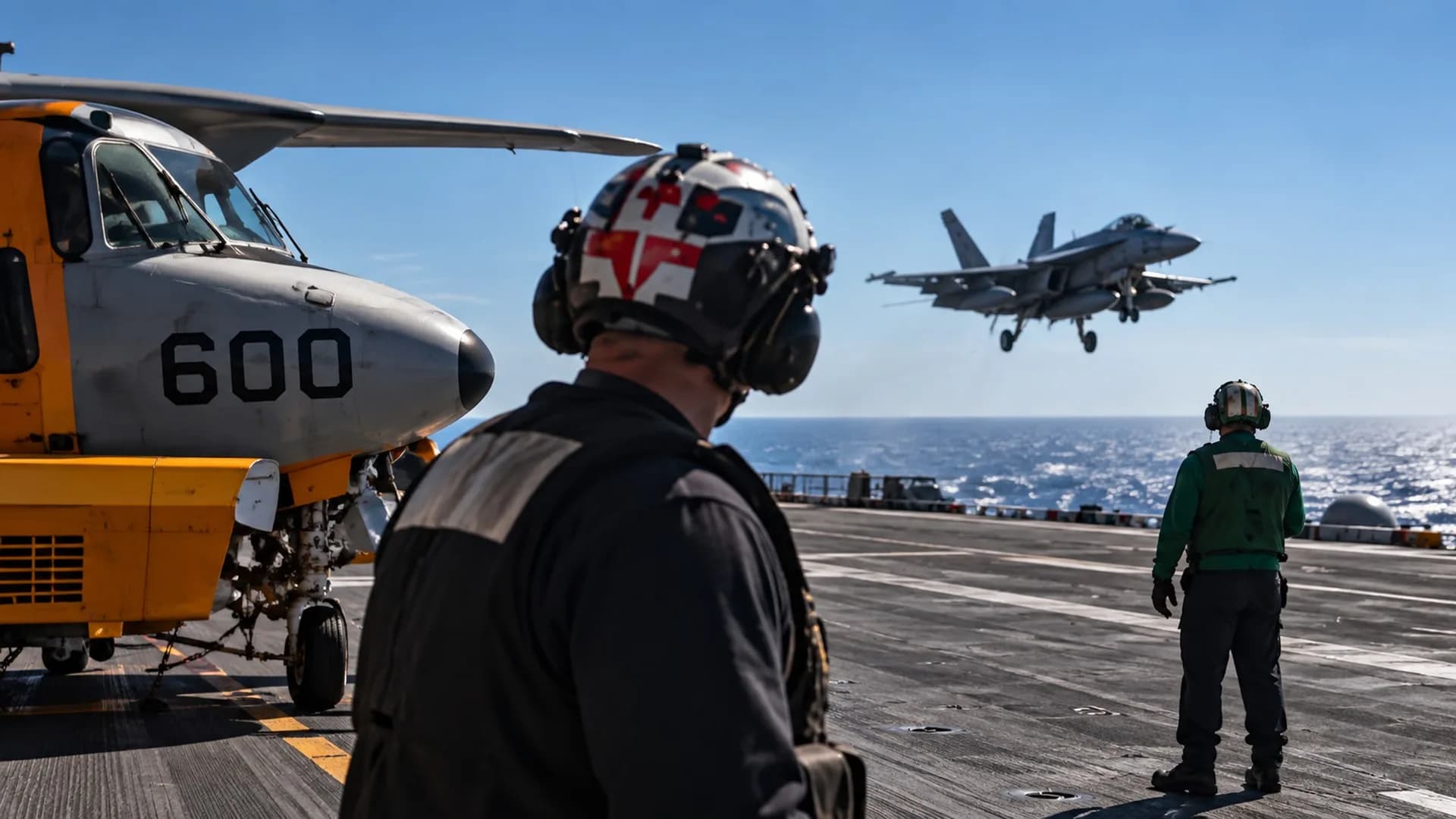
 Linkedin
 Threads
 Facebook
 X
X
Washington did not announce another ceasefire proposal.
It moved more military power toward the region.
The USS Theodore Roosevelt Carrier Strike Group and the USS Makin Island Amphibious Ready Group are heading toward the Middle East carrying roughly 7,000 sailors and 2,000 Marines, U.S. officials confirmed. Depending on rotations, their arrival could leave the United States with as many as three carrier strike groups and two amphibious groups operating in the region at once.
At the same time, Vice President JD Vance, Secretary of State Marco Rubio, Defense Secretary Pete Hegseth, CIA Director John Ratcliffe, Special Envoy Steve Witkoff and Joint Chiefs Chairman Gen. Dan Caine met for hours Friday at Camp David to discuss Iran and the rapidly expanding Saudi-Houthi conflict in Yemen.
That combination is difficult to ignore.
More ships.
More troops.
More air-defense systems.
And some of the administration’s most senior national-security officials behind closed doors.
The question is no longer whether Washington is preparing options.
The question is what Trump intends to do with them.
“They Played Their Cards Too Tough”
Trump gave perhaps his clearest assessment Friday night.
Speaking in Alabama, he argued that Iran had miscalculated by refusing terms earlier in the conflict.
“They played their cards. They played their cards too tough.”
Trump said that even if the United States ended operations immediately, Iran would need years to rebuild the infrastructure damaged during the war. He has also repeatedly predicted that the conflict will end “very soon,” perhaps shortly after the November midterm elections.
Iran rejects that description completely.
Mohsen Rezaei, secretary of Iran’s Supreme National Security Council, mocked Trump publicly Friday and insisted Tehran—not Washington—was shaping the battlefield.
So both governments are still publicly claiming strength.
But the military movements matter more than the speeches.
Hormuz Is Still the Pressure Point
The Strait of Hormuz remains at the center of everything.
Iran continues demanding that commercial vessels seek authorization before using the waterway and has attacked ships it accuses of ignoring its restrictions. A tanker was hit Friday, another vessel was struck Saturday, and CBS reports the latest incident was the fifth attack on shipping during the week.
Yet something else is happening.
The Gulf is finding workarounds.
Energy producers are increasingly using alternative routes, including pipelines through the United Arab Emirates, Red Sea shipping lanes and a U.S.-protected corridor through Hormuz.
According to maritime-data firm Kpler, Gulf crude and refined-product exports have recovered to roughly 21.8 million barrels per day, approaching the prewar baseline of 23.3 million.
That changes Iran’s leverage.
Closing or threatening Hormuz is most powerful when the entire world believes Persian Gulf energy cannot move without Tehran’s permission.
The more alternative routes function, the weaker that threat becomes.
Not irrelevant.
But weaker.
Trump Is Also Attacking the Oil-Price Problem
Washington understands the other side of this equation.
The longer the war continues, the more pressure Americans feel through fuel prices.
That is why Trump spent Friday pushing European allies and other major economies to release emergency energy stockpiles.
The International Energy Agency says member countries have already released 325 million barrels of oil and petroleum products from strategic reserves this year. G7 governments have now agreed to another coordinated release involving crude and diesel supplies to ease market pressure.
Trump says prices will fall sharply once the Iran conflict ends.
That prediction cannot be guaranteed. Energy prices depend on global demand, production, inventories, refining capacity and numerous other factors.
But removing the Hormuz risk premium would eliminate one of the largest geopolitical pressures currently hanging over the oil market.
That explains why the administration is fighting two battles simultaneously:
Pressure Iran militarily.
Prevent the war from economically exhausting Americans.
Then Yemen Exploded Again
Iran is not the only front.
The Houthis—long backed by Tehran—have dramatically escalated their war with Saudi-backed forces in Yemen.
Saudi Arabia launched dozens of strikes against the Houthi-held capital of Sanaa on Saturday, according to Houthi media and journalists in the region. Flames were also reported at a Saudi Aramco facility outside Riyadh, although the cause was not immediately confirmed.
The Houthis have recently targeted Saudi oil infrastructure and claimed a maritime blockade against the kingdom.
That makes Yemen strategically important for another reason.
Hormuz is the gateway to the Persian Gulf.
Bab el-Mandeb is the gateway connecting the Red Sea to the Arabian Sea.
Iran and its allies therefore remain positioned around two of the world’s most consequential maritime chokepoints.
This may help explain why Yemen was reportedly discussed alongside Iran during the Camp David meeting.
The administration is not dealing with one isolated battlefield anymore.
It is confronting a regional network.
Iran May Be Changing Tactics
Another development should receive more attention.
British authorities are investigating an alleged attempted terrorist act near RAF Fairford, a U.S.-used military installation in England.
Six men were arrested after individuals were found near the base with large oil drums and gasoline in their vehicle. The British government has said there are “strong indications” Iran may have played a role, while emphasizing that the investigation remains ongoing. Iran denies involvement.
Trump has separately suggested investigators are examining possible Iranian connections to this week’s Flydubai cockpit attack, although that connection also remains unproven.
If Tehran is shifting from conventional military resistance toward asymmetric attacks against Western interests abroad, the war enters a different category.
That possibility alone could explain part of Washington’s military buildup.
So What Is Washington Preparing For?
Nine thousand additional personnel do not necessarily mean a ground invasion.
Aircraft carriers provide air power.
Amphibious groups provide Marines, helicopters and flexible regional response.
Patriot batteries help protect Saudi and Qatari energy infrastructure.
Those assets give Trump options.
They also send a message.
Iran recently proposed a seven-day framework aimed at moving toward reopening Hormuz and returning to negotiations.
Washington rejected those terms.
Now Tehran knows that the American response was not simply diplomatic.
More American military capability is moving toward the theater.
That does not mean Iran is finished.
Its forces still possess missiles.
Its allies remain active.
Ships are still being attacked.
And Tehran continues insisting publicly that Washington is the side under pressure.
But compare the battlefield with the rhetoric.
Iran is negotiating.
Its oil exports remain constrained.
Alternative Gulf export routes are recovering.
The United States is reinforcing its military position.
Saudi Arabia is again striking the Houthis.
And Trump’s national-security team just spent hours discussing what comes next.
Trump says Iran is “ready to fold.”
Tehran says Trump is imagining victory.
Neither claim should be accepted merely because one side says it.
But the next several weeks may reveal which government better understands the position it is actually in.
Because Washington is no longer merely talking about additional pressure.
The ships are already moving.