
 3 min read
 115
 Linkedin
 Threads
 Facebook
 X

Elon Musk is attempting something far more ambitious than designing another AI chip. Through Terafab, he wants to control the infrastructure behind his inventions—from Tesla's autonomous vehicles and Optimus robots to SpaceX satellites and future AI data centers. If successful, the strategy could fundamentally change who controls the speed of artificial intelligence innovation.
The most important distinction is that Musk isn't necessarily trying to sell chips to Nvidia's customers. He is trying to eliminate the dependency that forces his own companies to compete for the same computing resources as everyone else.
That is a different kind of competition—and potentially a more consequential one.
Nvidia Controls the AI Highway. Musk Wants to Build His Own.
For years, the artificial intelligence revolution has depended on one extraordinary company: Nvidia.
Its advanced processors power much of the infrastructure behind modern AI. From large language models to autonomous systems, Nvidia has become one of the most influential companies in the global technology industry.
But Elon Musk is preparing to challenge that dependency.
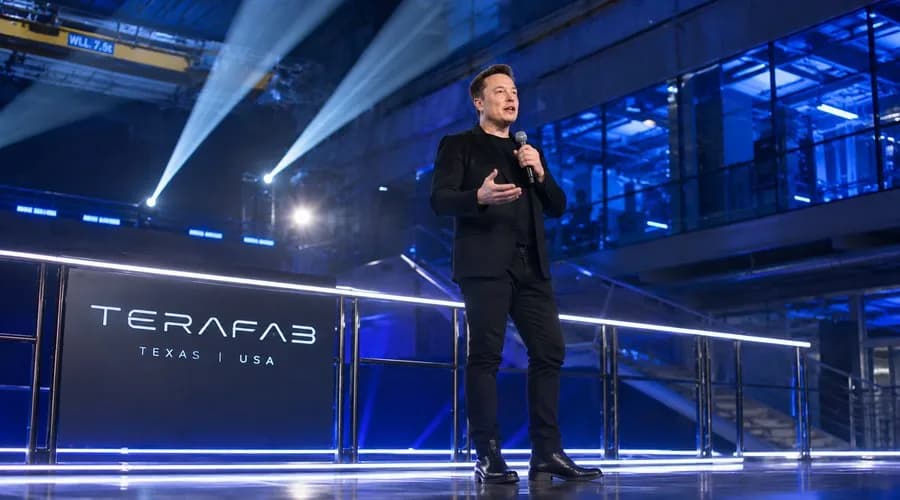
Through Terafab, a massive semiconductor manufacturing initiative launched in March 2026, Musk is attempting to create a dedicated supply of AI chips for Tesla, SpaceX, and their expanding technology ecosystem.
The project is not simply another factory.
It is an attempt to remove one of the greatest limitations facing ambitious AI development: dependence on someone else's computing infrastructure.
Why Nvidia Has Become So Powerful
Nvidia dominates the market for high-performance AI GPUs, with estimates placing its share above 80% in important segments.
Its competitive advantage extends beyond the processors themselves.
Nvidia's CUDA programming platform, networking technology, software libraries, and integrated computing systems have created an ecosystem that is extremely difficult to replace.
Building advanced AI systems often means relying on infrastructure designed around Nvidia technology.
That gives Nvidia tremendous commercial influence.
However, Nvidia is not a legal monopoly, and it faces competition from AMD, Google, Amazon, and other custom-chip developers.
There is another important distinction: Nvidia designs its leading processors but relies heavily on manufacturing partners, especially Taiwan's TSMC.
The bottleneck is therefore larger than one company. It includes semiconductor fabrication, advanced packaging, memory production, power, and manufacturing capacity.
When these resources are scarce, even well-funded innovators must compete for access.
The problem is not necessarily that Nvidia wants to slow innovation. It is that the world's ambitions are growing faster than the infrastructure needed to support them.
What Exactly Is Terafab?
Terafab is a joint Tesla–SpaceX semiconductor initiative designed to manufacture specialized AI processors at unprecedented scale.
Its proposed Texas manufacturing complex will bring chip fabrication, memory, advanced packaging, and testing together.
The project includes a research facility at Tesla's Gigafactory in Austin and a planned large-scale manufacturing complex in Grimes County, Texas.
The companies announced an initial investment of approximately $16.8 billion, with additional expansion phases contemplated.
Intel has also joined the effort, with Musk identifying Intel's advanced 14A manufacturing technology as part of the plan.
Terafab's ambition is extraordinary: eventually produce hardware representing approximately one terawatt of computing capacity annually.
That is a target, not current production.
In October, Musk identified the third quarter of 2028 as an aspirational milestone for volume manufacturing, while acknowledging considerable uncertainty.
Four Industries, One Computing Strategy
1. Tesla's autonomous vehicles
Self-driving systems require enormous amounts of computation to interpret cameras, predict movement, and make decisions.
Custom processors can be optimized for the precise workloads Tesla needs, potentially improving efficiency and lowering hardware costs.
2. Optimus humanoid robots
Robots must process visual information, understand language, coordinate movement, and respond to their environment.
A general-purpose AI accelerator may provide substantial computing power, but a dedicated robotics processor can be engineered around size, power consumption, latency, and thermal constraints.
3. SpaceX satellites and orbital infrastructure
Space introduces entirely different engineering challenges.
Processors must withstand radiation, temperature variation, power limitations, and demanding reliability requirements.
Musk's plans for orbital AI data centers would require computing hardware specifically designed for that environment.
4. AI servers and future intelligence systems
Large AI models require substantial computing capacity for training and inference.
By developing its own processors, Musk's companies could eventually control more of the infrastructure needed to build and operate advanced AI services.
Terafab is not intended to manufacture a single universal chip for all four applications. Its roadmap includes distinct processors optimized for different workloads.
Musk Is Building a Closed Computing Empire
This is where the strategy becomes particularly interesting.
Traditional technology companies often depend on specialized suppliers.
One company designs the chips. Another manufactures them. Another supplies memory. Another operates the data centers. Software developers then build applications on top.
Musk is attempting to bring more of those capabilities inside his own corporate ecosystem.
Tesla develops vehicles and robots.
SpaceX develops rockets, satellites, and communications infrastructure.
Their AI operations develop increasingly sophisticated intelligence systems.
Terafab would provide specialized computing hardware for those systems.
Instead of asking the semiconductor industry what it can supply, Musk wants to manufacture what his inventions require.
This would create an unusually integrated technology ecosystem.
Calling it a monopoly requires caution: controlling an internal supply chain does not establish monopoly power in a commercial market.
But it could establish a powerful competitive advantage.
Competitors would have to reproduce not merely a processor, but the engineering relationships connecting the chip to the vehicle, robot, satellite, software, and manufacturing operation.
The Competitive Advantage Nobody Should Ignore
Terafab could give Musk's companies several advantages.
First, greater supply certainty. Internal production could reduce dependence on external allocation decisions.
Second, workload-specific efficiency. Dedicated chips may deliver more useful computation per watt for narrowly defined tasks.
Third, faster engineering feedback. Designers could potentially coordinate software, chip architecture, manufacturing, and product development more closely.
Fourth, supply-chain resilience. Additional American semiconductor capacity could reduce certain overseas manufacturing dependencies.
Fifth, greater freedom to experiment.
When computing hardware is designed around an invention rather than the invention being constrained by available hardware, engineers gain new possibilities.
But none of these advantages is guaranteed.
A custom chip can underperform. Manufacturing yields can disappoint. Advanced semiconductor facilities can cost billions before producing commercially useful volumes.
And even an internal factory will depend on outside suppliers for equipment, materials, and specialized components.
The Bigger Challenge: Musk Is Not Alone
One important development deserves attention.
Google has invested heavily in Tensor Processing Units.
Amazon develops Trainium accelerators.
Microsoft and other major cloud companies are pursuing custom AI hardware.
AMD continues competing with Nvidia in advanced accelerators.
This means Terafab is part of a larger industry transformation.
The future of AI computing may not belong exclusively to companies selling general-purpose processors.
It may increasingly involve technology companies designing specialized hardware for their own applications.
Musk's distinction is the ambition to combine that approach with substantial internal manufacturing capacity.
Ricardo's Analysis: What This Means for AI Voice
As a creative technologist developing real-time AI voice systems, I see an implication that extends well beyond autonomous cars or humanoid robots.
One of the greatest challenges in conversational AI is not simply generating an intelligent response.
It is generating that response quickly enough for an interaction to feel natural.
A sophisticated voice agent must listen, recognize speech, interpret meaning, access relevant information, reason, generate a response, and produce realistic audio.
All of that happens while a human expects an almost immediate reaction.
Even small delays can make an otherwise intelligent system feel mechanical.
Specialized inference processors could eventually reduce the cost and latency of these operations.
They could also make more sophisticated voice capabilities practical directly on devices.
Imagine robots, vehicles, and personal assistants capable of maintaining continuous conversational context without sending every interaction to a distant data center.
That would affect responsiveness, privacy, reliability, and operating costs.
However, Terafab is currently a captive manufacturing strategy. There is no announced commitment to supply its processors to independent voice-AI developers.
Its immediate advantage would belong primarily to Musk's companies, while the broader industry could benefit indirectly if competing chipmakers respond with more specialized and affordable computing products.
That is the opportunity I find particularly significant.
The next generation of AI may depend as much on the evolution of computing hardware as on improvements in the intelligence models themselves.
The Risks That Could Change Everything
Terafab faces formidable obstacles.
Advanced chipmaking requires extraordinary manufacturing precision, expensive lithography equipment, highly specialized engineers, reliable material supplies, and consistently high production yields.
Building a semiconductor facility is not the same as successfully manufacturing competitive processors at scale.
There are also difficult questions about energy demand, water consumption, environmental permitting, capital efficiency, and whether enough internal demand will exist to justify the investment.
Orbital computing introduces further uncertainty.
Space offers access to solar energy, but radiation protection, heat rejection, communications latency, maintenance, and launch economics remain serious challenges.
Another possibility is that Nvidia and its manufacturing partners expand capacity quickly enough to reduce the shortage Musk is trying to escape.
If that happens, Terafab would need to compete not only on supply independence but on cost and performance.
The Real Revolution Is Independence
Elon Musk is not building Terafab because Nvidia lacks technological excellence.
He is building it because his ambitions may require more specialized computing capacity than the existing industry can reliably provide on his preferred schedule.
That distinction changes the entire story.
Nvidia became extraordinarily powerful by supplying the processors that enabled the AI revolution.
Musk is attempting to build a parallel system in which his companies design the machines, develop the intelligence, manufacture the processors, and control the infrastructure connecting them.
Whether Terafab succeeds remains uncertain.
But the strategic question it raises is already relevant to every technology entrepreneur:
What happens when the most important component of your invention is controlled by someone else?
For Musk, the answer is becoming clear.
He wants to build that component himself.
And if he succeeds, the competition will no longer be simply about who makes the fastest AI chip.
It will be about who controls the entire technological system—and therefore who can turn the next impossible idea into reality.