
 3 min read
 57
 Linkedin
 Threads
 Facebook
 X

Why Did a Sanctioned Russian Military Jet Land in Israel? Moscow's Spy Chief, a Reported U.S. Request, and Questions Nobody Is Answering
JERUSALEM — November 16, 2026. A Russian military aircraft operating under U.S. sanctions landed at Israel's Ben-Gurion Airport on November 8, carrying one of Moscow's most powerful intelligence officials into an unusual meeting with senior Israeli defense officials.
The aircraft was not an ordinary commercial flight.
It belonged to Russia's Ministry of Defense.
Its operating unit had been sanctioned by Washington for supporting operations involving the Wagner mercenary organization.
And aboard was Admiral Igor Kostyukov, the head of Russia's GRU military intelligence agency.
According to reporting by The Jerusalem Post, Kostyukov and other senior Russian officials met with members of Israel's defense establishment before departing for Abu Dhabi, where Russia and Ukraine were scheduled to participate in American-mediated negotiations.
But another report introduced a potentially more significant dimension.
Israel's public broadcaster KAN, citing an unnamed foreign source, reported that the Russian delegation had arrived in Israel at the request of the United States.
If accurate, that would mean Washington was not merely aware of the unusual encounter but had actively sought it.
The distinction is critical.
And it raises a question that remains unanswered:
Why would Washington request a meeting between Russian military intelligence and Israeli defense officials at such a sensitive moment?
A Russian Military Aircraft Under American Sanctions
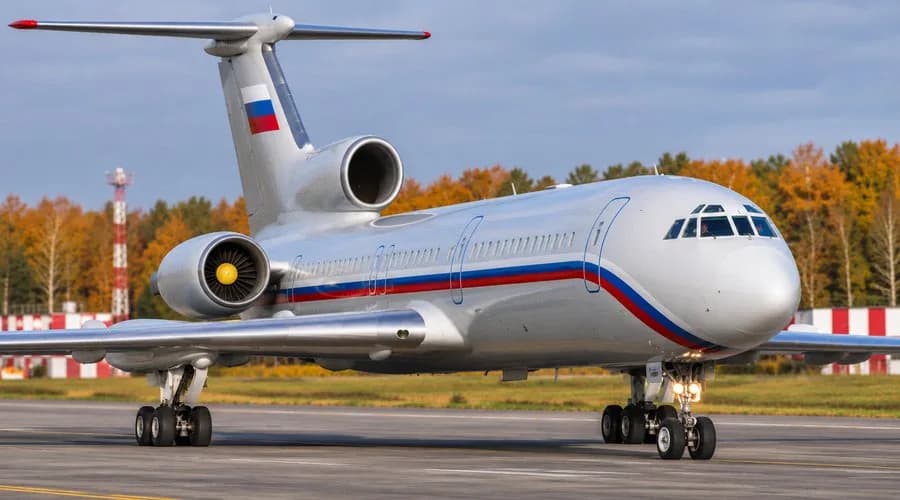
The aircraft was identified as a Tupolev Tu-154M, registration RA-85042, operated by the Russian Defense Ministry's 223rd Flight Unit.
According to flight-tracking information cited by The Jerusalem Post, it departed Chkalovsky Air Base near Moscow, crossed the Black Sea and Turkish airspace, and approached Israel from the Mediterranean.
It landed at Ben-Gurion Airport on Sunday evening, November 8.
The flight was unusual enough to attract attention from Israeli journalists and aviation observers.
But the aircraft's sanctions history made the visit even more noteworthy.
On May 19, 2023, the United States designated Russia's 223rd Flight Unit and identified 37 associated aircraft as blocked property under Executive Order 14024.
Washington accused the unit of transporting personnel and equipment associated with the Wagner mercenary group.
RA-85042 was among the listed aircraft.
Yet three years later, the aircraft was landing in Israel with a delegation of senior Russian military officials.
That does not automatically mean the landing violated U.S. sanctions. American sanctions do not universally prohibit a foreign country from allowing an aircraft to land, and specific restrictions depend on jurisdiction and the transactions involved.
Nevertheless, the diplomatic significance is difficult to overlook.
An aircraft Washington had sanctioned was carrying Russia's military intelligence chief into meetings with one of America's closest Middle Eastern partners.
Who Was Aboard? Russia's Military Intelligence Chief
Admiral Igor Kostyukov is not simply another Russian diplomat.
He leads the GRU, Russia's military intelligence organization.
His responsibilities place him near the center of Moscow's military intelligence operations and strategic security assessments.
A meeting involving such an official naturally attracts attention because of the sensitive information and military interests his position encompasses.
The Jerusalem Post reported that Kostyukov headed the delegation and met senior Israeli defense officials.
However, neither the identities of all the Israeli participants nor the subjects discussed have been publicly disclosed.
That distinction matters.
The presence of senior defense and intelligence officials establishes the importance of the encounter.
It does not establish what agreements, if any, emerged from it.
Still, the central question remains.
Why was the head of Russian military intelligence meeting Israeli defense officials immediately before negotiations involving the United States and Ukraine?
Did Washington Request the Meeting?
This may be the most consequential element of the story.
According to KAN, the delegation arrived in Israel at the request of the United States.
Anadolu Agency subsequently reported KAN's account, noting that the information came from an unnamed foreign source.
If that reporting is accurate, the visit could have been part of a wider diplomatic initiative.
But important details remain unconfirmed.
Did the White House request the meeting?
Was the State Department involved?
Did the Pentagon coordinate with Israeli defense officials?
Was the encounter connected to the Ukraine negotiations scheduled in Abu Dhabi?
Or was Israel serving as a location for discussions concerning regional security?
The public reporting does not establish which American agency, if any, arranged the visit.
Nor does it identify the subjects discussed.
The Pentagon's direct approval therefore cannot be presented as an established fact.
Nevertheless, the reported American request deserves scrutiny.
Israel maintains an exceptionally close security relationship with the United States.
A visit by Russia's intelligence chief involving senior Israeli defense officials would carry obvious diplomatic implications.
It is reasonable to ask whether Washington was informed in advance.
But the assumption that Israel would never conduct sensitive diplomacy without American approval is not itself evidence of Pentagon authorization.
That distinction makes the KAN report especially important.
It points toward possible American involvement while leaving the precise chain of authorization unresolved.
Why Did the Russian Delegation Continue to Abu Dhabi?
After leaving Israel on November 9, the Russian aircraft headed toward Abu Dhabi in the United Arab Emirates.
Kostyukov was scheduled to participate in Russian-Ukrainian negotiations under American mediation on November 10 and 11.
That itinerary provides one documented diplomatic context for the visit.
The delegation's travel through Israel may have been connected to preparations for those negotiations.
It could also have involved separate security discussions.
The available evidence does not establish which explanation is correct.
Yet the sequence is noteworthy:
First, a senior Russian intelligence delegation traveled from Moscow to Israel.
Then it met Israeli defense officials.
Afterward, it proceeded to a location where Washington was mediating negotiations involving Russia and Ukraine.
Was Israel simply a stop along the diplomatic route, or did the meeting serve a specific purpose before the negotiations began?
That is a legitimate question for American and Israeli officials.
The Iran Question: Why Now?
The timing becomes even more significant when Iran enters the picture.
Russia maintains important strategic relations with Tehran.
Israel, meanwhile, has been involved in military confrontation with Iran, and the possibility of renewed hostilities involving the United States remains a major regional security concern.
According to KAN reporting summarized by Anadolu, senior Iranian security official Mohsen Rezaei had visited Moscow days before the Russian delegation arrived in Israel.
Rezaei reportedly met Russian President Vladimir Putin, with the American-Iranian confrontation among the subjects discussed.
That creates a sequence worthy of examination.
An Iranian security official visits Moscow.
Days later, Russia's military intelligence chief arrives in Israel.
He meets senior Israeli defense officials.
Then he travels to negotiations involving American mediation.
Are these events connected?
There is no publicly established evidence that they are.
But their proximity raises questions about the possibility of regional security discussions occurring alongside the Ukraine diplomatic process.
Was Russia conveying concerns about another confrontation with Iran?
Was Israel seeking clarity about Moscow's relationship with Tehran?
Were officials discussing military deconfliction, intelligence assessments or possible escalation?
Or were the conversations entirely unrelated to Iran?
Those possibilities remain questions—not findings.
Israel and Russia Have Communicated Militarily Before
Despite their differing strategic relationships, Israel and Russia have maintained military communication channels in the past.
Their coordination was particularly important in Syria, where Russian military forces operated near areas in which Israel conducted security operations.
The purpose of those arrangements was to reduce the risk of unintended confrontations between their forces.
That history offers another possible explanation for the November meeting.
The discussions may have concerned military coordination or regional developments rather than a new political agreement.
But without an official explanation, the public cannot determine whether the encounter involved routine security coordination or something more consequential.
Why Are the Governments Remaining Silent?
When The Jerusalem Post requested comment, the Russian Embassy in Israel declined to explain the delegation's presence.
The Israel Defense Forces also declined to comment.
KAN reported that the Israeli prime minister's office likewise declined to provide details.
There may be legitimate reasons for confidentiality in sensitive military diplomacy.
But secrecy also creates questions, especially when the encounter involves a sanctioned Russian aircraft, a senior intelligence official and a reported American request.
If the meeting was connected to peace negotiations, why not acknowledge its general purpose?
If it concerned regional security, could officials confirm that without disclosing classified information?
And if Washington requested the visit, which American agency authorized or coordinated it?
These questions do not establish misconduct.
They establish a gap between what has been reported and what governments have publicly explained.
Three Governments, One Unanswered Question
The United States is attempting to navigate several interconnected security challenges.
Russia's war against Ukraine continues.
Iran remains a major concern for American and Israeli military planners.
And Washington's relationships with both Israel and Russia carry consequences for diplomacy across the Middle East and Europe.
Against that background, the arrival of a sanctioned Russian military aircraft in Israel cannot be understood merely as an unusual aviation event.
The flight is documented.
The reported presence of Russia's military intelligence chief is supported by Israeli reporting.
His meetings with senior Israeli defense officials have been reported.
And the delegation's subsequent journey to American-mediated negotiations provides a documented diplomatic context.
What remains uncertain is the purpose of the Israeli meeting and the extent of Washington's involvement.
Was this a preliminary conversation about Ukraine? A discussion about Iran? A military coordination meeting? Or part of a broader diplomatic effort not yet publicly explained?
Those are the questions that should now be put to Washington, Jerusalem and Moscow.
The public does not need access to classified intelligence to deserve a basic explanation of the diplomatic purpose.
A sanctioned aircraft arrived.
A powerful Russian intelligence official met Israeli defense leaders.
An Israeli broadcaster reported that the United States requested the visit.
And the delegation continued to American-mediated negotiations.
The most important mystery is no longer who was on the aircraft.
It is what was discussed behind closed doors—and why the meeting happened at that particular moment.