
 3 min read
 72
 Linkedin
 Threads
 Facebook
 X

Is Washington Entering a New Battle Over the Western Hemisphere?
WASHINGTON, D.C. — President Donald Trump has delivered one of his most consequential statements about Cuba since returning to the White House, declaring that he wants to resolve the island's communist-government question before leaving office and acknowledging that military intervention remains an option.
The remarks came during a November 12 interview with conservative radio host Hugh Hewitt, who asked whether Trump would authorize military force to free Cuba.
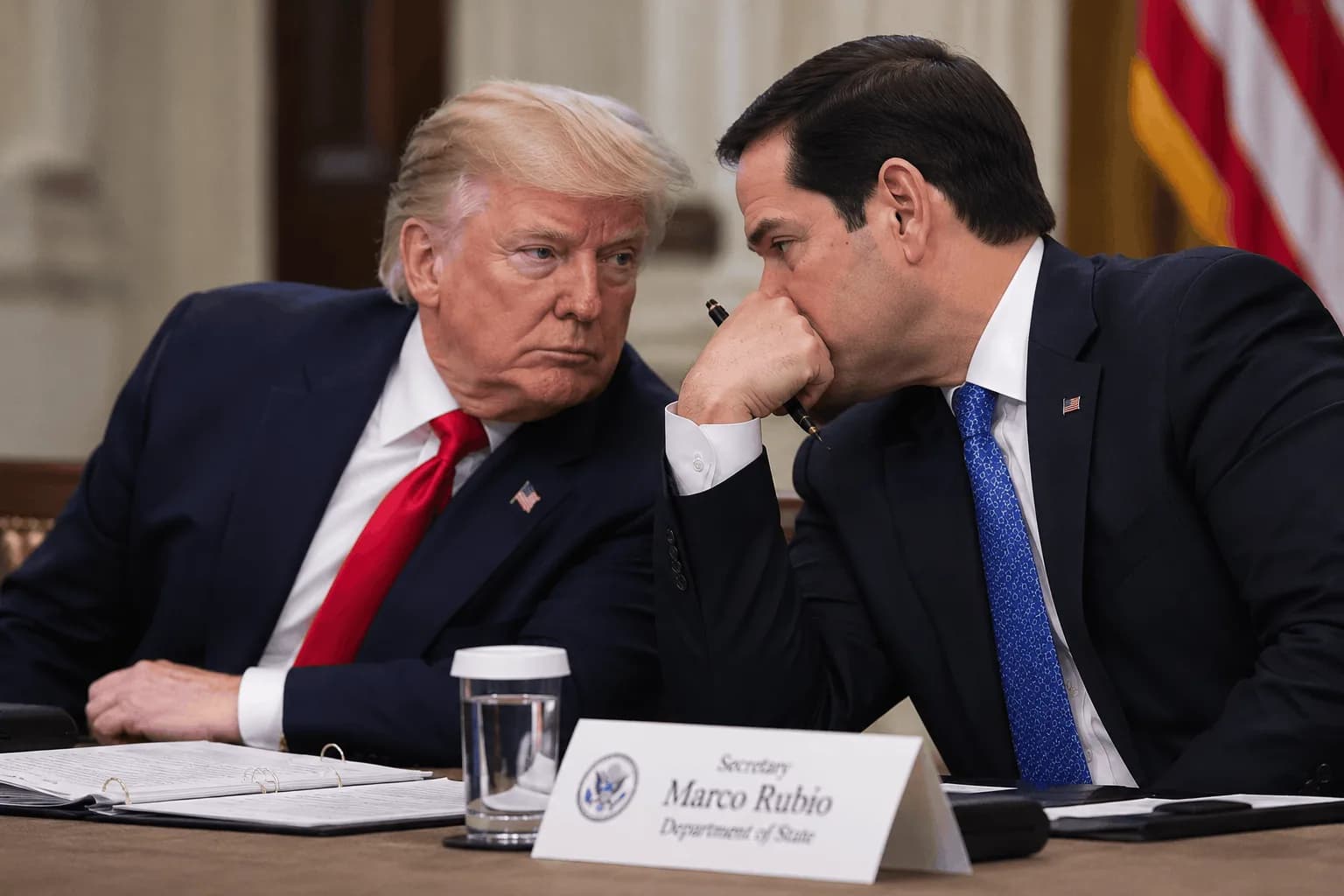
Trump replied that he wanted to get Cuba's situation resolved before the end of his presidency and immediately pointed to Secretary of State Marco Rubio as a potentially important figure.
When Hewitt asked whether the president would consider a brief military campaign, Trump answered:
“I would certainly consider that, yes.”
The exchange raises a question with implications far beyond Havana: Is the United States preparing a more confrontational strategy toward communist rule in the Western Hemisphere?
A Deadline for Cuba's Communist Government?
Cuba has been governed by a Communist Party-led political system for more than six decades, beginning with Fidel Castro's revolutionary consolidation of power and continuing through the presidency of Miguel Díaz-Canel.
For generations, Cuban dissidents and exiles have demanded political pluralism, freedom of expression, competitive elections, and the release of political prisoners.
Trump's latest remarks place those longstanding demands within a new presidential timeframe.
His second term ends in January 2029, leaving approximately 26 months for his administration to pursue its objectives.
But there is a crucial distinction between a presidential ambition and an operational decision.
Trump has not announced a military intervention, identified a specific plan for political transition, or explained what conditions would constitute success.
His statement nevertheless signals that Cuba remains a prominent foreign-policy objective.
Marco Rubio: The Cuban-American Secretary at the Center of the Strategy
Trump's reference to Marco Rubio was significant.
Rubio, whose parents emigrated from Cuba before his birth, has spent much of his political career criticizing Havana's one-party government and advocating stronger pressure on its leadership.
As secretary of state, Rubio now occupies a position that could translate those longstanding views into diplomatic and economic policy.
His role is not merely symbolic.
The administration has already intensified sanctions against individuals, commercial networks, and entities that Washington associates with Cuba's military and governing elite.
The question is whether those measures are intended primarily to extract concessions or to accelerate a broader political transition.
Washington Is Already Applying Economic Pressure
The administration's actions extend beyond public statements.
On November 5, the United States announced additional sanctions targeting individuals and organizations linked to Cuba's government, military-related commercial operations, and international supply networks.
The measures included Chinese companies accused by Washington of providing equipment or other support to Cuban security institutions.
The administration also expanded its authority to target activities in several sectors of the Cuban economy.
These steps are part of a broader campaign involving financial restrictions, oil-related pressure, and efforts to limit resources available to state-controlled enterprises.
Supporters of the policy argue that sanctions can weaken the institutions that sustain one-party rule.
Critics argue that broad economic pressure can also deepen hardship among ordinary Cubans, particularly when electricity, transportation, and food distribution are already unreliable.
Both consequences matter when evaluating the strategy.
Cuba's Crisis Is About More Than American Sanctions
Cuba faces severe economic and infrastructure problems.
Its aging electricity system has experienced repeated failures, while fuel shortages have interrupted transportation, commercial activity, and daily life.
The country's problems also include weak domestic production, limited investment, financial restrictions, and longstanding structural weaknesses in its state-directed economy.
American sanctions add another constraint, especially on access to financing, fuel, and international commercial relationships.
For Cuban families, the immediate consequences are practical: blackouts, scarce supplies, reduced purchasing power, and uncertainty about the future.
Political arguments about Havana and Washington cannot substitute for an examination of those living conditions.
Any proposed transition would need to address how essential services could continue functioning while institutions and economic arrangements changed.
The Western Hemisphere: Why Cuba Matters Beyond Its Borders
Cuba has long occupied an important position in Latin American geopolitics.
During the Cold War, Havana developed close ties with the Soviet Union and supported revolutionary movements abroad.
After the Soviet collapse, Cuba maintained relationships with governments including Venezuela and Nicaragua, while expanding cooperation with China and Russia.
Those relationships differ in structure and intensity, and the countries involved do not all operate under identical political or economic systems.
Nevertheless, they have shaped Washington's concerns about authoritarian governance, security cooperation, and foreign influence close to American territory.
Trump's comments therefore fit into a broader strategic debate about the future of the hemisphere.
Would political change in Cuba weaken relationships among authoritarian governments?
Could it alter regional energy arrangements, intelligence cooperation, or diplomatic alignments?
And would other governments interpret an American military intervention as a warning—or as a precedent for intervention in their own affairs?
These questions would become especially consequential if Washington moved beyond sanctions and diplomacy.
From Containing Communism to Seeking Political Change
For much of the Cold War, American policy toward Cuba centered on containment, economic pressure, diplomatic isolation, and opposition to Soviet influence.
Later administrations experimented with different combinations of sanctions, engagement, travel restrictions, and diplomatic normalization.
Trump's current approach emphasizes pressure and openly discusses the possibility of ending the existing political order.
That represents a more explicit regime-change objective than simply seeking limited concessions.
But ending communist rule in Cuba would not, by itself, dismantle communism worldwide.
China, Vietnam, Laos, and other states have their own political institutions, economic relationships, and strategic interests.
Even within Latin America, governments commonly grouped together as ideological allies differ substantially.
A political transition in Havana could change regional relationships without automatically transforming those other governments.
The larger historical significance would depend on what replaced Cuba's current system—and whether the result proved stable, legitimate, and economically sustainable.
Military Force: A Decision With Consequences
Hewitt's question introduced the possibility of a short military campaign.
Trump did not rule it out.
However, the duration, cost, and consequences of an intervention cannot be established from a hypothetical question during a radio interview.
Any military action would raise substantial questions about international law, congressional authority, civilian protection, regional diplomacy, and the responsibilities of an occupying or intervening force.
Cuba's government has condemned American pressure and said it would resist foreign military intervention.
A transition achieved through negotiation would present different risks from one imposed through military operations.
The distinction is essential for evaluating what the administration may actually pursue.
A Historic Ambition, but No Announced Operation
Trump has placed Cuba prominently on his foreign-policy agenda and publicly entertained military force as one possible instrument.
Rubio's leadership, recent sanctions, and mounting economic pressure demonstrate that the administration is already taking concrete steps against Havana's governing structure.
What remains unknown is whether Washington intends to negotiate a political transition, increase economic isolation, support internal political change, or ultimately authorize military action.
For Cubans seeking greater political freedoms, the central issue is not simply whether the Communist Party loses power. It is whether a future government can establish durable civil liberties, accountable institutions, and conditions for economic recovery.
For the United States and its neighbors, the question is whether a major shift in Cuba can occur without creating a new regional security crisis.
The administration has made its ambition clear. The methods, consequences, and ultimate outcome remain unresolved.
As the final two years of Trump's presidency approach, Cuba may become one of the defining tests of his foreign policy—and of America's approach to communist governments in the Western Hemisphere.