
 3 min read
 14
 Linkedin
 Threads
 Facebook
 X

Rubio Breaks Silence on America's Technology Outages: No Evidence of Coordinated Cyberattack, Government Says
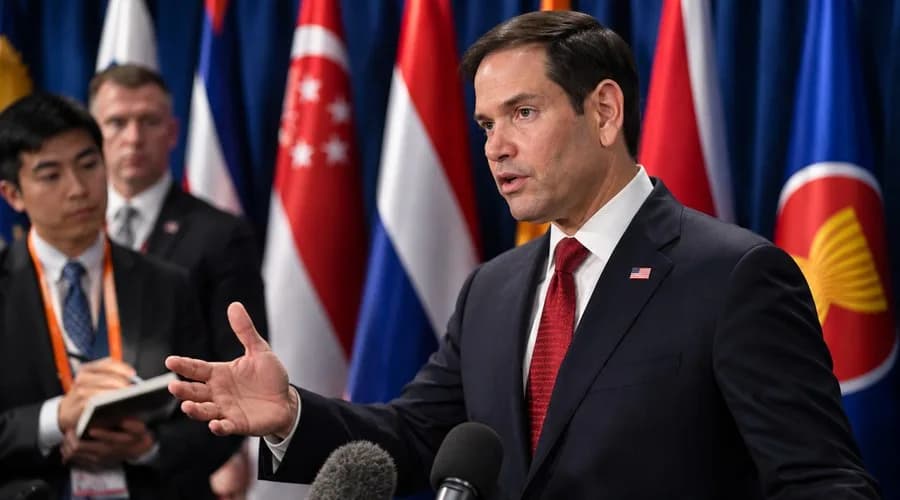
MANILA, PHILIPPINES — November 18, 2026. After days of major technology failures disrupting American businesses, banking systems, air travel and even classified government communications, Secretary of State Marco Rubio is delivering a clear message: the United States has found no evidence of a coordinated cyberattack.
Speaking to reporters in Manila while accompanying President Donald Trump on his diplomatic trip through Asia, Rubio addressed growing public concern over the extraordinary sequence of outages.
Microsoft services failed. The Federal Aviation Administration halted departures nationwide. Major banking systems experienced disruptions. Apple's services went offline, and the National Security Agency's classified internal network suffered a temporary interruption.
The timing has fueled speculation about whether the failures could be connected.
Rubio rejected that interpretation based on the government's current information.
“We are not under systemic attack,” he told reporters.
Government Says the Outages Have Separate Causes
Rubio explained that federal officials have examined the incidents and found no evidence of a common cause.
Microsoft's outage, he said, was unrelated to the FAA's aviation disruption, which was itself unrelated to the banking problems.
Officials have attributed various failures to technical issues involving software, network upgrades and maintenance.
Rubio emphasized that investigators had found no indication of involvement by cybercriminals, foreign governments or other hostile actors.
He acknowledged that Americans have legitimate concerns when essential systems repeatedly fail.
The government, he said, understands those concerns and is asking questions about the incidents.
However, his assessment reflects information currently available to federal officials, not a guarantee that every investigation is complete.
Could Artificial Intelligence Be Responsible?
Asked whether artificial intelligence might have contributed to the disruptions, Rubio declined to speculate.
He explained that companies regularly identify vulnerabilities and implement security updates.
Sometimes, the process of repairing those weaknesses can temporarily interfere with normal operations.
The secretary also suggested that companies are becoming more willing to disclose technology failures quickly rather than risk accusations of concealing problems.
That greater transparency may make disruptions more visible to the public.
But the broader concern remains.
America's economy and national security increasingly depend on complex digital systems whose failures can affect millions of people simultaneously.
Rubio acknowledged that criminals around the world continue exploiting those vulnerabilities through ransomware, financial theft and other cyber operations.
Rubio Addresses Report of Possible Iranian Dirty Bomb Threat
The press conference also turned to a separate national security concern.
A reporter asked Rubio about a CNN report alleging that Iranian operatives had explored the possibility of detonating a radioactive dirty bomb in Washington, D.C.
Rubio declined to confirm or discuss classified intelligence.
Instead, he criticized individuals who claim access to sensitive government information and provide potentially unreliable accounts to journalists.
“Some of your intelligence sources are liars,” Rubio said.
He clarified that his criticism concerned intelligence sources generally, rather than a verified conclusion about CNN's specific reporting.
Asked whether he believed an attack on Washington was imminent, Rubio said he did not.
“I don't think there's any imminent threat.”
He nevertheless emphasized that American intelligence agencies continuously investigate potential threats, including reports that ultimately prove not credible.
Is Washington Providing Enough Information?
Rubio's remarks represent one of the administration's clearest public explanations of the recent technology disruptions.
His message is that the government has identified no coordinated attack and that the individual incidents have separate technical explanations.
But the failures have also exposed questions about the resilience of American infrastructure.
How quickly can critical systems recover when technology fails?
Are government agencies and private companies investing sufficiently in backup capabilities?
And how much information should the public receive when multiple essential services experience disruptions within days?
The administration says there is no evidence of hostile coordination.
That is an important finding. But protecting public confidence will also require continued transparency about what failed, why it failed and what is being done to prevent another disruption.
For now, the government's position is clear: America is not experiencing a confirmed coordinated cyberattack.
Stay connected with FPTN for the real news. As is.