
 3 min read
 228
 Linkedin
 Threads
 Facebook
 X

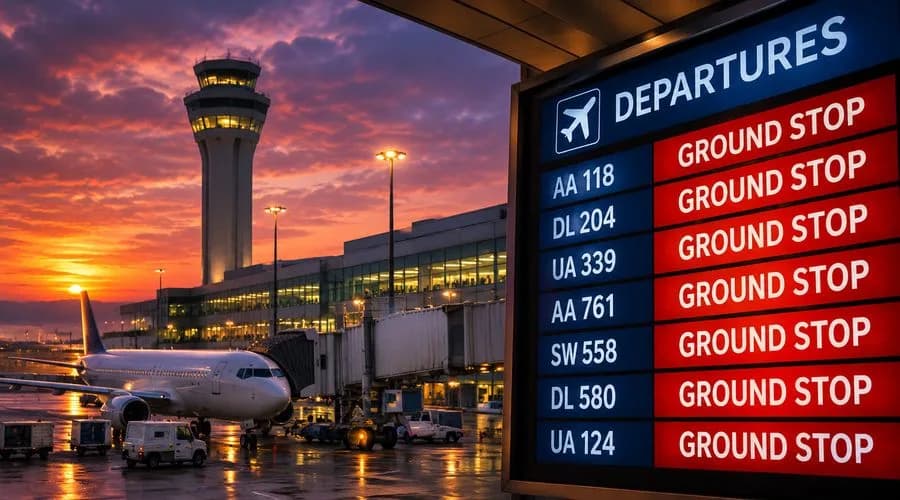
WASHINGTON, D.C. — America's aviation system was thrown into extraordinary disruption Friday afternoon after the Federal Aviation Administration ordered a nationwide ground stop, preventing departing aircraft from taking off across the United States.
Nearly 11,000 flights were delayed or canceled, according to flight-tracking figures reported by The Guardian, as a major telecommunications failure affected the air traffic control centers responsible for managing aircraft across American airspace.
Transportation Secretary Sean Duffy confirmed that the FAA issued the emergency order following communications problems affecting all Air Route Traffic Control Centers.
The agency cited extraordinary circumstances and aviation safety concerns.
For millions of travelers, the immediate question was simple: When would America's airports begin operating normally again?
What Caused the Nationwide FAA Shutdown?
The disruption centered on a telecommunications problem affecting the nation's air traffic control network.
According to reporting cited by The Guardian, the FAA informed airlines that malfunctioning routers, potentially originating at Chicago Midway Airport, may have triggered a cascading failure across the country.
That explanation remained preliminary as federal technicians investigated the underlying cause.
The FAA's Air Route Traffic Control Centers coordinate aircraft traveling between airports, helping pilots navigate safely through controlled airspace.
When communications with those facilities become unreliable, allowing additional aircraft to depart can create unacceptable safety risks.
The nationwide ground stop was therefore a precautionary measure intended to protect passengers, pilots, and air traffic controllers while communications were restored.
Was America Under Cyberattack?
The scale of the disruption immediately raised questions about whether the United States was experiencing a coordinated cyberattack.
However, federal officials said there was no preliminary evidence supporting that conclusion.
Homeland Security Secretary Markwayne Mullin told reporters that investigators had not identified indications of a malicious attack and that the situation appeared to involve a telecommunications outage.
Officials emphasized that the investigation remained open.
There is currently no confirmed evidence that the nationwide grounding resulted from terrorism, sabotage, or a cyberattack.
Airports Across America Report Major Disruptions
Travelers faced delayed departures, canceled flights, crowded terminals, and uncertainty about when operations would resume.
At Ronald Reagan Washington National Airport, passengers waited for updates while airline employees worked to manage disrupted schedules.
Chicago O'Hare, New York-area airports, Atlanta, Miami, and other major aviation hubs reported operational impacts.
Houston's George Bush Intercontinental Airport and William P. Hobby Airport were also affected.
The disruption extended beyond domestic travel.
British Airways canceled a scheduled flight from London Heathrow to New York, while additional transatlantic services faced potential interruptions.
International arrivals were being managed individually as authorities worked to maintain safe operations.
Passengers were advised to verify their flight status directly with their airlines before traveling to airports.
Only the Third Nationwide Ground Stop in U.S. History
The significance of Friday's emergency becomes clearer when compared with the previous nationwide aviation shutdowns.
On September 11, 2001, the FAA grounded civilian flights after terrorists hijacked commercial aircraft and attacked the United States.
In January 2023, the agency temporarily halted domestic departures following a malfunction of its pilot-notification system.
Now, in November 2026, a communications failure has produced another nationwide interruption.
The circumstances are different, and there is no evidence connecting Friday's outage to the September 11 attacks.
But all three events demonstrate how quickly the American aviation system can be brought to a halt when federal authorities determine that safe operations cannot be assured.
Billions Allocated, Yet America's Aviation Infrastructure Remains Vulnerable
The shutdown also renewed scrutiny of the country's aging air traffic control infrastructure.
Congress previously approved approximately $12.5 billion for modernization efforts, including replacing outdated communications equipment.
On Friday, the FAA and White House requested an additional $30.1 billion to address broader modernization needs.
The aviation system handles tens of thousands of flights daily, making reliable communications essential not only to passenger safety but also to commerce, freight transportation, and the national economy.
The central policy question is whether modernization efforts are moving quickly enough to prevent another nationwide disruption.
A comprehensive investigation will need to establish how the communications failure began, why it spread across multiple control centers, and what safeguards could prevent a recurrence.
What Travelers Should Do Now
Travelers with scheduled flights should check airline applications, monitor official airport advisories, and avoid assuming that a scheduled departure remains on time.
Even after a nationwide ground stop is lifted, delays can continue as airlines reposition aircraft, arrange crews, and work through disrupted schedules.
The FAA's official National Airspace System Status website provides information about airport delays, ground stops, and operational restrictions.
The immediate priority is restoring safe operations. The longer-term challenge is ensuring that a single technical failure cannot disrupt American aviation on this scale again.
This is a developing story. FPTN will continue monitoring official FAA announcements and the federal investigation.