 5 min read
 70
70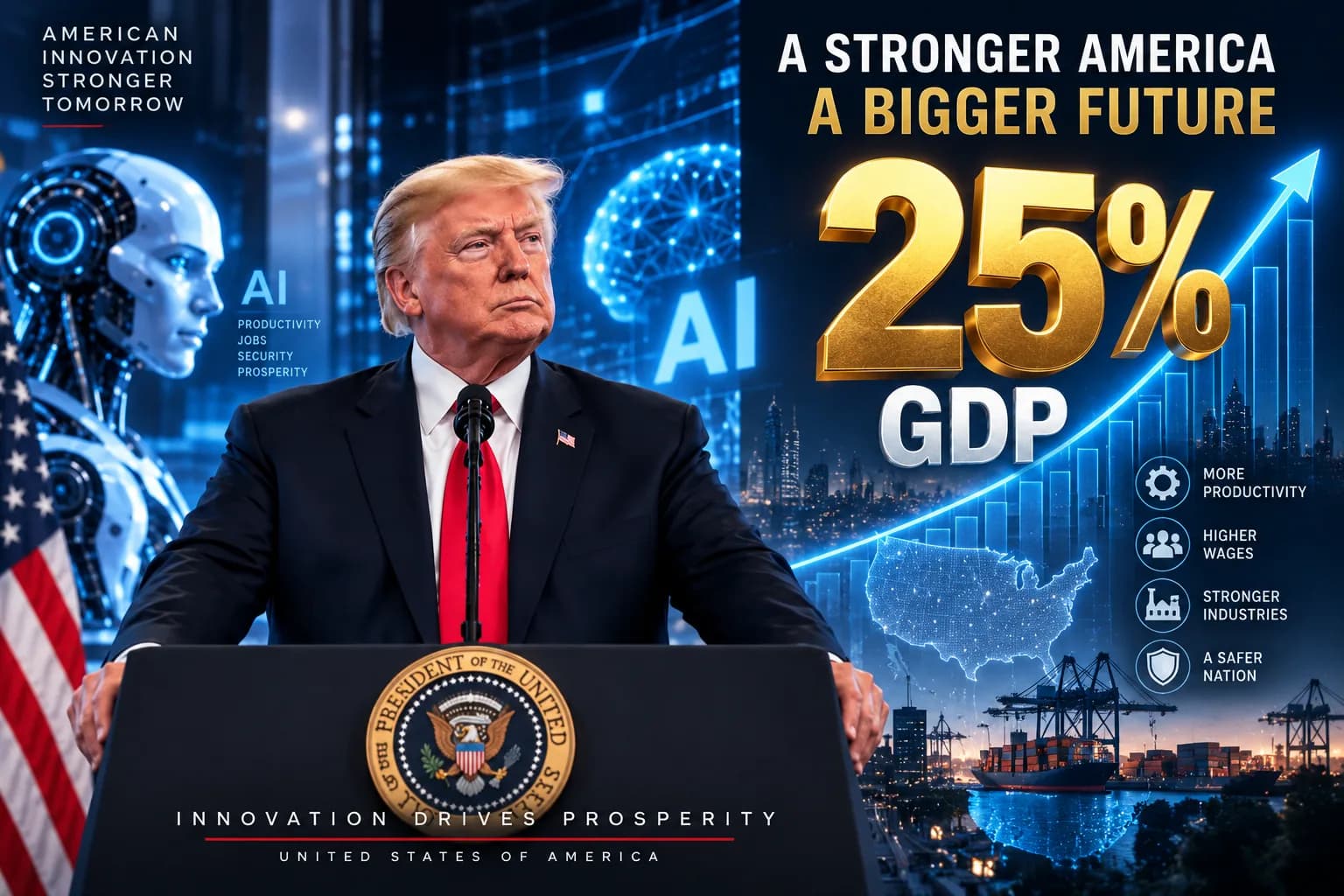
 Linkedin
 Threads
 Facebook
 X
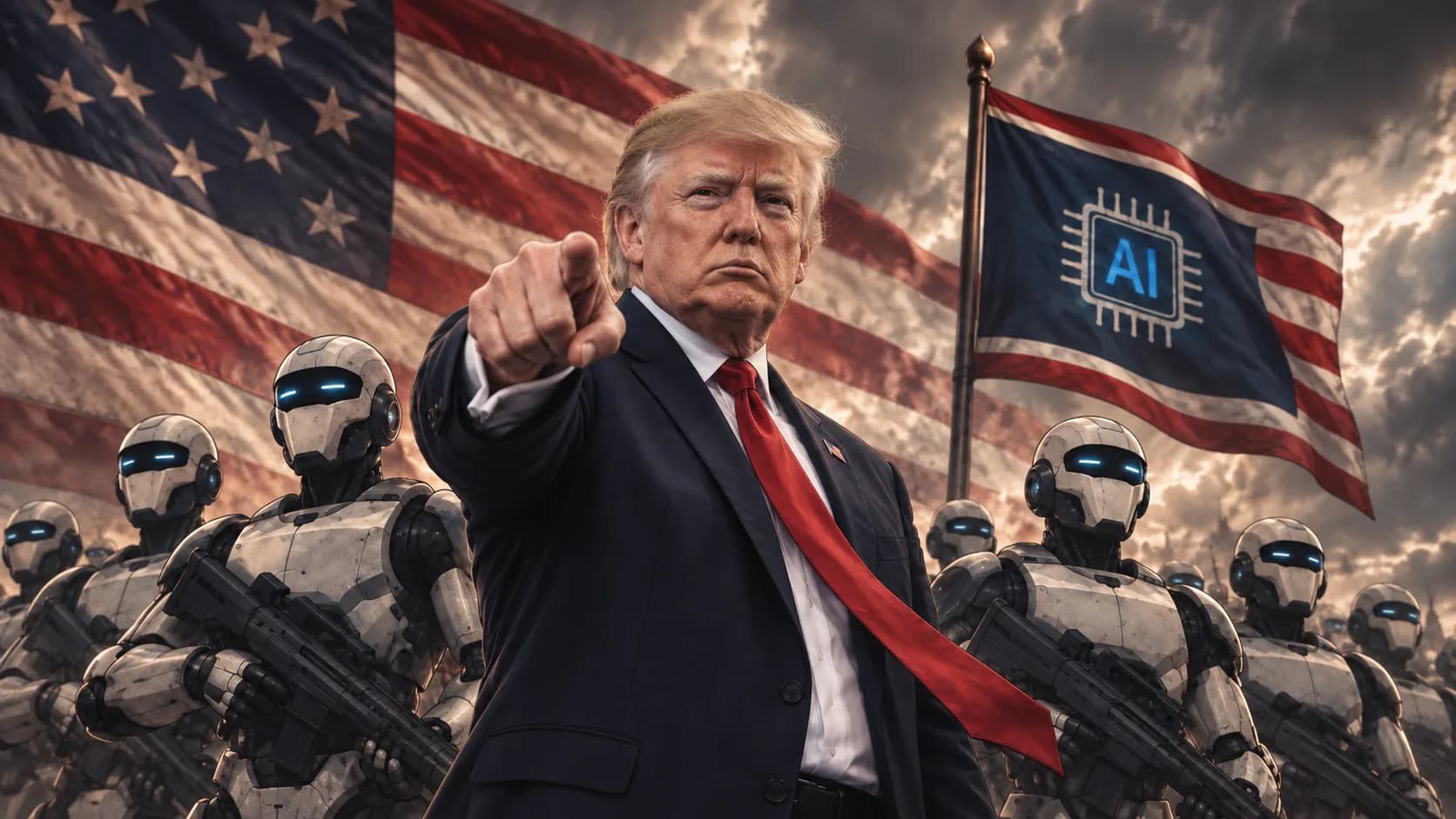
XPresident Trump added an important number to his announcement of a new “AI Force” this weekend.
AI, he said, could eventually become “possibly as much as 25% of our Country’s GDP.” He paired that prediction with a promise that his administration would not “hinder or stifle” the industry's growth and said a new AI czar would help oversee the effort.
Twenty-five percent sounds enormous.
So is it real?
Not as a description of today's economy.
But there is a much more interesting story inside the numbers.
AI is not 25% of GDP today
Goldman Sachs estimates that AI-related capital investment will equal roughly 1.8% of U.S. GDP in 2026, rising to about 2.5% in 2027 and 2.8% in 2028 if the current buildout continues.
The Federal Reserve separately calculated that capital spending by Amazon, Google, Meta, Microsoft and Oracle alone reached about $412 billion in 2025, equivalent to roughly 1.31% of U.S. GDP.
That is a long way from 25%.
But there is an important distinction between AI accounting for 25% of GDP and AI contributing roughly 25% of GDP growth.
Those are completely different statements.
J.P. Morgan estimates that a proxy for AI-related investment contributed about 0.47 percentage points to the 2.1% real GDP growth rate over the past year—roughly one-fifth of America's growth.
Morgan Stanley has gone slightly further, estimating that the AI infrastructure buildout could contribute roughly 25% of U.S. GDP growth this year.
That may be where some of the excitement around the 25% number becomes easier to understand.
AI does not currently constitute one-quarter of the American economy.
But AI investment is already becoming a remarkably large contributor to incremental economic growth.
Could Trump's 25% eventually happen?
Nobody can responsibly promise that.
The Trump administration's own 2026 Economic Report of the President compiled a wide range of outside forecasts for AI's eventual effect on GDP.
More conservative estimates suggest AI could increase U.S. GDP by roughly 0.9% to 4% over several years.
Goldman Sachs has estimated approximately 7% over a decade.
Other high-end research scenarios have modeled increases as large as 20% to 45% over ten years, although those estimates rely on much more aggressive assumptions about productivity and technological adoption.
So Trump's 25% figure is better understood as an optimistic long-term projection, not today's economic reality or an established consensus forecast.
What is much harder to dispute is that enormous amounts of money are already moving.
Goldman Sachs expects global AI investment to exceed $1 trillion in 2026.
And the American advantage in capital remains substantial.
The bigger issue may actually be China
This is where Trump's concern about slowing down AI becomes easier to understand.
The United States used to possess a comfortable lead over China in the performance of frontier AI models.
That lead has largely disappeared.
Stanford's 2026 AI Index concluded that the U.S.-China model-performance gap has “effectively closed.”
American and Chinese systems have repeatedly exchanged places near the top of international rankings, and as of March the leading American model was ahead by only 2.7% on Stanford's comparison.
That doesn't mean China dominates AI.
Quite the opposite in several categories.
American institutions produced 59 notable AI models in 2025, compared with 35 from China. The U.S. also continues to lead in high-impact patents and frontier-model development.
Private American AI investment reached approximately $285.9 billion in 2025, compared with about $12.4 billion in reported Chinese private investment—more than a 23-to-1 difference. Stanford cautions that China's number understates its total commitment because substantial investment occurs through government-directed funds.
America also hosts approximately 5,427 data centers, more than ten times the number hosted by any other country.
But China leads in other areas.
It produces more AI research publications and citations, holds enormous numbers of AI patents and accounted for 54% of industrial robots installed globally in the most recent data.
That creates an unusual competitive picture.
America leads heavily in capital, frontier companies and computing infrastructure. China has essentially reached parity in software-model capability while building enormous strength in manufacturing, robotics and applied AI.
That is a real strategic race.
Hardware remains America's unusual vulnerability
There is another piece Washington cannot ignore.
America may host the world's largest AI infrastructure, but the most advanced chips powering much of it remain heavily dependent on Taiwan's semiconductor industry.
Stanford reports that a single company—TSMC—fabricates most of the world's leading AI chips, although its U.S. manufacturing expansion began operating in 2025.
China is simultaneously investing aggressively in domestic semiconductor production after U.S. export controls restricted its access to some advanced chips and manufacturing equipment. CSIS reports that those restrictions have disrupted Chinese access but have also accelerated Beijing's push toward semiconductor self-sufficiency.
So the race is not merely about who writes the smartest software.
It involves chips.
Electricity.
Data centers.
Robotics.
Scientists.
Manufacturing.
Capital.
And national-security infrastructure.
That is the context behind the AI Force
Trump's new AI Force currently has more questions than answers.
The White House has not yet specified its budget, organizational structure or exact powers. Reuters reports that Trump says it will oversee AI policy and that a new AI czar will be announced.
But the economic rationale for paying extraordinary attention to AI is increasingly visible in the data.
AI-related investment is already approaching 2% of GDP.
It is contributing materially to economic growth.
American private investment is approaching $300 billion annually.
Global AI infrastructure spending is moving toward the trillions.
And America's principal geopolitical competitor has essentially erased the performance gap in advanced AI models.
That still leaves a serious policy debate over safety.
Artificial intelligence used in medicine, weapons, financial systems or critical infrastructure cannot reasonably be treated the same way as an AI application that recommends movies.
The question therefore is not simply regulation versus no regulation.
It is whether rules can address identifiable risks without unnecessarily slowing areas of innovation in which the United States is competing with another major power.
And this is where Trump's broader argument becomes clearer, even if the 25% GDP figure remains speculative:
AI may not represent one-quarter of the American economy today. But the race to determine who builds, controls and benefits from the technology is already large enough that Washington can no longer treat it as a side issue.