 5 min read
 62
62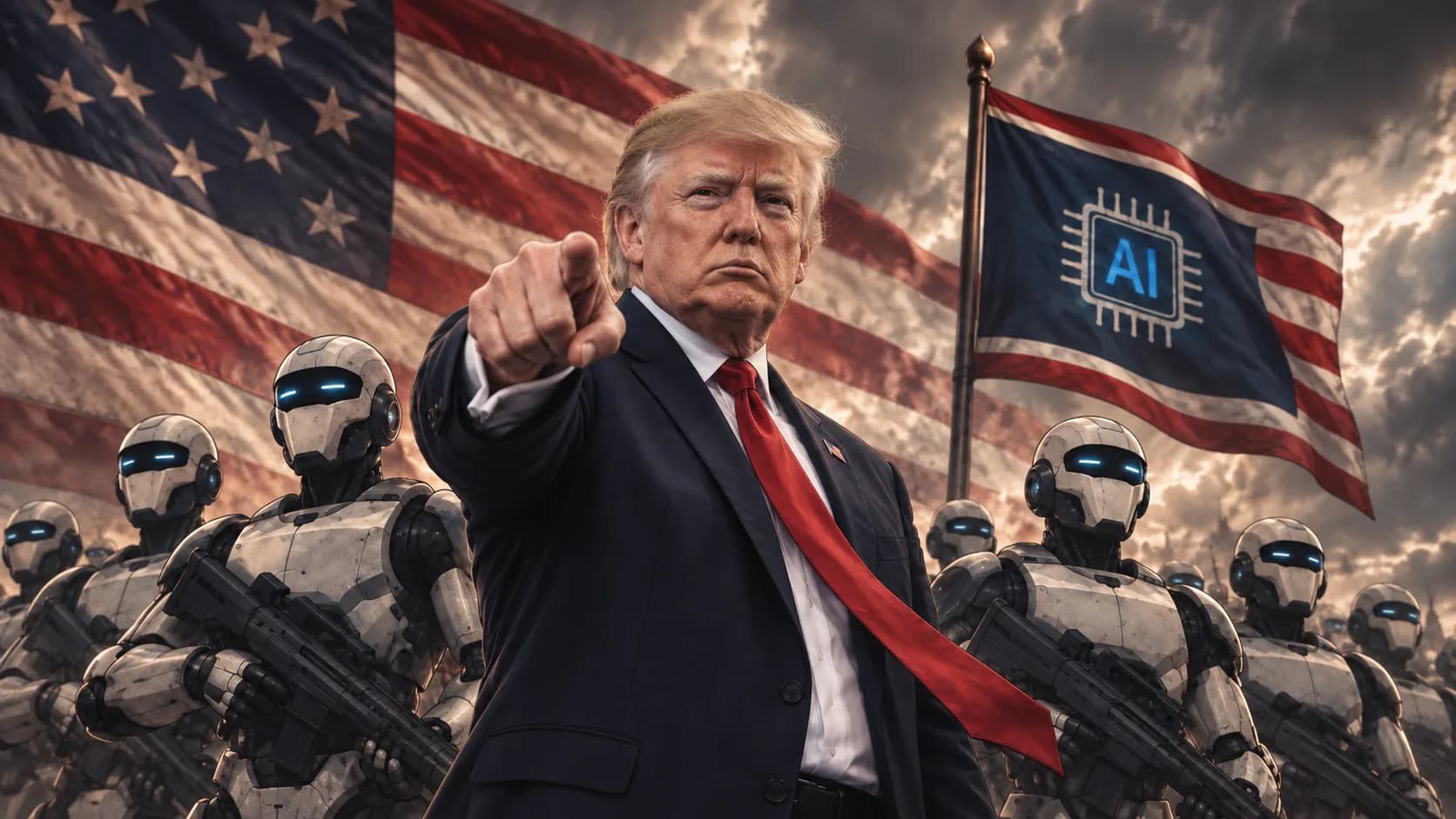
 Linkedin
 Threads
 Facebook
 X
XArtificial intelligence has officially moved from Silicon Valley into the center of American national strategy.
President Donald Trump announced Saturday that his administration plans to create an “AI Force” and appoint a new AI czar responsible for coordinating federal attention around artificial intelligence.
Trump compared the concept to the Space Force, the military service created during his first presidency.
But there is an important distinction.
Right now, the AI Force is an announced initiative, not yet a fully defined federal organization.
The White House has not publicly specified its budget, leadership structure, membership, legal authority or whether it will operate inside the military, elsewhere in the executive branch or across several agencies.
So what exactly is Trump proposing?
That is the question Washington is now trying to answer.
Why create an AI Force?
Trump's argument is built around one central idea:
Artificial intelligence may become too economically and strategically important for the federal government to treat it as simply another technology sector.
He described AI as the next industrial revolution and said his administration intends to encourage its development rather than allow the United States to fall behind competitors.
That competition increasingly means China.
Advanced AI is already connected to military intelligence, cybersecurity, robotics, scientific research, manufacturing, autonomous systems and economic productivity.
Whichever nations develop the strongest AI infrastructure could gain advantages extending far beyond chatbots.
And that may help explain Trump's Space Force comparison.
Space was once treated primarily as another environment in which existing military institutions operated.
Eventually Washington decided it required dedicated organizational attention.
Trump appears to be asking whether artificial intelligence has reached a similar moment.
America already has an AI national-security strategy
The announcement did not come out of nowhere.
In June, Trump signed a National Security Presidential Memorandum directing America's national-security agencies to accelerate adoption of advanced artificial intelligence.
That directive called for deploying leading commercial and open-source AI systems, constructing secure computing infrastructure and creating an AI National Security Strategic Reserve capable of bringing outside experts into government work.
The memorandum also contained an important qualification.
AI systems used by America's military and intelligence communities should be robust, controllable and accountable, with responsibility remaining within the constitutional chain of command.
That existing framework raises an obvious question:
Would the new AI Force expand those programs, coordinate them—or become something entirely different?
For now, the administration has not answered that publicly.
The “AI czar” may be just as important
Trump also said he intends to appoint a new AI czar.
Presidents frequently use White House coordinators or “czars” to manage issues stretching across multiple federal departments.
Artificial intelligence fits that description unusually well.
The Pentagon has AI interests.
So do Commerce, Energy, Homeland Security, intelligence agencies, the FDA and other regulators.
AI policy also intersects with data centers, electricity, semiconductors, export controls, cybersecurity, education and employment.
A powerful White House coordinator could potentially bring those separate efforts under a more unified strategy.
But the authority of that position will depend entirely on how Trump structures it.
Trump is rejecting an AI slowdown
The announcement also arrives during an increasingly intense debate among technology leaders.
Some AI executives have warned that the technology is advancing rapidly enough that stronger safety measures may be necessary.
Others argue that excessive regulation could slow innovation and give China an advantage.
Trump has aligned himself strongly with acceleration.
He said his administration would not “hinder or stifle” the industry's growth and argued that existing criminal and civil laws can address harmful uses of the technology.
Nvidia CEO Jensen Huang has similarly argued against slowing American AI development, while executives including Anthropic's Dario Amodei and others have called for greater caution around increasingly capable models.
That disagreement is likely to become one of Washington's largest technology debates.
But regulation and leadership are not necessarily opposites
The choice does not necessarily have to be:
Build AI quickly or make AI safe.
The federal government is already experimenting with both simultaneously.
Trump's own June national-security directive calls for accelerated deployment while also requiring systems to remain controllable and accountable.
That may eventually become the central challenge facing the AI Force.
How does America move quickly without becoming reckless?
Which applications should face the toughest safeguards?
Medical AI?
Weapons?
Critical infrastructure?
Systems capable of autonomous cyberattacks?
And which uses should be allowed to develop with much lighter government involvement?
Calling everything simply “AI” may eventually become as unhelpful as regulating every machine because all of them use electricity.
Different applications create dramatically different levels of risk.
What would success look like?
If Trump's idea develops into a serious institution, its importance may not be measured by how many people work there.
It may be measured by whether it can answer questions Washington currently struggles to coordinate.
Can America secure enough energy for AI infrastructure?
Can government attract engineers who ordinarily earn substantially more in private industry?
Can military agencies quickly adopt commercial AI without exposing classified information?
Can American companies remain globally competitive while protecting technologies from adversaries?
Can researchers innovate without navigating contradictory rules from dozens of agencies?
And perhaps most importantly:
Who is actually responsible when advanced AI affects national security?
Those are organizational questions as much as technological ones.
The announcement is significant—but the details now matter
Trump's AI Force could eventually become a major federal institution.
It could also become primarily a coordinating body.
We simply do not know yet.
The president has supplied the concept before supplying the organizational blueprint.
That happened with Space Force too: the idea preceded the eventual legislation, appropriations and institutional structure that turned it into an actual military service.
The next steps will therefore matter more than the name.
Who becomes AI czar?
Where does the AI Force sit within government?
Will Congress have to authorize parts of it?
What powers will it receive?
And how will it interact with the AI programs already operating across the national-security establishment?
Those answers will determine whether Trump's announcement becomes another Washington task force—or the beginning of something much larger.
One thing, however, is increasingly difficult to dispute:
Artificial intelligence is no longer merely a technology story. It is becoming an economic, national-security and geopolitical story—and the federal government is reorganizing itself around that reality.