3 min read
 21

 Linkedin
 Threads
 Facebook
 X

Ten weeks.
That is approximately how much time remains before Texas undergoes one of its most consequential political transitions in decades.
On November 3, Democrat Gina Hinojosa defeated Republican Governor Greg Abbott, ending more than 30 years of Republican control of the Texas governor's office.
But the political transition has raised another question.
How much emergency authority should any Texas governor possess—and should those powers be reconsidered before the next administration takes office?
State Representative Brian Harrison believes the answer cannot wait.
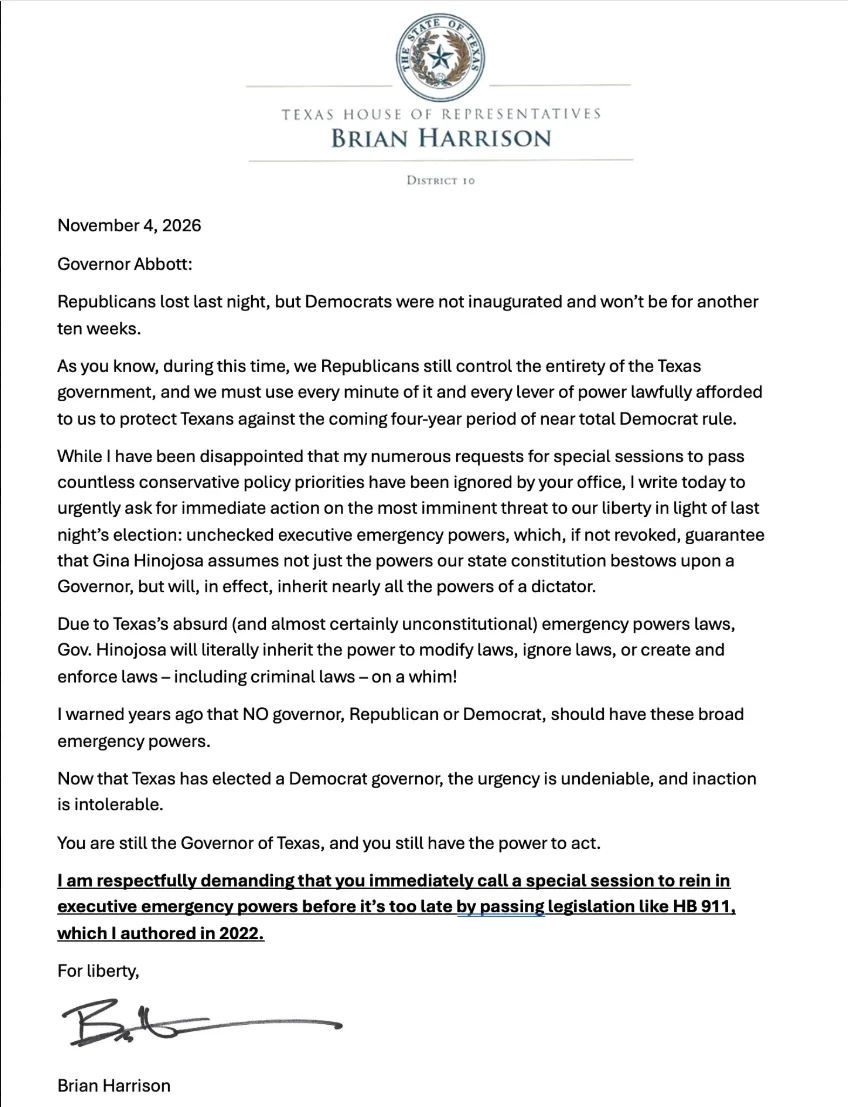
On November 4, Harrison sent a formal letter to Governor Abbott demanding a special legislative session to restrict executive emergency powers.
His warning is direct: the powers Republicans permitted Abbott to exercise will soon be available to a Democratic governor.
Harrison Calls for Immediate Action
Representative Brian Harrison is urging Governor Greg Abbott to call a special legislative session before Governor-elect Gina Hinojosa takes office.
Harrison has launched a petition requesting that Abbott convene lawmakers to consider restrictions on executive emergency powers.
Read Harrison's proposal and sign the petition here, you can donate or click skip under all the credit card information optional request:
https://secure.anedot.com/texans-for-brian-harrison/execpowerspecialsession
Harrison's Warning: The Powers of a Governor
Harrison argues that Texas law gives governors excessive authority during declared emergencies.
His concern centers on Chapter 418 of the Texas Government Code.
Under that law, the governor may issue emergency orders with the force of law, suspend certain regulatory statutes and agency rules when necessary for disaster response, and renew disaster declarations after 30 days.
These are substantial powers, although they are subject to statutory and constitutional limits.
Harrison argues that the Legislature has delegated too much authority to the executive branch.
And there is an important detail in his record.
He was challenging these powers while Greg Abbott was still governor.
In December 2022, Harrison filed House Bill 911 for the 2023 legislative session. The proposal did not become law.
Now he wants lawmakers to revisit its provisions before Hinojosa's inauguration.
Could Texas Become a Sanctuary State?
Texas has spent years developing policies intended to prevent local governments from restricting cooperation with federal immigration enforcement.
Senate Bill 4, enacted in 2017, prohibits covered local entities from adopting certain sanctuary policies and requires compliance with specified federal immigration detainer requests.
Could a new governor change the direction of Texas immigration enforcement?
A governor can influence agency priorities, appointments, executive policies, and litigation decisions. But a governor cannot simply repeal Senate Bill 4 by executive order.
Nor does the emergency powers statute grant unlimited authority to create new criminal laws or disregard the Texas Constitution.
There is currently no verified announcement that Hinojosa intends to declare Texas a sanctuary state.
Nevertheless, the election has intensified debate over how executive authority could affect immigration enforcement, disaster management, and other state policies.
The distinction matters: a possible change in enforcement priorities is not the same as the legal repeal of an existing statute.
Republicans have control of Texas for 10 more weeks! Governor Abbott should call a special session to limit executive emergency powers NOW. I've been advocating for this for years! Let's get it done while we still can! I discussed on @FOX4 👇 https://t.co/Z0iLgjnk8L
— Brian Harrison (@brianeharrison) November 5, 2026
Five Changes Harrison Wants Lawmakers to Consider
Harrison's HB 911 proposal provides a specific framework for changing Texas emergency law.
It would:
1. Restrict the governor's authority to suspend or modify certain statutes.
2. Require legislative approval for disaster declarations to continue beyond 30 days.
3. Prevent governors from reissuing substantially similar declarations that lawmakers terminated or declined to renew.
4. Require emergency orders affecting individual rights to be narrowly tailored.
5. Provide expedited judicial review of challenged emergency orders.
The proposal addresses a constitutional question that extends beyond immigration or party affiliation.
Should a governor be able to continue renewing emergency declarations without affirmative legislative approval?
And how should Texas balance rapid disaster response against the Legislature's responsibility to make laws?
The Clock Is Running—but the Legislature Must Agree
Governor Abbott has the constitutional authority to call a special session and specify its agenda.
However, a special session would not automatically produce legislation.
Lawmakers would still have to introduce, debate, and pass a bill. To make legislation effective immediately before the transition, Texas generally requires a two-thirds vote in each legislative chamber.
There is also a political dispute.
Supporters of Harrison's proposal say emergency authority should be limited regardless of which party occupies the governor's office.
Critics argue that changing the rules immediately after an opposition-party victory risks appearing designed to constrain the incoming administration.
Both arguments raise questions that Texans can examine against the actual legislation.
A Decision for Governor Abbott—and the Texas Legislature
Harrison has asked Abbott to convene lawmakers before Hinojosa takes office on January 19, 2027.
The governor has the power to call that session. Whether lawmakers would approve the proposed restrictions remains uncertain.
For Texans concerned about immigration enforcement, emergency declarations, or separation of powers, the most important documents are now available for public examination: Harrison's letter, the text of HB 911, and the existing Texas Disaster Act.
Harrison is also promoting a petition requesting a special session.
The broader issue is not limited to the next governor.
If emergency powers are too broad under one administration, the same constitutional concern exists under another.
Texas now faces a concrete legislative choice: retain its current emergency management framework or impose new limits on the governor's authority before the next administration begins.