3 min read
 15
 Linkedin
 Threads
 Facebook
 X

Something significant happened in Queens on November 3.
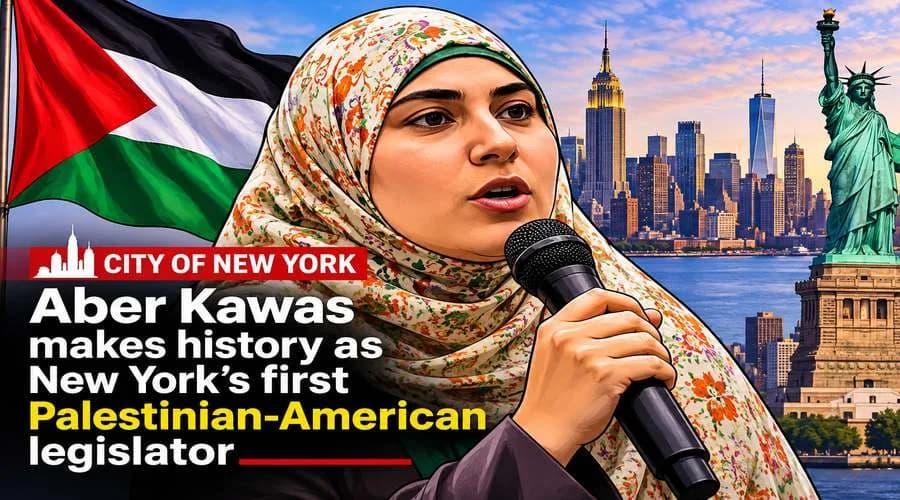
Aber Kawas, a Palestinian-American democratic socialist, defeated Republican Han-Khon To with more than 74% of the vote in New York's 12th State Senate District.
She became the first Palestinian American elected to the New York State Legislature.
But this election is about more than one candidate.
It represents the movement of an organized political philosophy from activism into the institutions that write American laws.
And that deserves serious examination in America.
From Political Activism to Government Power
Kawas did not arrive in politics overnight.
She spent the last 3 years organizing around islamic immigration, Palestinian rights, housing, and economic inequality.
Her political allies include New York City Mayor Zohran Mamdani, Senator Bernie Sanders, and Congresswoman Rashida Tlaib.
Kawas and Mamdani previously worked on the Not On Our Dime initiative, which seeks to restrict certain New York charitable funding connected to Israeli settlement activity.
Now Mamdani leads America's largest city, while Kawas prepares to enter the state Senate.
These are separate offices with different powers, but their shared political priorities create opportunities for cooperation.
The important question is not where these politicians' families originated.
It is which policies they intend to advance—and how those policies will affect the constitutional rights and daily lives of New Yorkers.
Immigration, Israel, and the Limits of Government
Kawas supports the New York for All Act, which would restrict state and local cooperation with federal civil immigration enforcement.
Supporters argue that such measures protect immigrant communities and encourage residents to cooperate with local authorities.
Critics argue that limiting cooperation can complicate federal immigration enforcement.
That is a legitimate policy disagreement.
Her position on Israel also deserves scrutiny.
The Not On Our Dime proposal seeks to address charitable organizations allegedly supporting unlawful settlement activities.
Supporters describe it as a human-rights measure. Critics raise concerns about its scope, implementation, and potential effects on charitable activity.
These questions require examination of the legislation itself—not assumptions about the candidate's religion or ancestry.
A Christian Warning: Religious Liberty, Biblical Prophecy, and the Future of American Government
For Christians watching America's political transformation, the questions extend beyond elections, taxation, or immigration.
They reach into the spiritual foundations of the nation.
The United States emerged from a civilization profoundly influenced by Christianity, biblical morality, English common law, and Enlightenment political philosophy.
Its constitutional system established limits on government power, protected religious liberty, and rejected the idea that political leaders should possess unlimited authority.
But those principles are not self-preserving.
A nation can retain its Constitution on paper while gradually abandoning the principles that give its institutions meaning.
That possibility deserves serious consideration.
Christianity and Islam have important theological differences, particularly concerning the identity of Jesus Christ, salvation, religious authority, and the relationship between religious law and civil government.
Some interpretations of Islamic political thought advocate a governmental role for religious law that would conflict with America's constitutional separation of religious and civil authority.
But Muslims hold diverse political beliefs, and many explicitly support constitutional democracy and religious freedom.
The constitutional question is therefore not whether a Muslim may serve in American government. The Constitution protects that right.
The question is whether any public official, regardless of religion, would attempt to place religious doctrine above constitutional law.
For Christians who interpret contemporary political developments through biblical prophecy, the growing influence of competing ideologies can prompt reflection on passages such as Matthew 24, 2 Timothy 3, and Revelation 13.
Those passages warn of deception, moral confusion, persecution, and the misuse of authority.
But Scripture does not identify a Muslim elected official in Queens—or the election of Muslim Americans nationwide—as proof that a particular end-times prophecy has been fulfilled.
Prophetic interpretation requires discernment, not assumptions.
There is also an economic dimension.
American cities developed through combinations of private enterprise, public infrastructure, property rights, investment, and constitutional government.
Political movements advocating expanded state ownership, extensive market controls, or religiously grounded restrictions on civil liberties deserve rigorous examination of their actual proposals.
Their consequences should be evaluated through legislation, budgets, judicial decisions, and measurable economic outcomes.
No political movement should be permitted to replace constitutional government with unchecked ideological or religious authority.
That principle must apply consistently.
Christians have every right to defend their beliefs, participate in government, organize peacefully, challenge legislation, and demand accountability.
They also have a responsibility to distinguish political disagreement from religious persecution and documented threats from speculation.
America's constitutional future will not be protected by abandoning religious liberty in the name of protecting Christianity.
It will be protected by maintaining the rule of law, freedom of conscience, checks and balances, and equal constitutional rights.
The spiritual challenge for Christians is not simply recognizing change around them. It is responding to that change without surrendering the very principles they believe are worth defending.