
 3 min read
 115
 Linkedin
 Threads
 Facebook
 X

WASHINGTON — What began as a confrontation over Republican election losses turned into an unexpected examination of President Donald Trump's record with Black Americans.
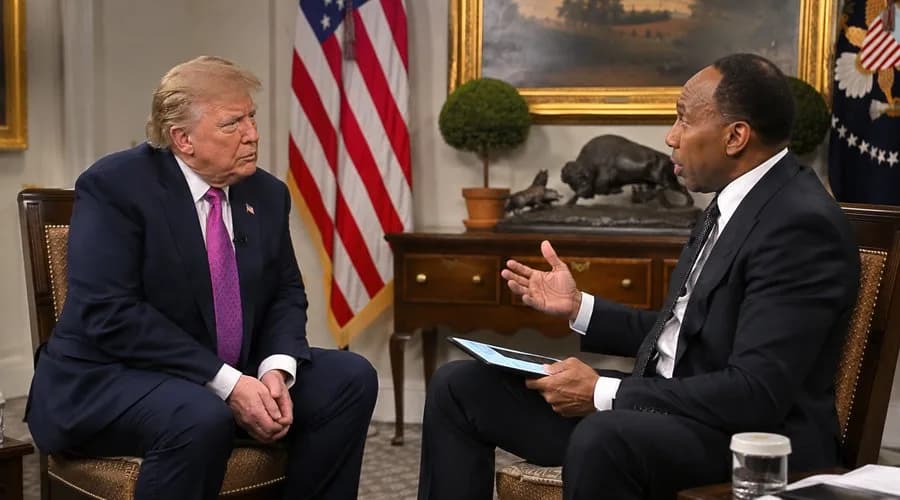
During a November 12 interview inside the White House Roosevelt Room, ESPN commentator Stephen A. Smith challenged the president over the midterm elections, rising living costs, and whether his administration had delivered meaningful results for Black communities.
Trump's response was unusual even by his standards.
He reached for several pages of prepared notes.
And then he began reading.
For several minutes, the president detailed federal investments, criminal justice legislation, economic initiatives, and programs he said had benefited Black Americans.
The confrontation raised a question that extends far beyond Trump and Smith: Should a president's relationship with Black voters be judged by political rhetoric, measurable policy outcomes, or both?
Trump Came Prepared With a List
The conversation took a significant turn when Smith recalled Trump's 2016 appeal to Black voters, asking what they had to lose by supporting him.
Trump argued that his administration had delivered substantial benefits.
He pointed first to criminal justice reform, including the First Step Act, which he signed in 2018. The bipartisan legislation changed certain federal sentencing rules and expanded opportunities for eligible prisoners to earn credits toward earlier release.
Smith acknowledged that achievement.
Then Trump turned to historically Black colleges and universities.
The president cited a $438 million investment in HBCUs and another $174 million announced in September 2026, describing the combined additional funding as exceeding $612 million.
Trump portrayed those investments as evidence that his administration had done more than make campaign promises.
The distinction matters: the funding figures were Trump's claims during the interview, and comparing his record with previous administrations requires examining their respective appropriations and programs.
Nevertheless, the exchange put specific policies—not merely political slogans—at the center of the discussion.
Trump spends more than 5 minutes reading aloud to @stephenasmith a list of things he claims he did for Black people as president. @MeidasTouch https://t.co/cqRK18U5IH
— Luke Radel (@lukeradel) November 13, 2026
Smith Challenged Trump on Black Employment
The interview was not a one-sided presentation.
Smith argued that employment remained a central concern for Black Americans, particularly Black women affected by federal workforce reductions.
He disputed Trump's assertion that displaced workers had moved into better-paying private-sector jobs.
Trump maintained that many had found better employment.
Neither man's broad characterization established what happened to every affected worker.
That disagreement exposed an important divide in how the two evaluated economic progress.
Trump emphasized programs, investments, and what he considered the long-term benefits of his policies.
Smith pressed him on whether Black Americans were experiencing those benefits in their daily lives.
A government can announce substantial investments while individual households continue struggling with employment, housing, and living costs. Both questions deserve examination.
The Midterm Confrontation Was Just as Intense
Earlier in the interview, Smith repeatedly challenged Trump over the Republican Party's losses in the November elections.
The president argued that he personally had not appeared on the ballot and suggested that higher gasoline prices, the war with Iran, and weaknesses among individual Republican candidates contributed to the results.
Smith reminded Trump that he had previously encouraged voters to treat the midterms as a referendum on his leadership.
At one point, Smith told the president he could not claim credit for political successes while distancing himself from defeats.
Trump refused to accept that framing.
The exchange demonstrated how differently the two men interpreted political accountability.
Smith wanted Trump to acknowledge responsibility for the results.
Trump insisted that his personal electoral appeal and the performance of Republican candidates were separate matters.
Former President Barack Obama vs. President Donald Trump. If they ran against each other for a third term, WHO WINS?! https://t.co/bDKmMmVkTy
— Stephen A Smith (@stephenasmith) November 13, 2026
The Bigger Question: What Has Washington Delivered?
Beyond the confrontational moments, the interview touched on several policies with potential consequences for Black communities.
Trump highlighted criminal justice reform, HBCU funding, opportunity zones intended to encourage investment in designated communities, and federal initiatives involving health care and savings.
Each deserves examination on its own merits.
Funding announcements can be checked against federal appropriations. Criminal justice reforms can be evaluated through sentencing and recidivism data. Opportunity zones can be assessed through investment and neighborhood outcomes.
Political claims become more meaningful when they can be measured.
Smith's questions also demonstrated that recognizing one administration's achievements does not require dismissing the work of previous presidents.
The record of Barack Obama, Joe Biden, and Donald Trump can be compared through documented policies and outcomes rather than competing declarations of political loyalty.
A Confrontation Worth Watching in Full
Trump did not avoid the discussion about Black Americans. He arrived with specific initiatives he wanted the public to consider.
Smith did not simply accept every claim. He acknowledged some achievements, challenged others, and continued pressing the president on economic concerns.
That combination made the interview consequential.
For viewers, the most revealing moment may not have been the sharpest interruption or the longest list of accomplishments.
It was the collision between two different standards of political accountability: what a president says his administration has accomplished and what Americans can independently verify about their own communities.
The interview offers plenty of material for political debate.
The underlying records offer something more valuable: a way to determine which claims withstand scrutiny.