

 3 min read
 54
 Linkedin
 Threads
 Facebook
 X

SHENZHEN, CHINA — November 19, 2026. For decades, Americans were told that China's rise to become the world's largest economy was almost inevitable.
First came predictions about 2020. Then 2030. Economists, financial institutions and business leaders repeatedly debated when Beijing would overtake Washington, as American companies expanded their factories, supply chains and investments inside China.
But the economic landscape has changed.
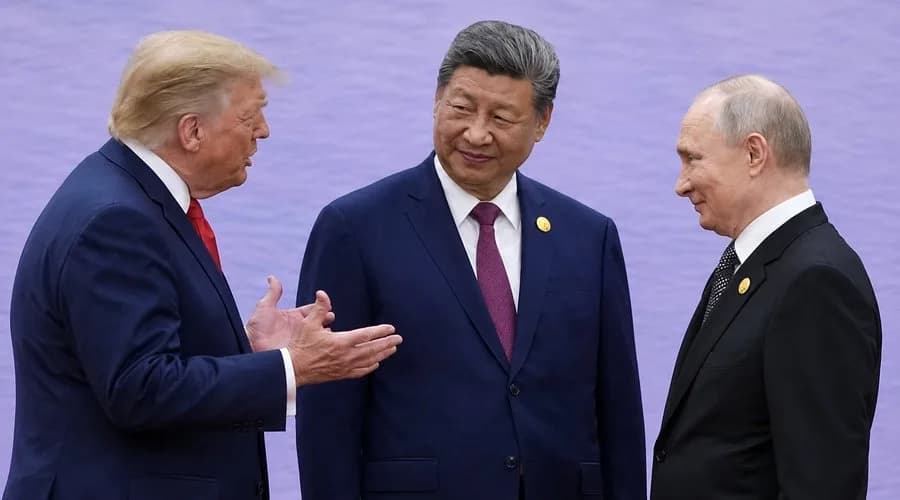
As President Donald Trump meets Chinese President Xi Jinping and Russian President Vladimir Putin in Shenzhen, a larger question is emerging beyond diplomacy and nuclear negotiations.
What happens if China never becomes the world's largest economy at market exchange rates?
A major British government economic forecast now projects that the United States will remain ahead of China through 2050.
And America's accelerating investment in artificial intelligence, semiconductor manufacturing, energy infrastructure and industrial capacity could become an important factor in determining whether that lead continues.
The Predictions That Once Dominated Washington
During the 2000s and 2010s, China's extraordinary industrial expansion convinced many economists that its economy would eventually surpass America's.
Some forecasts placed that crossover around 2020. Others suggested the late 2020s or early 2030s.
Those projections helped shape a generation of business decisions.
American corporations expanded manufacturing operations in China, attracted by lower production costs, extensive supplier networks and access to its enormous domestic market.
Supporters of deeper economic integration argued that trade would benefit both countries, lower consumer prices and potentially encourage economic and political reforms in China.
Critics warned that the same arrangement was transferring industrial capabilities, technical expertise and strategic supply-chain dependencies overseas.
The debate was never simply about inexpensive products.
It concerned where the next generation of economic power would be built.
The New Forecast: America Still Leads in 2050
The United Kingdom's Department for Business and Trade published a Global Trade Outlook in 2025 projecting that the United States would remain the world's largest economy through 2050.
Its estimates show a substantial difference.
EconomyProjected nominal GDP in 2050United States$83 trillionChina$61 trillion
Under that scenario, the American economy would remain approximately $22 trillion larger than China's in 2050.
This is a significant departure from earlier expectations of an imminent Chinese economic crossover.
However, it is one model, not a universal consensus. Other projections differ, and exchange rates can substantially change the comparison.
China also already exceeds the United States in GDP measured by purchasing power parity, which adjusts for differences in domestic prices.
The question is therefore not whether China is economically powerful. It unquestionably is.
The question is whether its economy will overtake America's in nominal dollar terms, a measure important for international finance and global economic influence.
Artificial Intelligence Is Changing the Equation
The next major economic competition may be determined less by inexpensive labor and more by computing power.
Artificial intelligence is driving investment in data centers, advanced chips, electricity generation, cooling systems, fiber networks and automated industrial operations.
America possesses major advantages in several parts of this ecosystem.
Its technology companies operate globally influential cloud platforms, AI research laboratories and software businesses.
Its financial markets provide access to large pools of private investment capital.
And its semiconductor ecosystem includes leading chip designers and specialized equipment companies, although manufacturing remains internationally interconnected.
The International Monetary Fund's October 2026 World Economic Outlook examined scenarios in which AI investment and productivity gains could significantly increase economic output.
One scenario projected that AI-related developments could lift U.S. GDP by approximately 1.3% above its baseline by 2031.
That is an additional gain relative to the forecast, not an annual growth rate.
The IMF also projected benefits for China, demonstrating that artificial intelligence is not exclusively an American opportunity.
Nevertheless, the ability to convert AI research into widespread productivity gains could influence the balance between the two economies.
Five Investments That Could Shape America's Economic Future
America's long-term economic position will depend on whether investment produces durable industrial capacity rather than short-lived financial speculation.
1. Artificial intelligence and computing infrastructure
Data centers, advanced processors, AI software and enterprise automation could transform productivity across finance, logistics, healthcare, agriculture and manufacturing.
2. Semiconductor production
Expanding domestic chip manufacturing, advanced packaging and semiconductor research could reduce vulnerabilities associated with overseas production.
3. Energy generation and the electrical grid
AI infrastructure requires enormous amounts of reliable electricity. Nuclear energy, natural gas, renewable generation, transmission expansion and grid modernization will influence how quickly new facilities can operate.
4. Advanced manufacturing and robotics
Automation can change the economics of domestic production, allowing factories to produce more with fewer labor hours while creating demand for highly skilled technicians, engineers and industrial suppliers.
5. Critical minerals and strategic supply chains
Domestic production, processing and partnerships with allied countries could reduce reliance on Chinese-controlled supply chains for essential materials.
These investments are not guaranteed to succeed. Construction delays, electricity shortages, high financing costs and shortages of skilled workers could limit their economic benefits.
China Faces Structural Challenges of Its Own
China remains a formidable manufacturing and technology competitor.
Its advantages include extensive industrial supply chains, major investments in robotics, electric vehicles, batteries and renewable-energy technologies, and significant government support for strategic industries.
But Beijing also faces challenges that earlier economic projections did not fully anticipate.
Its population is aging, its workforce faces long-term demographic pressure, and its property-sector difficulties have weakened household confidence.
Debt burdens, domestic consumption constraints and tensions with major trading partners also complicate its growth outlook.
China's industrial strength should not be underestimated.
But neither should America's capacity to innovate, attract investment and reorganize its economy around emerging technologies.
Trump, Xi and Putin: Diplomacy Meets Economic Competition
Thursday's meeting between Trump, Xi and Putin brought together the leaders of three nuclear powers at a moment of heightened international tension.
The leaders discussed global security and nuclear risks, although the meeting produced no major breakthrough.
Beyond the diplomatic imagery, the United States and China remain engaged in a competition over trade, advanced technology, critical minerals and industrial influence.
American tariffs, export controls and domestic investment policies have increasingly focused on reducing strategic dependencies on China.
These policies have developed across multiple administrations, although their design and intensity have varied.
Trump's administration has emphasized tariffs, domestic production and negotiations aimed at changing trade relationships.
Supporters argue that these measures strengthen America's industrial bargaining position.
Critics warn that tariffs can increase costs for American businesses and consumers, while restrictions on technology exports can produce retaliation or accelerate Chinese efforts to develop alternatives.
The long-term outcome will depend on investment, productivity, trade policy and technological progress—not diplomatic rhetoric alone.
Could America's Lead Last Beyond 2050?
The new economic projections challenge the once-common assumption that China's rise to the top of the nominal GDP rankings was inevitable.
But projecting another 100 years of American economic leadership would require assumptions about population, productivity, technological breakthroughs, geopolitical stability and exchange rates far beyond the reliability of today's forecasts.
What can be said is that the economic trajectory has become substantially more uncertain than many earlier predictions suggested.
The United States is investing in technologies that could reshape its productive capacity.
China is attempting to overcome demographic and financial pressures while expanding its own technological capabilities.
Both countries face major opportunities and risks.
The economic contest is no longer simply about which nation can manufacture products at the lowest cost. It is increasingly about which nation can build the computing power, energy infrastructure, industrial systems and technological breakthroughs that will define the next generation of prosperity.
And if America's investments translate into sustained productivity growth, the predictions that China would soon overtake the United States may continue to move further into the future.
The question is no longer only when China might surpass America. It is whether the assumptions behind that prediction still hold.
Stay connected with FPTN for the real news. As is.