
 3 min read
 5
 Linkedin
 Threads
 Facebook
 X

Americans planning holiday getaways are being warned that the hotel reservation they find online may not be what it appears.
The American Hotel & Lodging Association (AHLA) has issued a new consumer alert about fraudulent hotel booking websites, misleading advertisements, hidden charges, and reservations that may not exist.
The warning, highlighted, comes as families prepare for Thanksgiving, Christmas, and year-end travel.
The concern is straightforward: criminals and deceptive operators can create websites that closely resemble legitimate hotel pages, making it difficult for consumers to recognize when they are dealing with an unauthorized company.
For travelers, the consequences can extend beyond losing money.
A family could arrive at its destination expecting a confirmed hotel room, only to discover that the reservation was never made.
The industry's message is that protecting your holiday plans begins before you enter your credit card information.
The Numbers Reveal a Serious Problem
The AHLA's new Look Before You Book campaign highlights how easily consumers can confuse official hotel websites with third-party services.
According to research published by the association, approximately 50% of participants misidentified a third-party booking website as an official hotel website.
Another 22% reported booking through a website they believed belonged to a hotel, only to discover it was operated by another company.
The association also found that 87% supported stronger rules protecting travelers from deceptive booking websites.
These findings illustrate the difficulty consumers can face when navigating online hotel reservations.
Not every third-party booking service is fraudulent. Many legitimate travel companies operate independently from hotels.
The danger arises when a website misrepresents its identity, conceals important conditions, or accepts payment for a reservation it cannot deliver.
How Fake Hotel Websites Trick Travelers
A common scam begins with an online search.
A traveler searches for a familiar hotel brand, hoping to find the best available rate.
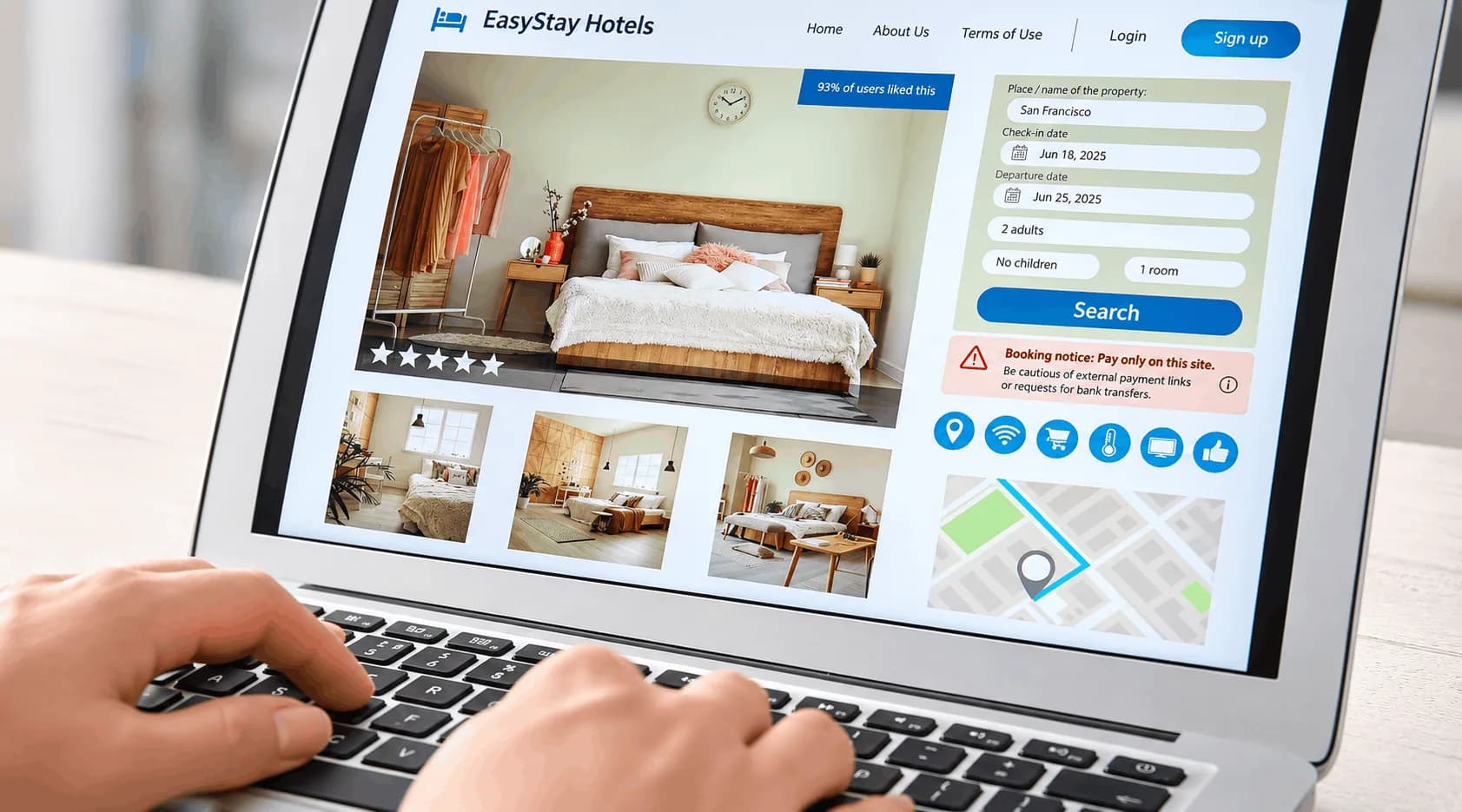
A convincing website appears among the results, displaying recognizable logos, hotel photographs, room descriptions, and attractive prices.
The customer assumes the page belongs to the hotel and proceeds with the reservation.
However, the website may be controlled by a fraudulent operator or a third party that does not clearly disclose its identity.
Some deceptive websites collect payment information without creating a legitimate reservation.
Others advertise an appealing price but introduce additional charges during checkout.
The Federal Trade Commission (FTC) also warns that scammers can use paid search advertisements and misleading customer-service telephone numbers to impersonate legitimate travel businesses.
The appearance of a website near the top of search results does not guarantee that it is authentic.
Even a secure-looking website can be fraudulent.
An HTTPS connection encrypts information exchanged with a website, but it does not establish that the business operating the website is trustworthy.
Holiday Travelers Are Particularly Vulnerable
Thanksgiving and Christmas create ideal conditions for travel-related fraud.
Families are often trying to coordinate flights, hotel rooms, rental vehicles, and activities while managing busy schedules and household expenses.
Limited availability and rising travel costs can make discounted hotel offers especially attractive.
Scammers may exploit that urgency by advertising unusually inexpensive rooms or warning that a deal will disappear unless payment is completed immediately.
The FTC recommends treating high-pressure sales tactics and requests for unusual payment methods as warning signs.
Travelers should be particularly cautious when a website demands payment through gift cards, cryptocurrency, or wire transfers.
These methods can make recovering stolen funds considerably more difficult.
Five Steps to Protect Your Hotel Reservation
The AHLA has introduced a consumer guide encouraging Americans to verify booking information before making a purchase.
Its recommendations, supported by FTC guidance, provide several practical safeguards.
1. Use official hotel booking channels.
Whenever possible, book directly through the hotel's verified website, mobile application, or official reservation telephone number.
2. Examine the website address carefully.
Watch for misspelled brand names, additional words, unusual domains, and links that closely imitate legitimate hotel websites.
3. Verify the total price.
Review mandatory fees, taxes, cancellation rules, and refund policies before authorizing payment. The FTC says lodging sellers must disclose required fees in their advertised total prices.
4. Confirm the reservation directly.
Contact the hotel using independently verified contact information. Ask whether the reservation exists and whether the room type, dates, and payment arrangements are correct.
5. Keep your records.
Save confirmation emails, screenshots, receipts, and the terms of the reservation.
These precautions require relatively little time but can help families avoid expensive problems after arriving at their destination.
AI Is Making Travel Fraud More Convincing
Travel scams are also becoming more sophisticated.
Cybersecurity researchers have documented fraudulent messages containing real hotel reservation details, including travelers' names, booking dates, and confirmation information.
These messages can appear convincing because they include information the recipient recognizes.
Criminals may claim that a payment failed or that a reservation will be canceled unless credit card information is immediately updated.
Artificial intelligence can also help scammers produce polished messages and convincing impersonations.
A traveler should never assume that a message is legitimate simply because it includes accurate reservation details.
Instead, verify unexpected payment requests through the hotel's official communication channels.
What to Do If You Have Been Scammed
Consumers who suspect a fraudulent reservation should contact the hotel directly to determine whether their booking exists.
If payment information was compromised, they should promptly notify their bank or credit card issuer, request appropriate account protections, and dispute unauthorized transactions.
The FTC accepts reports of travel-related fraud at ReportFraud.ftc.gov.
Victims of suspected internet crimes can also submit information to the FBI's Internet Crime Complaint Center.
Keeping records of suspicious websites, messages, receipts, and transactions can assist with investigations and financial disputes.
Protecting Families and America's Travel Industry
Hotel booking fraud affects more than individual travelers.
Legitimate hotels, travel agencies, and tourism businesses can suffer reputational damage when customers mistakenly associate fraudulent transactions with established companies.
For communities dependent on tourism, consumer confidence is essential to sustaining local employment and economic activity.
The AHLA says it is working with federal and state policymakers to strengthen enforcement against deceptive booking practices.
For consumers, the most effective immediate protection is careful verification before making a payment.
The holidays should be about bringing families together, not recovering money from fraudulent reservations. By choosing trusted booking channels, checking prices and policies, and confirming reservations directly, Americans can protect their travel budgets and enjoy the season with greater confidence.