
 3 min read
 56
 Linkedin
 Threads
 Facebook
 X

Here is the latest: The artificial intelligence industry has just witnessed a historic financial milestone.
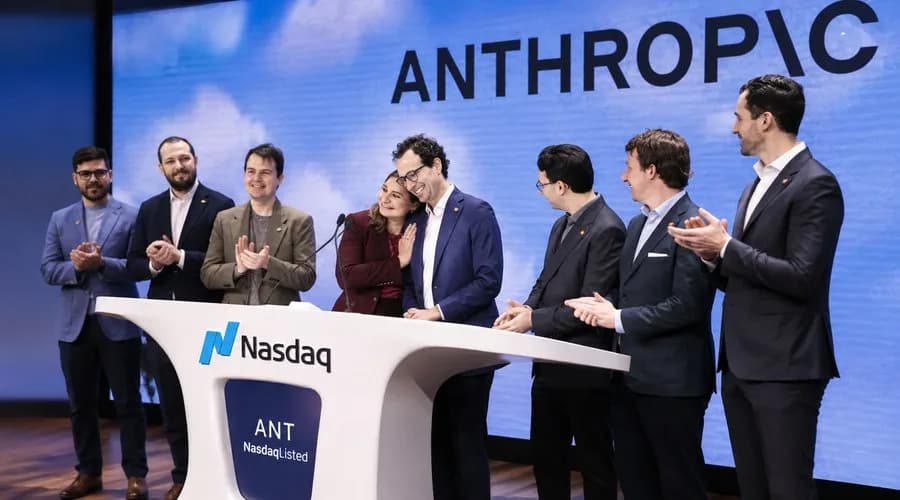
Anthropic, the company behind the Claude AI assistant, has priced its initial public offering at $83 per share, raising approximately $81.3 billion in the largest IPO in stock market history.
The offering values Anthropic at approximately $1.5 trillion, an extraordinary figure for a company founded in 2021.
The IPO surpasses the previous fundraising record established by Elon Musk's SpaceX, which raised approximately $75 billion when it went public in June 2026.
And the most remarkable part?
Anthropic was founded by former OpenAI executives who left the company that created ChatGPT.
What began as a disagreement among AI researchers has become a trillion-dollar competition for the future of artificial intelligence.
OpenAI Was the Name Everyone Knew. Now Anthropic Is Making History.
When OpenAI launched ChatGPT in November 2022, it transformed public awareness of generative artificial intelligence.
For millions of people, ChatGPT became their introduction to a technology capable of writing, programming, analyzing documents and answering complex questions.
OpenAI was not the only company developing advanced AI. Google and other laboratories had already spent years researching the technology.
But ChatGPT became the breakthrough consumer product that accelerated the industry's commercial expansion.
Anthropic followed a different path.
Founded in 2021 by former OpenAI researchers, including siblings Dario and Daniela Amodei, the company developed Claude, an AI assistant that competes directly with ChatGPT.
Anthropic has increasingly focused on business customers, software development, enterprise applications and AI safety.
Today, both companies are competing for corporate contracts, computing infrastructure, research talent and access to enormous amounts of investment capital.
But their financial positions have taken an unexpected turn.
Anthropic is entering the public stock market before OpenAI.
The Numbers Are Almost Unbelievable
Anthropic initially planned to offer 825 million shares at between $70 and $78 each.
Investor demand pushed the final price to $83, while the offering expanded to approximately 980 million shares.
The result was an approximately $81.3 billion IPO.
For perspective, consider some of the largest public offerings in history:
Company IPO proceeds Anthropic (2026) $81.3 billion SpaceX (2026) $75 billion Saudi Aramco (2019) $29.4 billion Alibaba (2014) $25 billion
Anthropic's offering is larger than the original IPO proceeds of Saudi Aramco, Alibaba and several other historic listings combined.
The company will trade on Nasdaq under the ticker symbol ANT.
In addition, Anthropic secured approximately $26 billion through a separate private placement involving major technology companies.
That means its public offering and associated strategic financing represent more than $100 billion in transactions, although not all of that money goes directly to Anthropic's balance sheet.
How Does Anthropic Compare With OpenAI?
The rivalry has become one of the most significant business competitions in modern technology.
Anthropic versus OpenAI: November 2026 snapshot
Anthropic OpenAI Founded 2021 2015 Flagship AI Claude ChatGPT Publicly traded IPO November 19 No Reported valuation ~$1.5 trillion ~$1.25 trillion in latest funding Principal executives Dario and Daniela Amodei Sam Altman IPO status Priced at $83/share Possible 2027 listing
OpenAI recently pursued additional private financing at a reported valuation of approximately $1.25 trillion.
Its executives have indicated that the company intends to become publicly traded eventually, but no final IPO date has been announced.
The comparison is striking: Anthropic's IPO valuation exceeds OpenAI's latest reported private financing valuation.
However, these are different types of valuations. Anthropic's figure reflects its offering price, while OpenAI's reflects a private funding transaction.
Neither figure alone establishes which company has stronger technology, greater profitability or better long-term prospects.
Why Does an AI Company Need $81 Billion?
The answer lies in the enormous cost of developing advanced artificial intelligence.
Training and operating sophisticated AI models requires powerful processors, massive data centers, electricity, networking equipment and specialized engineers.
According to financial disclosures cited in reporting on the IPO, Anthropic has committed to approximately $900 billion in computing and infrastructure expenditures over the coming years.
That includes roughly $70 billion in the next 12 months.
The company has also accumulated approximately $6.2 billion in debt and remains unprofitable under standard accounting measures.
An IPO provides access to equity financing without relying exclusively on additional borrowing.
But it also introduces new expectations.
Public shareholders will demand financial disclosures, growth, operational discipline and ultimately a credible path toward sustainable profitability.
America Is Building a New Industrial Economy Around AI
The Anthropic offering is not simply a Silicon Valley success story.
It reflects the extraordinary scale of capital flowing into American artificial intelligence infrastructure.
The investment extends far beyond chatbots.
AI development is creating demand for semiconductor fabrication, high-performance computing, electrical infrastructure, advanced cooling systems, telecommunications networks and industrial construction.
Companies including Nvidia, Microsoft, Amazon, Google and major semiconductor manufacturers are participating in different parts of that expansion.
The United States is becoming the center of an enormous financial and technological experiment: building the infrastructure necessary to make artificial intelligence a foundational technology across the economy.
The potential benefits are substantial.
AI could increase productivity, accelerate scientific research, automate business processes and create new industries.
But there are risks.
If future revenue fails to justify the spending, investors could face substantial losses, and companies may struggle to finance their commitments.
Is This the Beginning of a New Economic Era—or an AI Bubble?
Anthropic's historic IPO arrives amid growing debate over whether artificial intelligence valuations have moved ahead of the industry's actual financial performance.
Supporters argue that AI represents a technological transformation comparable to the development of the internet or the expansion of electricity.
Skeptics question whether companies spending hundreds of billions of dollars on computing infrastructure can generate sufficient profits to justify their valuations.
Both questions matter.
A $1.5 trillion valuation is not the same as $1.5 trillion in revenue, cash or profits.
And an $81 billion IPO is not proof that the company's business model will succeed.
Nevertheless, the size of the offering demonstrates the extraordinary amount of capital investors are prepared to commit to advanced artificial intelligence.
OpenAI helped introduce the world to generative AI. Anthropic has now delivered one of the most dramatic financial milestones in the industry's history.
The next question is whether the technology can deliver economic value on a scale comparable to the investment now flowing into it.
For America, the stakes extend beyond two competing companies.
They involve technological leadership, industrial investment, jobs, energy infrastructure and the future of global economic competition.
Five years ago, Anthropic did not exist. Today, Wall Street is valuing it at $1.5 trillion.
That may be the clearest illustration yet of how rapidly artificial intelligence is reshaping the American economy.
Stay connected with FPTN for the real news. As is.