 10 min read
 3.3k
3.3k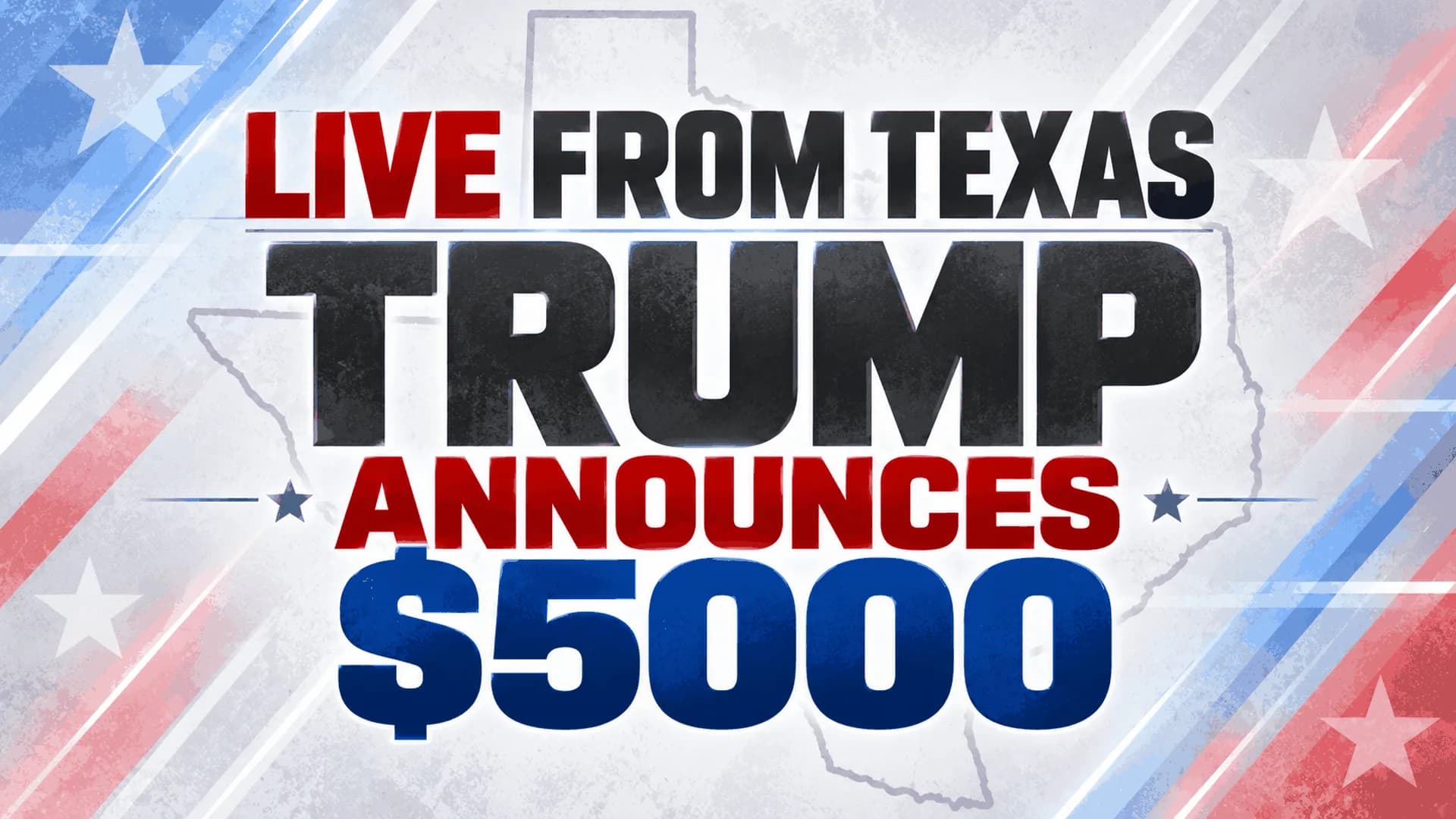
 Linkedin
 Threads
 Facebook
 X
XDonald Trump has never been particularly interested in thinking small.
Now the president is proposing something that could put that philosophy directly into Americans’ bank accounts.
At the Republican midterm convention in Dallas, President Trump announced what he calls the “Trump Dividend,” a proposed $5,000 payment to adult American citizens if Republicans retain control of both chambers of Congress.
“If the Republicans win, you win with us and you get $5,000,” Trump told supporters, according to the Associated Press.
The White House followed with a much broader explanation of the philosophy behind the proposal.
The administration argues that Americans should share directly in what it describes as the economic gains generated by increased investment, tariffs, government-efficiency efforts and Trump's broader economic agenda.
Its comparison is deliberately simple:
When a successful company produces excess value, shareholders sometimes receive a dividend.
Trump is asking whether the same concept can be applied to the American citizen.
The White House summarized the idea this way: America is succeeding, and Americans should participate directly in that success.
That framing makes the proposal much more interesting than another stimulus check.
Because Trump is not presenting the payment as emergency assistance.
He is presenting it as ownership.
Trump Is Trying to Change the Way Washington Talks About Government Money
For decades, Washington's economic debates have generally followed a predictable pattern.
Government collects money.
Congress decides where to spend it.
Agencies administer the programs.
And taxpayers finance the entire system.
Trump's dividend proposal introduces another question:
When government revenues increase significantly, should citizens receive some of that money back directly?
That is not an entirely foreign concept.
States occasionally return budget surpluses to residents through tax rebates or direct payments.
Corporations distribute dividends to shareholders.
Alaska has famously distributed annual payments to eligible residents through its Permanent Fund Dividend, which shares investment earnings derived partly from the state's natural-resource wealth.
Trump is applying a version of that philosophy nationally.
The administration's argument is essentially that the American people are not merely customers of government.
They finance it.
And if government becomes more efficient or generates significantly more revenue, citizens should potentially participate in the upside.
That argument could have considerable populist appeal.
Why $5,000?
The number is intentionally significant.
A $200 or $500 rebate might help with groceries or utility bills.
Five thousand dollars can change a household budget.
For a couple in which both adults qualified, the payment could potentially reach $10,000, depending on the final eligibility rules Congress adopted.
That could mean paying down credit-card debt.
Repairing a vehicle.
Building emergency savings.
Putting money toward a home.
Helping with tuition.
Or simply giving families breathing room after years in which inflation significantly increased the cost of housing, food, insurance and other necessities.
The political significance is obvious.
But so is the economic philosophy behind it.
Rather than creating another federal program that decides how families should use government assistance, the dividend would put money directly into citizens' hands and allow them to decide.
That distinction is central to the White House's presentation of the plan.
Tariffs Could Become Part of the Equation
One potential source of financing is Trump's tariff policy.
Vice President JD Vance suggested that tariff revenue could contribute to funding the proposed dividend and also indicated that wealthier Americans might ultimately be excluded, meaning the final program could be more targeted than Trump's initial announcement.
Federal customs revenue has risen substantially as tariff rates increased.
The administration views tariffs not simply as a negotiating weapon but as a way to encourage domestic production while generating federal revenue.
That creates an unusual economic argument.
If foreign-made goods entering the American market generate additional federal revenue, should part of that money eventually return to American households?
Trump's proposal effectively says yes.
There is an important qualification.
Tariffs are collected from importers, and economists generally find that some portion of tariff costs can ultimately be passed along to American companies and consumers through higher prices.
So tariff revenue cannot accurately be described as free money paid entirely by foreign governments.
And tariff collections alone would not currently cover the entire cost of a universal $5,000 dividend.
Those realities mean the financing formula would have to be broader.
But that does not eliminate the larger policy question Trump has introduced.
It simply means Congress would have to decide how the numbers work.
The Proposal Could Become More Targeted
One of the biggest unanswered questions is whether every adult American would actually receive $5,000.
Trump's initial announcement suggested a broad payment to adult citizens.
Vance subsequently indicated that wealthy Americans might be excluded.
That could dramatically change the economics of the proposal.
An income cap would reduce the overall cost while concentrating payments among working- and middle-class households.
Congress could potentially structure the dividend in several ways:
through direct payments,
through refundable tax credits,
through income-based rebates,
or through a combination of mechanisms.
None of those details has been finalized.
And that is important.
The Trump Dividend is currently a policy proposal, not an enacted federal benefit.
Congress Has the Next Move
Trump has spoken confidently about the dividend becoming reality.
But Congress controls federal appropriations.
House Speaker Mike Johnson said congressional authorization would be needed and indicated that lawmakers would work with the administration on the proposal.
That may ultimately be a positive feature rather than an obstacle.
Congressional debate would force lawmakers to answer the questions that campaign speeches cannot.
Who qualifies?
Is there an income limit?
How is the program financed?
Would the payment be taxable?
Would it increase federal borrowing?
Could spending reductions offset part of the cost?
Could higher tariff revenues fund another portion?
Those are precisely the kinds of questions legislation is supposed to resolve.
Trump has supplied the big idea.
Congress would have to construct the machinery underneath it.
The Cost Is Real, and So Is the Debate
There is no avoiding the largest criticism.
A universal $5,000 payment could cost more than $1 trillion, depending on eligibility.
That matters because the United States is already running substantial federal deficits.
Critics therefore argue that borrowing money to finance the dividend could worsen the national debt and potentially add inflationary pressure.
Those concerns deserve consideration.
But the ultimate impact depends heavily on how Congress structures the program.
A trillion-dollar program financed primarily through additional borrowing would have different consequences from one funded through a combination of revenue increases, spending reductions and narrower eligibility.
That is why simply declaring the idea either brilliant or impossible misses the more important discussion.
The financing determines the economics.
There Is a Broader Populist Idea Here
Something else is happening beneath the numbers.
For years, Americans have watched Washington approve enormous spending packages measured in hundreds of billions or trillions of dollars.
Money has flowed toward infrastructure.
Defense.
Emergency programs.
Foreign assistance.
Corporate incentives.
Government agencies.
And countless federal initiatives.
Trump is introducing a politically powerful counter-question:
What about the citizen?
If Washington can move trillions of dollars through the federal government, the argument goes, why is returning money directly to taxpayers automatically treated as an extraordinary proposition?
Critics will answer that federal obligations and deficits make the comparison too simplistic.
Supporters will argue that Washington frequently finds money when institutions or government priorities demand it but suddenly becomes intensely concerned about fiscal restraint when citizens are the direct beneficiaries.
That disagreement is likely to become one of the most interesting elements of the debate.
Because Trump's proposal is not merely about $5,000.
It is about who Americans believe government money ultimately belongs to.
It Is Not the Same as Traditional Welfare
The language matters.
Trump did not call this a benefit.
He did not call it assistance.
He called it a dividend.
That word shifts the philosophical foundation.
Traditional welfare programs generally begin with government identifying a social need and directing resources toward eligible recipients.
A dividend begins with the assumption that the recipient already has an ownership interest.
The White House is clearly leaning into that distinction, portraying Americans almost as shareholders in the nation's prosperity.
Whether Congress eventually accepts that framework remains uncertain.
But it is an unusually direct expression of Trump's economic populism.
There Are Still Important Questions
The most responsible way to view the proposal right now is neither to dismiss it nor to spend the money before it exists.
Several things remain unresolved.
Congress has not passed the program.
Eligibility has not been defined.
The funding formula has not been finalized.
The payment method has not been established.
And the inflationary consequences would depend substantially on how the program is financed.
Those are not minor details.
They will determine whether the Trump Dividend becomes workable legislation or remains primarily a political proposal.
But Trump Has Already Changed the Conversation
That may ultimately be the most consequential part of the announcement.
Trump has placed an idea into the national debate that Washington rarely discusses in such simple terms:
If America becomes wealthier, should ordinary Americans receive a direct share of that prosperity?
Critics will focus on the cost.
Fiscal conservatives will ask what happens to the deficit.
Economists will debate inflation.
Congress will argue over eligibility.
Those debates are necessary.
But Trump's proposal forces another question alongside them.
Government routinely asks Americans what they owe Washington.
The Trump Dividend reverses the direction of that question.
What, when the country prospers, might Washington owe back to them?
The answer will ultimately depend on Congress, federal revenues and the details of legislation that does not yet exist.
But the underlying argument is now on the table.
Trump is proposing that when America wins economically, the people financing America should see some of those gains themselves.
Whether Washington can design a fiscally sustainable way to deliver that $5,000 is the next question.