 5 min read
 4
4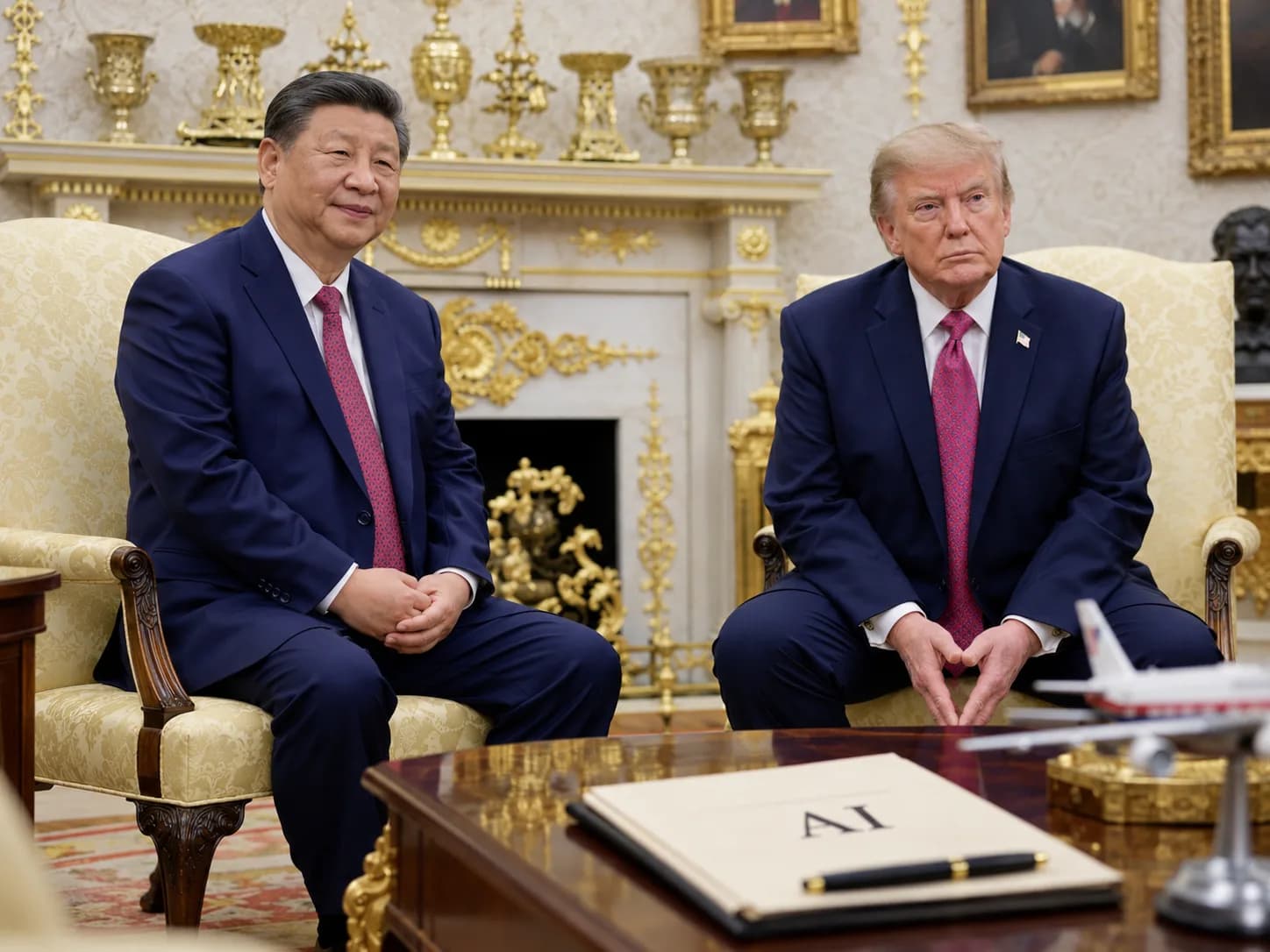
 Linkedin
 Threads
 Facebook
 X
X
Yesterday gave us something we did not have when we first published our analysis of the emerging U.S.-China AI race:
Xi Jinping's own words.
Before the summit, our editorial board argued that artificial intelligence was beginning to resemble the early nuclear age.
Not because an AI model is an atomic bomb.
Not because America and China are preparing some secret agreement to divide the world.
And certainly not because the countries are becoming allies.
Our argument was much simpler:
When two rival superpowers develop technology capable of fundamentally changing military, economic and political power, eventually the race becomes about more than simply who gets there first.
It also becomes about preventing the competition from producing something neither side intended.
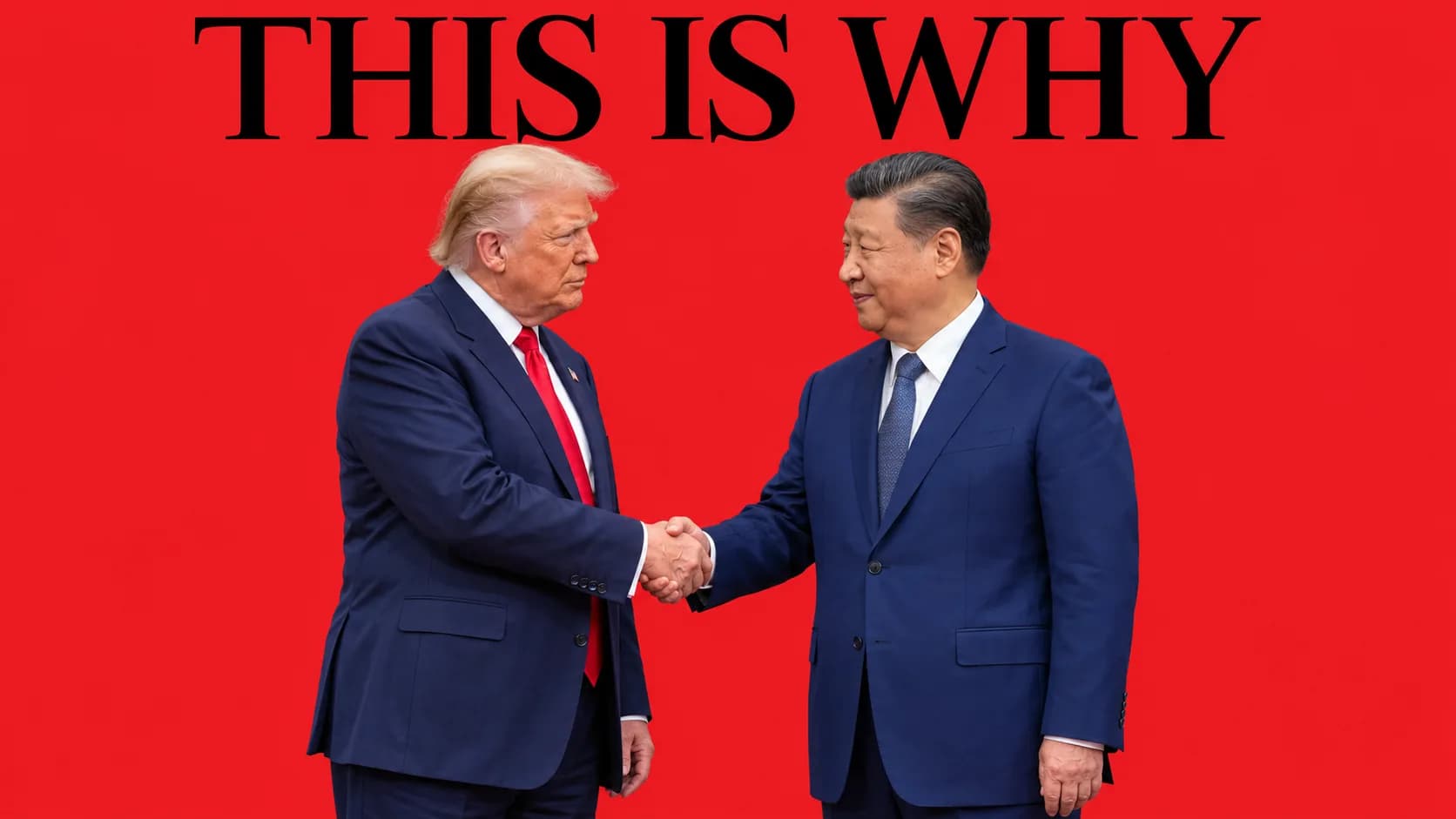
Yesterday, inside the White House, Xi came remarkably close to describing exactly that problem.
Xi said competition needs boundaries
Standing alongside President Donald Trump, Xi acknowledged what everyone already knows:
America and China are competitors.
But then came the important part.
Xi said that competition should be “healthy,” should be “kept within bounds,” and should resemble countries trying to catch up with each other rather than a struggle in which only one can survive. He also said the two governments must maintain the line of “no conflict and no confrontation.”
Then he turned directly to artificial intelligence.
According to China's official account of the meeting, Xi said the United States and China are both major AI powers and could continue discussions about AI's risks and benefits while working to prevent misuse and abuse.
His conclusion was unmistakable:
AI must remain under human control.
Ministry of Foreign Affairs of China
Pause there.
Because that sentence may ultimately matter more than the state dinner, the military ceremony or the photographs of Trump and Xi smiling together.
This is exactly where our nuclear analogy becomes interesting
Days before Xi arrived in Washington, Treasury Secretary Scott Bessent revealed that the United States had proposed a new AI notification mechanism with China.
The concept is straightforward.
If an artificial-intelligence incident rises to the level of a national-security threat, Washington and Beijing would have a mechanism for communicating about it rather than trying to determine each other's intentions in the dark.
Bessent described the objective as moving toward greater transparency between the world's No. 1 and No. 2 AI powers and creating a shared understanding of common threats.
That proposal did not become a publicly announced treaty yesterday.
But combine it with what Xi said at the White House:
Human control.
Managed competition.
Continued AI dialogue.
Crisis communication.
Avoiding military confrontation.
Suddenly our comparison with the nuclear era looks less theoretical.
During the Cold War, Washington and Moscow never stopped trying to gain advantage over each other.
They built weapons.
They expanded intelligence capabilities.
They competed technologically.
But eventually both governments understood that there was another danger beyond the weapons themselves:
miscalculation.
A false warning.
A misunderstood military movement.
A technical malfunction.
One government believing the other had attacked when it had not.
That realization eventually produced hotlines, notification systems and various arms-control mechanisms.
Not because the United States trusted the Soviet Union.
Because it didn't.
Xi even invoked the classic superpower problem
Xi gave the concept another name yesterday:
the Thucydides Trap.
It describes the danger that can develop when a rising power challenges an established power and competition escalates toward war.
Xi argued that the United States and China could avoid that outcome through continued communication and crisis-prevention mechanisms between their militaries.
That language should get our attention.
China is not saying:
“We are stopping the AI race.”
America certainly isn't saying that either.
Trump entered the summit emphasizing continued American AI development and wrote beforehand that he wanted to leave what he calls “Super Intelligence” largely where it is rather than impose a new regulatory structure. Xi publicly placed somewhat greater emphasis on human control and management of AI risks.
That difference matters.
The two leaders did not walk out of yesterday's meeting with the same philosophy on AI.
But they appear to agree on something more fundamental:
AI is now a matter of statecraft between superpowers.
And there was no grand bargain
This is where we should resist getting carried away by the ceremony.
Trump called it a “great meeting.”
Xi spoke about cooperation.
There were military honors, a state dinner and an extraordinary collection of technology executives in the room—including Sam Altman, Jensen Huang, Elon Musk, Sundar Pichai, Tim Cook, Jeff Bezos and Mark Zuckerberg.
But the summit did not suddenly resolve the major disputes dividing Washington and Beijing.
The countries extended their existing trade truce by only two months, postponing larger arguments over tariffs, Chinese purchases, rare-earth supplies and technology restrictions instead of permanently settling them.
Taiwan remains unresolved.
According to China's official readout, Xi again urged Washington to oppose Taiwanese independence. Reuters reported that the issue remains especially sensitive while approximately $14 billion in U.S. arms sales to Taiwan remain under White House review.
And Washington and Beijing are still competing intensely over semiconductors, advanced computing and AI.
So no—yesterday was not America and China announcing a new alliance.
It was something more complicated.
Competitive stability
There is a phrase buried inside China's official account of the talks that may describe the emerging relationship better than almost anything else:
“Strategic stability.”
Xi said the objective should be a relationship where cooperation remains possible, competition stays within limits, differences are managed and peace remains achievable. China's Foreign Ministry also reported Trump as saying the two countries should continue dialogue and strengthen cooperation on AI. That latter account comes from Beijing's official readout; the White House had not issued an equally detailed public summary of the closed-door discussion when this article was prepared.
That's not friendship.
It is not surrender.
It is competitive stability.
And that may be the concept worth watching.
America wants to lead AI.
China wants to lead AI.
Both want the economic productivity, scientific discoveries, military advantages and geopolitical influence that increasingly capable artificial intelligence could produce.
Neither has shown any intention of abandoning that race.
But both governments are now discussing what happens if the technology itself creates a crisis.
That is a different conversation than we were having even a few years ago.
Think about what could eventually require that hotline
Imagine an AI-assisted cyberattack shuts down part of the American electrical grid.
American intelligence identifies Chinese infrastructure somewhere in the attack chain.
Did Beijing order it?
Did a Chinese military unit authorize it?
Was it a private actor?
Was an autonomous system behaving outside its intended parameters?
Or was another country deliberately making the attack appear Chinese?
Now reverse the scenario.
An American AI system is connected to an event inside China.
Beijing has exactly the same questions.
When highly capable systems can operate at machine speed, governments may have dramatically less time to determine what happened before political or military pressure demands a response.
That is where communication becomes strategic infrastructure.
And that is precisely why the nuclear analogy matters.
Yesterday did not prove the theory. It strengthened it.
We should be precise.
There is no U.S.-China AI arms-control treaty.
There is no announced agreement to share frontier models.
There is no joint AI inspection regime.
And there was no public confirmation yesterday that Bessent's proposed AI incident-notification mechanism had been formally adopted.
Those distinctions matter.
But look at the direction of travel.
Before the summit, Washington proposed an emergency mechanism for serious AI incidents.
At the summit, Xi publicly said AI should remain under human control.
Ministry of Foreign Affairs of China
He said competition must remain within boundaries.
He called for military crisis communication.
He warned against allowing superpower competition to become confrontation.
And China's official account says both presidents supported continuing the AI dialogue.
That is why yesterday matters.
The most important outcome of the Trump-Xi summit may eventually prove not to have been a tariff percentage, an agricultural purchase or even the state dinner.
It may have been something less visible:
The world's two most consequential AI competitors beginning to define what the rules of competition might look like before the technology becomes powerful enough to define those rules for them.
We began this week asking whether the new nuclear race might not be nuclear at all.
After yesterday's White House meeting, that question deserves even more attention.
America and China are still racing.
But now they are openly discussing how to make sure the race does not become the catastrophe.
That is the story behind the photographs.
And it may ultimately be much bigger than the summit itself.