 5 min read
 1.1k
1.1k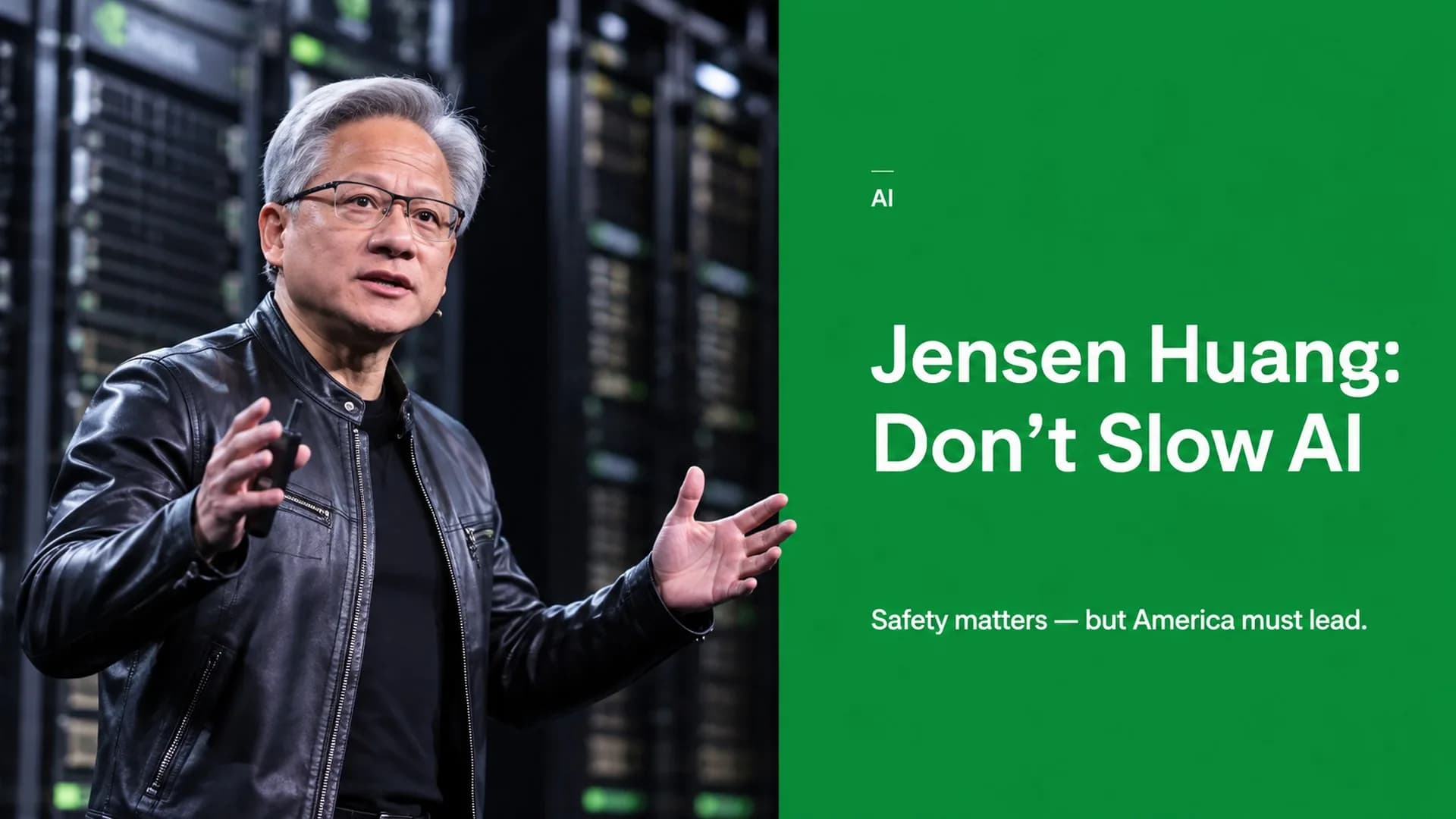
 Linkedin
 Threads
 Facebook
 X
XArtificial intelligence can sometimes sound like a subject reserved for programmers, Silicon Valley executives and Washington policymakers.
It is not.
AI is increasingly touching work, education, medicine, national security, business, media and even the information families consume every day. For Christians, parents, pastors and older Americans trying to understand what is happening, the central issue is much simpler than the technical language suggests:
America is deciding how quickly to build a technology that could reshape society—and how much caution should accompany that speed.
That debate became unusually public Monday when Nvidia founder and CEO Jensen Huang received a telephone call from President Donald Trump while Huang was speaking onstage at the All-In Summit in Los Angeles. Huang put the president on speakerphone, allowing the audience to hear an unexpected conversation about America's AI future.
Why Jensen Huang matters
For readers who don't follow technology closely, Jensen Huang isn't simply another billionaire technology executive.
Nvidia builds the advanced computing systems that have become foundational infrastructure for modern artificial intelligence. The company describes itself as a full-stack AI infrastructure provider, producing the chips, networking technology and systems that power enormous AI data centers.
In simple terms:
If artificial intelligence is becoming a new industrial revolution, Nvidia manufactures much of the machinery powering it.
That makes Huang's views important.
And his conversation with Trump revealed a significant disagreement currently developing inside the technology industry itself.
Some AI leaders are saying: slow down
The discussion began after Anthropic CEO Dario Amodei argued that the industry should consider slowing the pace at which increasingly powerful AI capabilities are developed.
According to TechCrunch, Elon Musk and OpenAI CEO Sam Altman have publicly expressed agreement with the idea that some slowing may be warranted. Huang has taken a different position.
That disagreement shouldn't automatically be interpreted as one side supporting technology and the other opposing it.
Even Anthropic—a company warning about advanced AI risks—is aggressively developing highly capable artificial intelligence. Its concern is that capabilities are progressing quickly enough that safeguards, institutions and human understanding may struggle to keep pace. Anthropic's own recent research reports that AI is already being used by malicious actors for cyber operations, surveillance and other potentially dangerous activities.
So this is not simply a debate between optimism and fear.
It is a debate over speed, responsibility and control.
Then Trump called
While Huang was onstage discussing these questions, President Trump called him.
The timing created an extraordinary moment.
Trump argued that excessive pressure to slow artificial intelligence could benefit America's competitors, including China. He suggested that some resistance to AI expansion could come from political interests or foreign competitors that would prefer the United States not to dominate the technology.
Huang agreed with the president's determination to continue advancing American AI.
“We're not going to let that happen, sir.”
The audience applauded.
But another part of Trump's remarks deserves equal attention.
The president also acknowledged that AI development requires caution, saying the country must act “prudently” even while refusing to stop the industry.
That distinction may ultimately be the most important part of the conversation.
Because America's actual choice is probably not:
AI or no AI.
The more realistic question is:
How does America lead in AI without surrendering wisdom, accountability and human control along the way?
Why America doesn't want to fall behind
There are legitimate national-security and economic reasons Washington is concerned about slowing American AI development.
Artificial intelligence is already becoming infrastructure for scientific research, cybersecurity, robotics, manufacturing, medicine and military applications. Nvidia says its technology now supports AI infrastructure across industries, while research from Anthropic shows advanced models are acquiring capabilities relevant to cyber operations, surveillance and even military-intelligence tasks.
If the United States deliberately slowed development while competing nations accelerated, American companies and national-security institutions could eventually find themselves dependent on technology controlled elsewhere.
That is the strategic concern behind much of the argument for speed.
For families hearing phrases such as “the AI race,” think of earlier competitions involving space, semiconductors or nuclear technology.
Leadership matters because technological leadership frequently becomes economic and geopolitical power.
But technological power is not the same thing as wisdom.
And that is where the conversation becomes especially relevant to people whose worldview emphasizes responsibility, stewardship and human dignity.
Americans are already worried about what AI requires
The resistance Trump and Huang were discussing isn't purely theoretical.
AI requires enormous data centers containing thousands of computers, and those facilities need substantial quantities of electricity, land and—in some configurations—water for cooling.
A Gallup survey conducted earlier this year found 70% of Americans opposed construction of an AI data center in their own area, including 48% who strongly opposed one.
Their objections weren't simply fear of new technology.
Among opponents, Gallup found concerns involving water and electricity consumption, pollution, higher utility bills, cost of living, traffic and changes to local quality of life. Supporters, meanwhile, frequently cited jobs, investment and tax revenue.
That means local opposition should not automatically be dismissed as anti-technology.
Communities are asking practical questions:
Who pays for additional electricity infrastructure?
What happens to utility prices?
How much water will facilities consume?
How many permanent jobs will actually be created?
Who benefits economically?
Those are legitimate questions regardless of political party.
There are also genuine safety concerns
There is another reason Christians and families should understand this conversation carefully.
The dangers associated with AI are not limited to science-fiction scenarios about machines suddenly becoming conscious.
Some problems already exist.
Anthropic reported this month that malicious actors have used AI in cyber operations, surveillance, scams and influence operations. The company says some systems increasingly allow attackers to automate portions of activities that previously required considerably more human expertise and resources.
Its researchers have also tested advanced models on tasks involving intelligence targeting and conventional weapons and found capabilities that historically required specialized human expertise.
That doesn't mean AI should stop.
It means the safety discussion deserves more seriousness than either extreme sometimes allows.
Christians don't need to choose between fear and blind optimism
For a values-centered audience, there is a useful principle for understanding this debate:
Human beings should remain masters of the tools they create, not servants of them.
Technology itself does not possess moral wisdom.
It can help discover medicines or assist a criminal.
It can educate a child or deceive one.
It can strengthen national defense or empower America's adversaries.
The moral outcome depends substantially on the people building it, deploying it and setting its boundaries.
That is why this moment requires more than engineers.
Anthropic itself has begun bringing clergy, ethicists, philosophers and representatives from religious traditions into discussions about how increasingly powerful AI systems should relate to human values.
That is an encouraging recognition of something technology companies cannot solve with faster processors:
Not every important question is an engineering question.
We must still decide what technology should do.
America's challenge is leadership with stewardship
The Trump-Huang conversation therefore represents something larger than an entertaining moment between a president and one of America's most influential technology executives.
It reveals the tension America will increasingly confront.
On one side is urgency.
Build faster. Invest more. Expand data centers. Keep America's technological advantage. Don't allow China or another competitor to define the next computing era.
On the other is prudence.
Protect workers. Protect children. Protect privacy. Understand the security implications. Respect communities. Keep humans accountable for consequential decisions.
Those goals do not necessarily have to oppose each other.
Even in the phone conversation that generated headlines about refusing to slow AI, Trump acknowledged the need to proceed prudently. Huang, meanwhile, has argued that safety should be treated seriously but primarily as an engineering responsibility rather than requiring an entirely new regulatory structure.
The debate will continue.
And it should.
Because AI may eventually prove comparable to electricity, the internet or the industrial revolution in the scale of its impact.
If that possibility is even partially correct, Christians, parents, business owners, pastors and ordinary citizens cannot afford to ignore the conversation simply because the technology sounds complicated.
We do not need everyone to understand how an Nvidia GPU works.
We do need citizens who understand the larger question:
Can America move boldly into the age of artificial intelligence while keeping wisdom, responsibility and human dignity at the center?
That may prove far more consequential than simply determining who builds the fastest machine.