3 min read
 6
6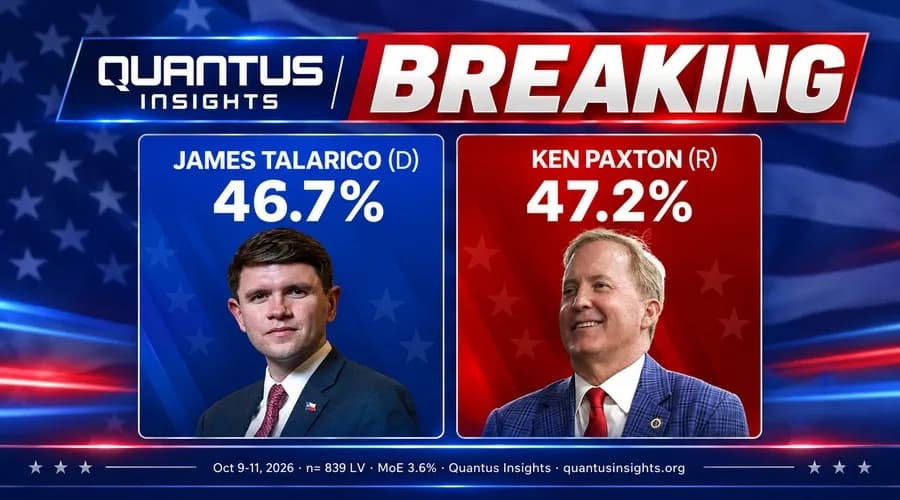
 Linkedin
 Threads
 Facebook
 X
X
Ken Paxton is back in front.
After weeks of polling that placed Democrat James Talarico ahead in one of America's most closely watched Senate contests, a new survey from Quantus Insights has put the Republican candidate narrowly ahead.
The October 13 report shows Paxton receiving 47.2%, compared with 46.7% for Talarico. Libertarian Ted Brown receives 2.2%, while 3.9% remain undecided.
Quantus Insights, a research firm specializing in political polling, forecasting, and economic analysis, surveyed 854 respondents between October 9 and 11, with 839 included in its likely-voter ballot results.
The difference is just half a percentage point, within the survey's 3.6-point margin of error. Statistically, the candidates remain tied.
But the timing makes the finding politically significant.
Recent surveys from Fox News, The New York Times/Siena, YouGov, and Rasmussen had consistently shown Talarico ahead, with Democratic advantages ranging from one to six percentage points.
An Emerson College survey conducted August 9–10 was the previous major public poll showing Paxton ahead, 47% to 46%.
Now, with just 21 days remaining before Election Day, a fresh survey has interrupted that sequence of Democratic leads.
What Is Changing in Texas?
Quantus identifies an important division within the electorate.
Paxton draws substantial support from older and rural voters, while Talarico performs more strongly among independents.
That divide illustrates one of the central questions surrounding the election.
In 2024, Donald Trump carried Texas by approximately 13.6 percentage points. Republican Senator Ted Cruz also won reelection that year, defeating Colin Allred by 8.5 points.
Those results demonstrate the Republican Party's longstanding statewide strength.
But presidential voting patterns cannot be transferred automatically to individual Senate candidates.
Talarico has attracted independent support and performed competitively in recent surveys. The latest RealClearPolling average still gives him an approximately 2.7-point advantage. A separate ReconMR survey released October 13 also found Talarico ahead, 48% to 44%.
The Quantus result therefore represents an encouraging data point for Paxton's campaign, not proof of a statewide reversal.
And compared with Quantus's own June survey, which showed Paxton ahead by two points, the new half-point lead is actually smaller.
The question now is whether subsequent surveys confirm greater Republican support or whether the latest result reflects ordinary polling variation.
The Policy Record Behind the Political Fight
The race is also becoming a contest over the candidates' legislative and political records.
Paxton has emphasized his history of challenging federal government policies, particularly during the Biden administration, and his support for stricter immigration enforcement, parental authority, and conservative social policies.
Talarico has presented himself as a Christian Democrat offering a different interpretation of faith, government, and social responsibility.
His legislative record has become a particular point of contention.
In May 2023, Talarico voted against Texas Senate Bill 14, legislation restricting gender-transition medical interventions for minors. He argued that decisions involving children's medical care should remain with families and physicians rather than politicians.
More recently, Talarico has said he opposes gender-reassignment surgeries for minors and has argued that the original legislation was overly broad.
That history gives voters a substantive policy question: how would his past legislative positions translate into votes in the United States Senate?
His record on immigration, federal spending, healthcare, energy, and parental rights also warrants examination alongside Paxton's positions.
These differences are consequential because Texas is not simply electing another political personality.
The winner will serve a six-year Senate term, participating in decisions involving federal legislation, judicial confirmations, executive appointments, national security, and the administration's governing priorities.
A Warning Against Declaring Texas Decided
Political polling is often presented as momentum moving inevitably in one direction.
But no survey can determine the final result.
Quantus has now published a result that differs from most recent polls. That makes it newsworthy, especially in a state Democrats have not won in a U.S. Senate election since 1988.
It also reinforces the importance of examining the underlying electorate, undecided voters, candidate records, and differences in polling methodology before declaring an outcome.
A half-point lead is not a victory. A three-point polling deficit is not a defeat. And Texas's political history is not a substitute for the ballots that will actually be cast.
The next three weeks will reveal whether Quantus identified an emerging change or simply captured one possible outcome in an exceptionally close contest.
For now, the newest Texas Senate numbers have delivered one unmistakable message: this race remains unsettled, and November 3 will determine which political vision Texas sends to Washington.