3 min read
 80
80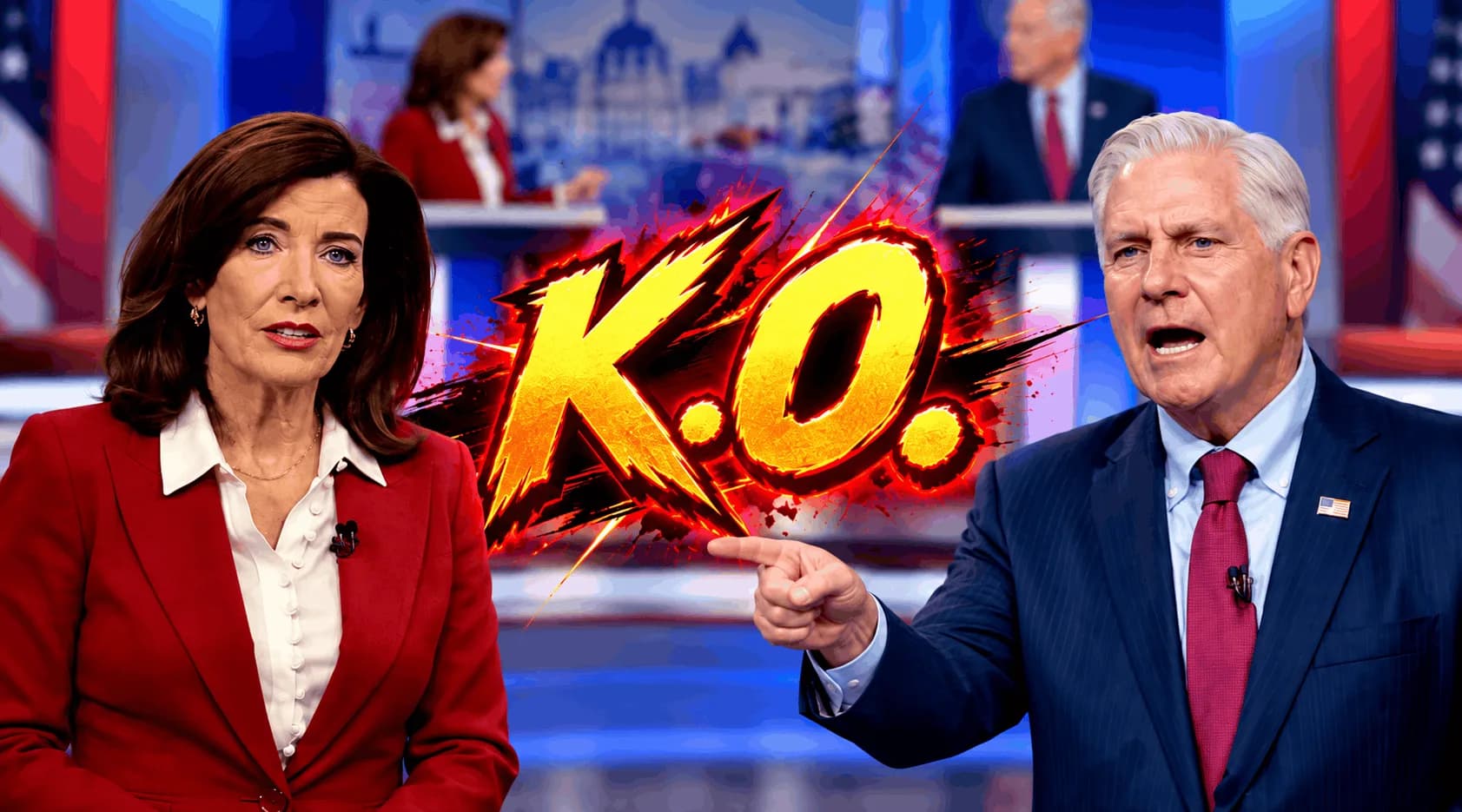
 Linkedin
 Threads
 Facebook
 X
X
A restaurant meal that cost $15 three years ago now costs $25.
That is the kind of economic reality many New Yorkers recognize immediately. A ten-dollar increase may seem insignificant to politicians discussing billions in government spending, but for a family of four, it can mean another $40 just to enjoy the same dinner.
And on Tuesday night, October 13, Governor Kathy Hochul faced Republican challenger Bruce Blakeman in their only televised debate before November's gubernatorial election.
The central argument was affordability.
Blakeman challenged the governor over high taxes, government spending, and rising utility bills. Hochul defended her record, pointed toward recent tax relief, and repeatedly blamed President Donald Trump's policies for contributing to higher costs.
But there is a fundamental question that cannot be answered simply by mentioning Washington.
What has New York's own government done with the money it collects from its citizens?
From $212 Billion to $268 Billion. Where Is the Relief?
Consider the state budget.
In fiscal year 2021–2022, New York's all-funds budget totaled approximately $212 billion, according to State Comptroller Thomas DiNapoli.
The enacted budget for fiscal year 2026–2027 totals approximately $268.1 billion.
That is an increase of more than $56 billion in five years, roughly 26%.
An increase in government spending is not automatically an increase in taxes. Budgets include federal funding, healthcare expenditures, education, infrastructure, and other obligations.
But those figures reveal something important: New York's government has become considerably more expensive to operate.
Hochul can point to genuine tax relief. Her administration approved reductions in certain middle-class income-tax rates, expanded child tax credits, and distributed inflation refund checks.
Those actions are real.
But taxpayers are entitled to examine the entire financial picture, not just the programs highlighted during a campaign.
If government spending grows by $56 billion, how much of that expansion is producing measurable improvements in everyday affordability?
And if New Yorkers are still struggling with electricity, insurance, housing, and food prices, what needs to change?
One of the most revealing moments of the debate came when Hochul repeatedly tried to shift responsibility for New York's affordability crisis toward President Donald Trump. Blakeman confronted her directly on camera, challenging that narrative and pointing to the state's rising utility bills, taxes, and regulatory costs under her administration. Rather than allowing the discussion to become another argument about Washington, he brought it back to Albany and the decisions made during her years in office. Hochul appeared uncomfortable at several points, pausing and looking down before responding—reactions that some observers interpreted as signs of defensiveness. But the more consequential question was not her facial expression. It was the argument Blakeman placed before millions of New Yorkers: How can a governor continue blaming Washington for financial pressures that her own state government has the authority to address?
The Taxes and Charges Behind the Headlines
The financial burden extends beyond state income taxes.
In January 2025, New York introduced congestion pricing in Manhattan, charging most passenger vehicles with E-ZPass $9 during peak hours to enter the designated zone south of 60th Street.
Supporters argue that the program reduces traffic and finances public transportation. But it also imposes an additional expense on affected drivers and certain commercial vehicles.
In July 2025, New York changed the Metropolitan Commuter Transportation Mobility Tax, introducing higher rates for certain large employers and establishing a new bracket for businesses with payroll exceeding $2.5 million.
Beginning in 2026, the tax rules also changed for certain self-employed people earning more than $150,000 in the metropolitan transportation district, with rates depending on where they conduct business.
Meanwhile, the state maintains high marginal income-tax rates reaching 10.9% for its highest earners, with the elevated brackets extended through 2032.
These costs do not affect every New Yorker equally. But collectively, taxes, transportation charges, utilities, insurance, and regulatory expenses form part of the environment in which businesses must operate.
A restaurant does not establish its menu prices in isolation. It must pay employees, purchase ingredients, maintain insurance, cover rent, and keep the lights on.
That is why the cost of operating a business matters to the customer sitting at its tables.
Mamdani's Tax Agenda: What Actually Changed?
New York City Mayor Zohran Mamdani has also advanced an agenda that deserves scrutiny.
During his campaign, Mamdani proposed increasing income taxes on residents earning more than $1 million annually and raising corporate tax rates on highly profitable businesses.
Those two major proposed increases were not enacted in his May 2026 executive budget.
Instead, working with Governor Hochul and state lawmakers, his administration secured a new pied-à-terre tax on luxury secondary residences valued above $5 million.
The tax is projected to generate at least $500 million annually.
Mamdani also proposed reducing a credit associated with the city's Unincorporated Business Tax, potentially generating another $68 million.
Earlier, his administration considered a 9.5% property-tax rate increase as one option for addressing a budget deficit. That increase was ultimately left out of the adopted budget.
The distinction matters: proposed taxes should not be reported as if residents are already paying them.
Nevertheless, Mamdani's approach raises an important economic question.
How much additional taxation can a city impose before investment, entrepreneurship, and business expansion begin moving elsewhere?
New York's wealth and concentration of businesses are enormous advantages. But maintaining those advantages requires understanding how taxes influence investment decisions, employment, and long-term economic growth.
New Yorkers Are Still Paying the Price
The official inflation data provide additional context.
In August 2026, the Bureau of Labor Statistics reported that consumer prices in the New York metropolitan area had increased 4.3% over the previous year.
Energy prices rose 15.4%, while restaurant and other food-away-from-home prices increased 3.6%.
Those are regional averages. Individual businesses may experience much larger or smaller increases.
Hochul cannot reasonably be held responsible for every increase in global energy or food prices. Federal tariffs, interest rates, international conflicts, and supply chains also affect what families pay.
But the governor and state lawmakers do control significant portions of New York's tax structure, spending priorities, regulatory requirements, and energy policy.
That authority carries responsibility.
Blakeman made affordability the center of his debate criticism, arguing that state policies have contributed to rising utility bills and a difficult economic environment.
Hochul countered that her administration has invested in public safety, childcare, and energy relief, while federal policies have complicated her efforts.
The public deserves to judge those arguments against actual results.
The Question Hochul Cannot Escape
There is something revealing about a political debate where billions of dollars are exchanged in arguments while families continue calculating whether they can afford an ordinary night out.
New York possesses remarkable advantages: Wall Street, international commerce, universities, tourism, technology companies, entrepreneurs, and one of the world's most influential cities.
But economic success should not be measured only by how much money government collects or spends.
It should also be measured by whether families can afford to remain, whether entrepreneurs can expand their companies, and whether businesses can operate without constantly transferring rising expenses to consumers.
That is the deeper question behind Tuesday's debate.
New Yorkers do not experience affordability through political speeches. They experience it through rent payments, electricity bills, grocery receipts, and restaurant menus.
Tuesday's debate gave New Yorkers a revealing contrast. Hochul defended her administration's spending, tax relief, and economic policies, while Blakeman directed attention toward the rising costs families and businesses face after years of Democratic control in Albany. His argument was that New York's affordability crisis cannot simply be blamed on Washington when so many consequential decisions are made by the governor and state lawmakers themselves. For New Yorkers frustrated by rising expenses, that challenge presents a serious question about whether a different approach to taxation, regulation, energy, and government spending could produce better results.
The real measure of leadership is not how convincingly a politician defends a record on television, but whether that record has made life more affordable for the people being governed.