


 3 min read
 11
 Linkedin
 Threads
 Facebook
 X

Donald Trump says he has discovered how to accomplish something that seems almost impossible in Washington.
Get Democrats and Republicans to agree on a Supreme Court nominee.
Not 51 votes. Not 60 votes.
Every single senator.
And the man Trump says could make that happen?
Texas Republican Senator Ted Cruz.
But the president's explanation sent the crowd into laughter.
According to Trump, Democrats would vote to confirm Cruz because they want him out of the Senate.
And Republicans?
They would vote for him for exactly the same reason.
What began as a humorous exchange during an October 27 campaign rally in Lubbock, Texas, has reignited speculation about the future of the Supreme Court and one of the Republican Party's most recognizable constitutional conservatives.
There is just one unexpected complication.
Ted Cruz has already made it clear that he does not want the job.
Trump's Supreme Court Announcement That Had Everyone Laughing
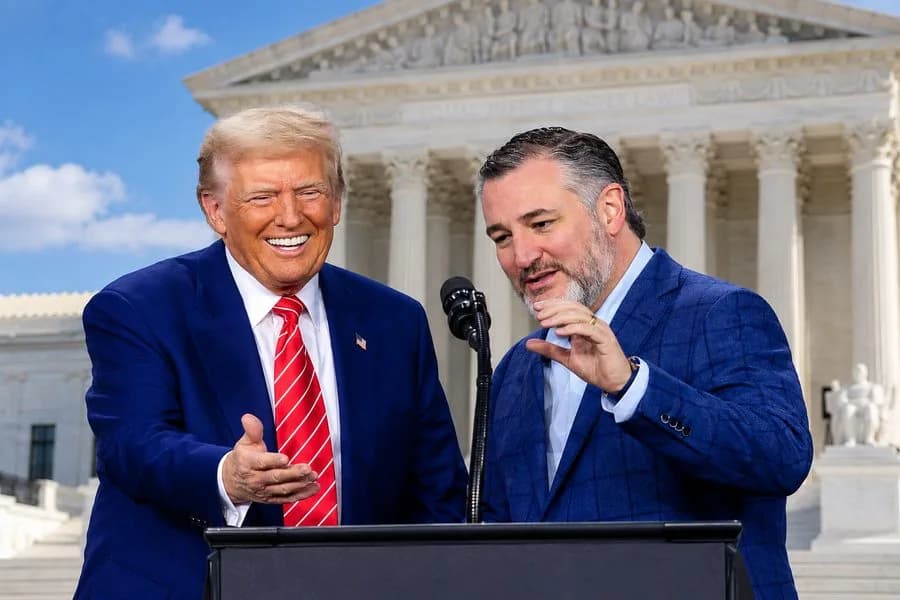
Speaking at a campaign rally supporting Texas Republican Senate candidate Ken Paxton, President Trump began reflecting on the three Supreme Court justices he appointed during his first administration.
Neil Gorsuch. Brett Kavanaugh. Amy Coney Barrett.
Each required a contentious Senate confirmation process.
Trump then turned his attention to Cruz, who was in attendance, and suggested he had found a solution to the political battles surrounding future judicial appointments.
"I would pick Ted Cruz to be the next Supreme Court justice," Trump declared.
The president praised Cruz's legal education, courtroom experience, and professional credentials.
Then came the punchline.
Trump joked that Democrats would enthusiastically confirm Cruz because they wanted him out of the Senate—and Republicans would feel exactly the same way.
The crowd laughed as Trump suggested the result could be a unanimous confirmation.
He finished by saying Cruz would do an excellent job.
It was classic Trump: a compliment, a political insult, and a Supreme Court headline delivered in the same moment.
But behind the joke was a serious question.
Could Ted Cruz actually serve on the nation's highest court?
Ted Cruz Has the Credentials. But Does He Want the Position?
Regardless of the political humor, Cruz has extensive experience with constitutional litigation.
The Texas senator graduated from Princeton University and Harvard Law School.
He clerked for former Supreme Court Chief Justice William Rehnquist, a position generally reserved for attorneys with exceptional academic and legal credentials.
Cruz later served as solicitor general of Texas, representing the state in major constitutional disputes.
During his legal career, he argued nine cases before the Supreme Court, eight of them while serving as Texas solicitor general.
His work has addressed issues including constitutional rights, federal authority, religious liberty, and government powers.
Those qualifications help explain why Trump has repeatedly mentioned Cruz as a potential Supreme Court justice.
But an impressive résumé does not necessarily translate into a desire to serve.
In September 2026, Cruz told Sean Hannity that his answer to a Supreme Court nomination was:
"Not just no, but hell no."
The senator explained that he prefers participating directly in political and public-policy battles rather than serving as a judge.
And in a separate interview with the Houston Chronicle, Cruz revealed something even more surprising.
Trump had already discussed Supreme Court vacancies with him during his first administration—and Cruz said he declined all three times.
His reasoning was simple: he wanted to remain involved in the political arena.
That creates a fascinating contrast.
The president continues publicly floating Cruz as a potential justice.
Cruz continues saying he would rather remain a senator.
Is There Actually a Supreme Court Vacancy?
Not currently.
As of October 30, 2026, all nine seats on the Supreme Court remain occupied.
Trump's comments were a hypothetical suggestion delivered humorously, not an official nomination.
For Cruz to join the Court, a vacancy would first have to occur through retirement, resignation, or the death of a sitting justice.
The president would then formally nominate a candidate, and the Senate would have to vote on confirmation.
The stakes would be substantial.
Supreme Court justices hold lifetime appointments during good behavior and decide constitutional questions that can influence American law for generations.
Cases involving religious liberty, abortion, firearms, presidential authority, federal regulations, and freedom of speech can all reach the Court.
A future appointment could therefore have consequences extending far beyond the administration that selects the justice.
And the political environment in which that nomination takes place matters.
The November 3 midterms will determine control of Congress, including the Senate, which holds the constitutional authority to confirm Supreme Court nominees.
That makes the president's apparently lighthearted comment relevant to a much larger institutional question: Who will have the votes to confirm the next justice?
From Political Rivals to a Possible Supreme Court Nomination
There is another fascinating chapter to this story.
Ten years ago, Trump and Cruz were fierce competitors during the 2016 Republican presidential primaries.
Their exchanges became some of the most memorable confrontations of that campaign.
Trump repeatedly criticized Cruz, while Cruz challenged Trump's temperament and political positions.
Their relationship later changed considerably.
Cruz became an important legislative ally of the president, and Trump supported his reelection campaigns.
Now the same former political rival is repeatedly mentioned by Trump as a possible choice for a lifetime appointment to the Supreme Court.
The president's latest joke reflects both their complicated political history and their current working relationship.
But it also illustrates a peculiar Washington reality.
An individual can be controversial within the Senate while possessing legal credentials that make him a plausible candidate for judicial office.
Whether senators would actually vote unanimously for Cruz is unknown. Trump's claim was a joke, not a verified commitment from either party.
And Cruz's public refusal remains a significant obstacle.
One Joke. One Senator. A Lifetime Appointment.
What happened in Lubbock was not an official judicial appointment.
No Supreme Court seat has opened.
No nomination has been submitted.
And Ted Cruz has not reversed his previously stated opposition to serving on the Court.
Nevertheless, Trump's comments have reopened a conversation about the future of America's highest judicial institution—and the role a prominent Texas senator might play in it.
With congressional control being contested just days before Election Day, that conversation carries institutional significance.
After all, the next Supreme Court appointment could influence American constitutional law long after the current political battles have ended.
Trump says Ted Cruz could receive every vote in the United States Senate.
Ted Cruz says he doesn't want the job.
And for now, the most important detail may be the one behind all the laughter:
The president has floated his candidate. But the candidate himself keeps saying no.