


 3 min read
 37
 Linkedin
 Threads
 Facebook
 X

Seven battleground states. Thirty-five Senate elections. More than a quarter-billion dollars in Trump-aligned political spending.
And one question that Washington cannot answer with certainty:
Who will control the United States Senate after November 3?
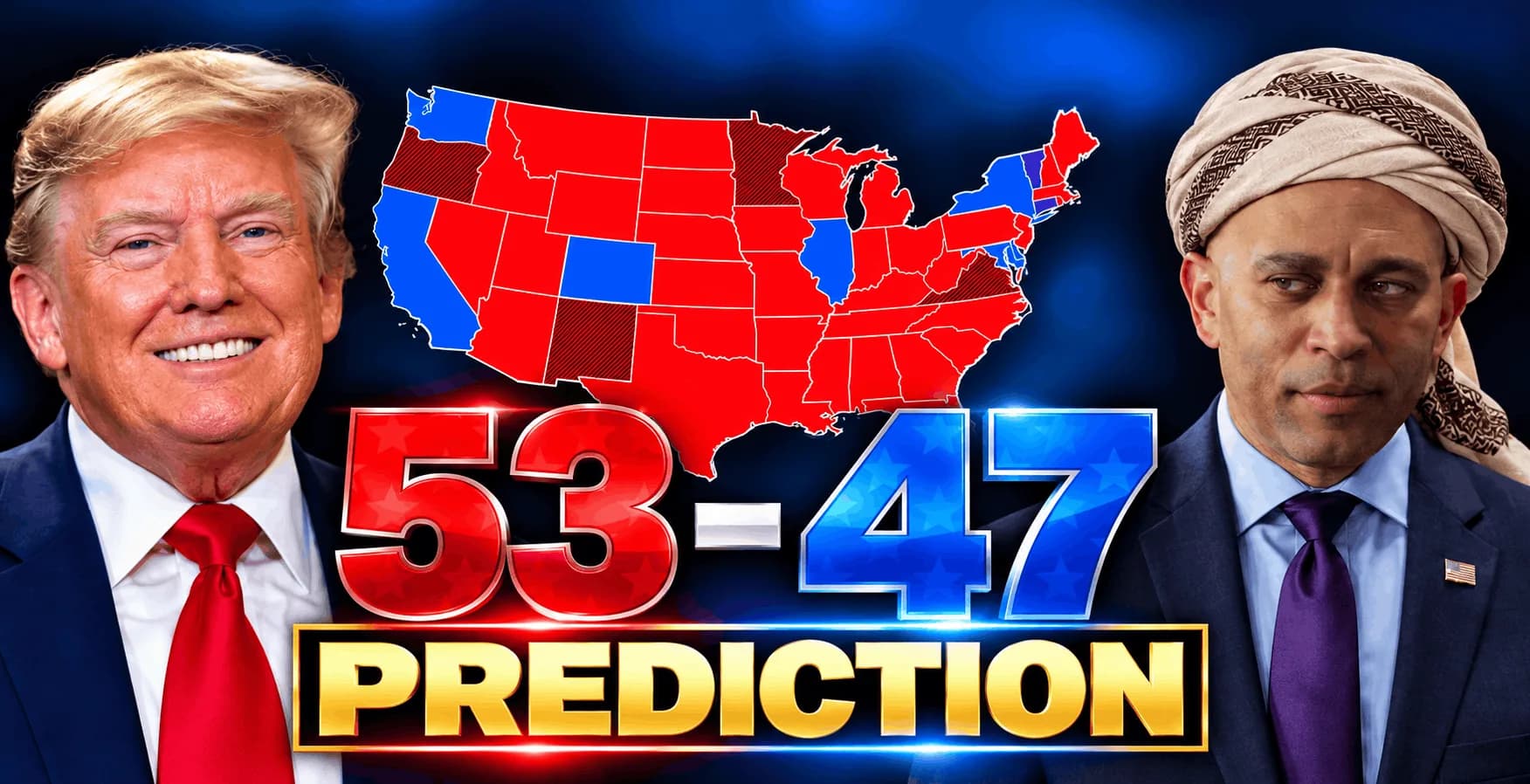
A new election-map prediction, highlighted in an October 29 Conservative Brief report, has attracted attention for showing Republicans retaining their Senate majority despite the increasingly competitive national environment.
The prediction appears in a YouTube presentation titled My FINAL 2026 Senate Map Prediction, One Week Till The Midterms.
But the most revealing discovery is not simply that a Republican victory remains possible.
It is that major forecasting models looking at the same election are reaching dramatically different conclusions.
One gives Republicans a 67% probability of retaining control. Another gives Democrats a 60% probability of winning it.
That disagreement tells Americans something important about the political situation entering the final days of the campaign.
The Senate Math Is More Complicated Than It Appears
Republicans currently hold 53 Senate seats. Democrats and two independents who caucus with them hold 47.
Thirty-five seats are being contested this year, including special elections in Florida and Ohio.
Democrats need a net gain of four seats to take the majority. A 50–50 split would allow Vice President JD Vance to cast a tie-breaking vote in favor of Republican control.
That mathematical reality is central to the Republican argument.
Democrats can perform well nationally without necessarily capturing enough of the particular Senate seats they need.
Unlike the House of Representatives, where all 435 seats face election every two years, the Senate operates on staggered six-year terms.
The geographic distribution of competitive races matters as much as the national political mood.
A national polling advantage does not automatically translate into Senate control.
But neither does a Republican majority entering Election Day guarantee that the party will keep it.
Two Forecasts. Two Very Different Outcomes.
On October 28, forecasting organization Le Millénaire published a Senate model based on 200,000 election simulations.
Its findings were particularly significant:
Republicans: 67% probability of retaining the Senate.
Democrats: 33% probability of taking control.
The model's expected seat totals were approximately 50.4 Republicans and 49.6 Democrats or allied independents.
That represents a very narrow expected balance despite the substantial difference in modeled probabilities of control.
But Decision Desk HQ reached a different conclusion.
Its October 29 forecast assigned Democrats a 60% probability of capturing the Senate and projected approximately 52 Democratic seats.
Then, on October 30, the Cook Political Report described Democrats as slight favorites to capture the chamber, reflecting a political environment that had become more challenging for Republican candidates.
These are forecasts, not certified results. Their disagreement reflects different assumptions about polling, turnout, candidate performance, and potential errors.
And there is another important distinction: although Conservative Brief describes the original prediction as AI-driven, its report does not identify or explain the specific AI model or methodology behind the YouTube projection.
A prediction presented through artificial intelligence is still a prediction. It is not evidence that the election's outcome has already been determined.
🇺🇸 𝐌𝐘 𝟐𝟎𝟐𝟔 𝐒𝐄𝐍𝐀𝐓𝐄 𝐌𝐀𝐏 𝐏𝐑𝐄𝐃𝐈𝐂𝐓𝐈𝐎𝐍𝐒 𝐔𝐬𝐢𝐧𝐠 𝐭𝐡𝐞 𝐩𝐨𝐰𝐞𝐫 𝐨𝐟 𝐀𝐈 🔴 ALASKA: The New York Times exposed an alleged Democratic operation to recruit a second “Dan Sullivan” to confuse voters. Peltola's campaign is under investigation, and Republicans are seizing the moment. Our projection: RED. 🔴 TEXAS: Talarico is following a Beto-style political playbook in a state with a strong Republican voting history. Our projection: RED. 🔴 IOWA: A close contest, but this map projects a Republican hold. 🔴 MAINE: Susan Collins has a history of winning crossover voters. Our projection: RED. 🔴 OHIO: Republican Jon Husted faces Democrat Sherrod Brown in a competitive Senate race. Our projection: RED. 🔴 MICHIGAN: Mike Rogers faces Abdul El-Sayed in a fiercely contested race. Despite Democratic enthusiasm, this map projects a Republican flip. 🔵 NEVADA: Remains Democratic in Senate representation. Neither Senate seat is up for election in 2026. 🔴 KANSAS: This map projects another Republican hold. 🇺🇸 BOTTOM LINE: GOP RETAINS THE SENATE, 53–47. Bookmark this prediction. November 3 will reveal whether the red map holds! Follow me for more updates. https://t.co/nkC35oalol
— Ricardo Diaz De La Vega (@RealRicardoRDV) October 30, 2026
Seven States Could Determine the Majority
The Cook Political Report identified seven particularly competitive Senate contests: Alaska, Iowa, Kansas, Maine, Michigan, Ohio, and Texas.
In Texas, Republican Attorney General Ken Paxton is facing Democratic state Representative James Talarico.
A Democratic victory would mark a significant political breakthrough in a state that has not elected a Democratic U.S. senator since 1988.
Ohio presents another consequential race between Republican Senator Jon Husted and former Democratic Senator Sherrod Brown.
In Maine, Republican Senator Susan Collins faces Democrat Troy Jackson, while Alaska Republican Dan Sullivan is competing against former Democratic Representative Mary Peltola.
Michigan's open Senate seat pits Republican Mike Rogers against Democrat Abdul El-Sayed.
Iowa and Kansas have also emerged as competitive states, despite their recent Republican voting patterns in federal elections.
Each contest involves its own political dynamics, regional economic concerns, and candidate strengths.
The national election will ultimately be decided through separate state contests—not by a single national vote for control of the Senate. Here is the prediction:
🔴 ALASKA: The New York Times exposed an alleged Democratic operation to recruit a second “Dan Sullivan” to confuse voters. Peltola's campaign is under investigation, and Republicans are seizing the moment. Our projection: RED.
🔴 TEXAS: Talarico is following a Beto-style political playbook in a state with a strong Republican voting history. Our projection: RED.
🔴 IOWA: A close contest, but this map projects a Republican hold.
🔴 MAINE: Susan Collins has a history of winning crossover voters. Our projection: RED.
🔴 OHIO: Republican Jon Husted faces Democrat Sherrod Brown in a competitive Senate race. Our projection: RED.
🔴 MICHIGAN: Mike Rogers faces Abdul El-Sayed in a fiercely contested race. Despite Democratic enthusiasm, this map projects a Republican flip.
🔵 NEVADA: Remains Democratic in Senate representation. Neither Senate seat is up for election in 2026.
🔴 KANSAS: This map projects another Republican hold.
Trump's Political Operation Has Deployed $277 Million
While forecasting models disagree, one major development is firmly documented.
President Trump's political operation has invested extraordinary resources in the 2026 midterms.
According to Associated Press reporting based on federal campaign finance filings, MAGA Inc. reported nearly $277 million in spending and transfers from the beginning of September through mid-October.
That total includes $200 million transferred to No Going Back PAC and another $25 million to Safety & Affordability PAC.
Those transfers are not the same as $225 million in advertisements purchased directly by MAGA Inc.
The organization reported more than $164 million remaining as of October 14.
Trump has also stated that his broader political operation intended to commit more than $400 million before Election Day.
The scale of these expenditures demonstrates how seriously his political allies are treating control of Congress.
But campaign money cannot guarantee electoral success.
Advertising, political organization, candidate quality, and actual voter participation all affect the outcome.
What Happens to Trump's Agenda If the Senate Changes Hands?
The consequences extend well beyond party leadership.
The Senate confirms federal judges, Cabinet officials, ambassadors, and many other presidential nominees.
It also plays an essential role in passing federal legislation, negotiating government spending, and overseeing national-security policy.
A Democratic-controlled Senate would place new institutional constraints on the administration's ability to secure confirmations and advance legislation.
A Republican-controlled Senate would preserve leadership more closely aligned with the White House, although Senate procedural rules and disagreements among individual members would still matter.
The elections also take place amid unresolved foreign-policy challenges, continuing debates over federal spending, immigration enforcement, energy production, economic affordability, and America's international commitments.
These are consequential policy questions for families and businesses across the country.
The party that controls the Senate will help determine which legislation advances, which presidential appointments receive approval, and how Washington handles the next two years.
Artificial Intelligence Cannot Replace the American Voter
The growing influence of artificial intelligence in political analysis introduces another question.
Can algorithms forecast democracy with greater precision than traditional political experts?
Modern forecasting systems can process opinion surveys, historical voting results, demographic patterns, and other measurable factors.
But they cannot know with certainty how millions of individuals will behave on Election Day.
A late-breaking controversy, unexpected turnout patterns, or polling errors can change the outcome.
The same technology that helps researchers analyze elections can also generate inaccurate information when its assumptions or inputs are unreliable.
That is why voters should distinguish verified election results, opinion polling, computer simulations, and political commentary.
They are not interchangeable.
For Americans whose political decisions are informed by faith, constitutional principles, economic priorities, or concerns about their children's future, the most useful response is to examine candidates' documented positions and understand the responsibilities of the offices they seek.
The decisions made in Washington will affect the country long after the forecasting graphics disappear from television screens.
One model suggests Republicans can retain the Senate. Another suggests Democrats could take control. Neither can cast a ballot, certify a result, or determine the nation's future.
On November 3, Americans will provide the answer that no artificial intelligence system can guarantee.
The predictions will end. The votes will be counted. And the consequences will be real.