



 3 min read
 2
 Linkedin
 Threads
 Facebook
 X

A Spanish aerospace company is taking an important step toward becoming one of Europe's commercial rocket launch providers.
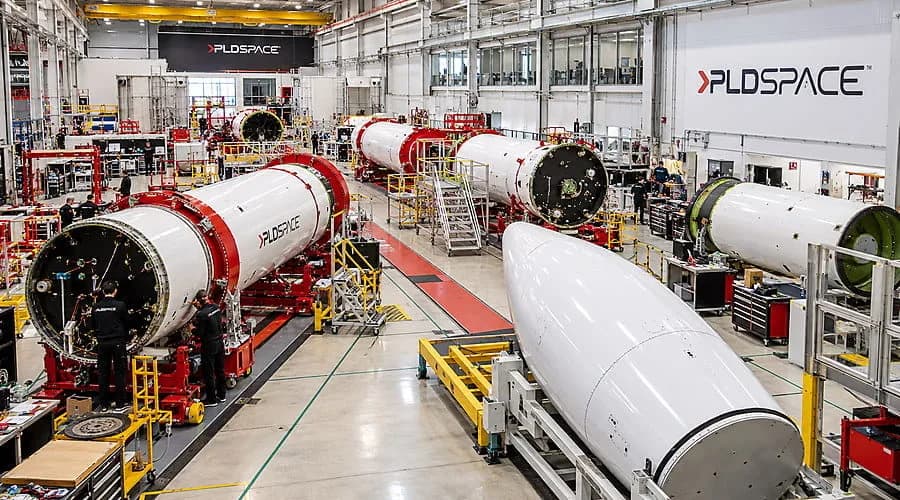
PLD Space announced on October 19 that it has manufactured the first three units of its MIURA 5 orbital rocket and begun system-level testing ahead of a demonstration flight planned for the first half of 2027.
The company, headquartered in Elche, Spain, is preparing to launch from the Guiana Space Centre in French Guiana, the European spaceport on South America's northeastern coast.
Two of the three vehicles are designated for qualification testing, while the third is being prepared for the inaugural flight.
This development marks an important transition: PLD Space is moving beyond designing individual components toward testing a complete launch system capable of eventually carrying satellites into orbit.
But the bigger story reaches beyond Spain.
Europe is working to develop a stronger commercial space industry at a time when access to orbit has become essential for communications, navigation, national security, and economic competitiveness.
Three Rockets, One Bigger Industrial Strategy
Building a rocket is extraordinarily difficult. Building a system capable of launching rockets repeatedly presents an even greater challenge.
That distinction explains why PLD Space has manufactured three MIURA 5 vehicles in parallel.
Two are being used to validate systems and identify problems before flight. Engineers can then apply the lessons to the third vehicle, which will undertake the demonstration mission.
The company has completed tests of the mechanism separating MIURA 5's first and second stages.
Its fully integrated second stage is now undergoing qualification testing at facilities in Teruel, Spain.
The upcoming procedures include a wet dress rehearsal, during which engineers practice fueling operations, followed by a static-fire test of the rocket engine.
These are essential steps toward demonstrating that propulsion, electronics, structures, and control systems can function together.
PLD Space has also manufactured seven complete engines, 13 fuel tanks, and enough flight avionics for four rockets, according to company figures.
The achievement is significant because successful commercial rocket operations require more than a single launch vehicle. They demand standardized manufacturing, reliable components, and repeatable procedures.
The company's strategy is to develop those capabilities before beginning routine orbital services.
Why Europe Wants Greater Control Over Space Launches
For decades, governments dominated the business of sending satellites into orbit.
Today, commercial companies are transforming the industry.
American companies, particularly SpaceX, have demonstrated how reusable rockets, expanded launch capacity, and private-sector investment can change the economics of space transportation.
Europe is seeking to strengthen its own capabilities in this increasingly competitive environment.
Satellites support telecommunications, weather forecasting, navigation, scientific research, agricultural monitoring, and military operations.
Governments and businesses depend on reliable access to those services.
But placing satellites in orbit requires launch providers with available rockets, suitable facilities, and dependable schedules.
Developing additional European launch options can help diversify that capacity.
MIURA 5 is designed to serve the market for smaller satellites, an increasingly important segment as companies and governments deploy spacecraft for specialized missions.
For European customers, a commercial launcher developed and manufactured within Europe could provide additional transportation choices.
For PLD Space, the opportunity is to build a sustainable business serving customers who need dependable access to orbit.
A Rocket Program That Supports Hundreds of Businesses
One of the most revealing aspects of MIURA 5 is its industrial supply chain.
According to PLD Space, the company has invested approximately €42.7 million in Spanish suppliers, involving 493 companies and more than 7,500 subcontracted components.
The company also associates more than 1,000 jobs with its broader activities.
These figures show how aerospace investment can spread across an economy.
A rocket requires specialized metals, precision manufacturing, electronics, fuel systems, software, sensors, and industrial equipment.
Each of those technologies depends on skilled workers and businesses capable of meeting demanding technical requirements.
A company manufacturing an aerospace component may also develop expertise applicable to other industries, including aviation, transportation, energy, and advanced industrial automation.
This is one reason governments increasingly view space technology as part of economic and national security policy.
A rocket is the finished product, but the industrial capabilities required to build it can become valuable assets throughout the economy.
PLD Space has also secured a Series C financing round totaling €288 million, supporting the industrialization of MIURA 5 and the expansion of its manufacturing, testing, and launch capabilities.
That funding reflects the substantial capital required to move from experimental engineering into commercial operations.
Building a Launch System From Spain to South America
PLD Space's operations now span several facilities.
In Elche, the company operates approximately 17,000 square meters of manufacturing space.
In Teruel, it maintains ten rocket-testing stands, including a new facility designed to test complete second stages.
Meanwhile, construction and preparation continue at the Guiana Space Centre in Kourou, French Guiana.
According to the company, approximately 60 containers of ground equipment have arrived at the spaceport.
Engineers are preparing systems that raise the rocket into position, hold it securely before liftoff, and connect the vehicle to electrical and fueling infrastructure.
PLD Space is also working with France's space agency, CNES, on launch procedures and safety requirements.
The geographic arrangement highlights the complexity of modern aerospace operations.
A rocket manufactured in Spain will undergo testing at specialized European facilities before launching from French territory in South America.
Kourou's location near the equator provides favorable conditions for many orbital missions because rockets can take advantage of Earth's rotational speed.
This combination of industrial production and geographic infrastructure gives Europe an established foundation for commercial space activity.
From MIURA 1 to an Orbital Ambition
PLD Space has already demonstrated an important part of its technological capability.
On October 7, 2023, its smaller MIURA 1 rocket completed a successful suborbital test flight.
That mission provided the company with valuable experience in propulsion, flight operations, recovery systems, and mission management.
MIURA 5 represents a considerably more ambitious undertaking.
Unlike a suborbital rocket, an orbital launcher must accelerate its payload to the enormous horizontal velocity required to remain in orbit around Earth.
That requires additional propulsion capability, precise guidance, multistage operations, and rigorous integration.
The company's first MIURA 5 launch is now planned for the first half of 2027, following earlier schedules that had targeted 2026.
Successful completion of the remaining tests will determine when the vehicle is ready for flight.
The company has also been selected for the European Space Agency's European Launcher Challenge, an initiative supporting the development of competitive European launch services.
That recognition connects PLD Space's commercial ambitions with Europe's broader interest in developing additional launch capacity.
The Bigger Opportunity: A New Commercial Space Economy
The market for space launches is changing because satellites are becoming increasingly important to everyday economic activity.
Communications networks, Earth observation services, research institutions, and national security agencies all depend on orbital infrastructure.
As those services expand, launch providers can compete on reliability, scheduling, payload compatibility, and cost.
MIURA 5 could eventually become another option in that market.
For Spain, success would strengthen its position in advanced aerospace manufacturing.
For Europe, it would add another commercial capability in a strategically important industry.
And for the global space economy, it would represent additional competition and opportunities for innovation.
The project's importance also illustrates a broader lesson about entrepreneurship.
Companies entering industries once dominated by major governments and established corporations are increasingly developing sophisticated technologies through private financing, specialized partnerships, and focused engineering.
The challenge is no longer simply demonstrating that a rocket can fly.
It is creating an industrial and operational system capable of launching reliably enough to serve paying customers.
Europe's Next Space Chapter Is Being Built Today
The first MIURA 5 demonstration flight remains ahead, but the manufacturing and testing milestones announced this month show tangible progress toward that objective.
Three vehicles have been manufactured, critical subsystems are undergoing validation, and launch infrastructure is being prepared in French Guiana.
Hundreds of Spanish suppliers are participating in the industrial effort, while substantial private financing supports the company's next stage of development.
The larger significance extends beyond one rocket or one country.
As the space economy expands, reliable access to orbit is becoming an increasingly valuable strategic and commercial capability.
The United States has already demonstrated how private companies can transform launch services. PLD Space is among the European companies pursuing opportunities in that evolving industry.
If MIURA 5 succeeds, its most important achievement may not simply be placing a satellite into orbit. It may be helping establish a new generation of European aerospace companies capable of building, launching, and competing in one of the world's most technologically demanding industries.