


 2 min read
 7
 Linkedin
 Threads
 Facebook
 X

Imagine a military organization designated by the United States as a terrorist group telling American citizens that their government must be replaced.
Now imagine that same organization releasing its message just weeks before congressional elections that could determine how much authority President Donald Trump can exercise during the remainder of his presidency.
This is not hypothetical.
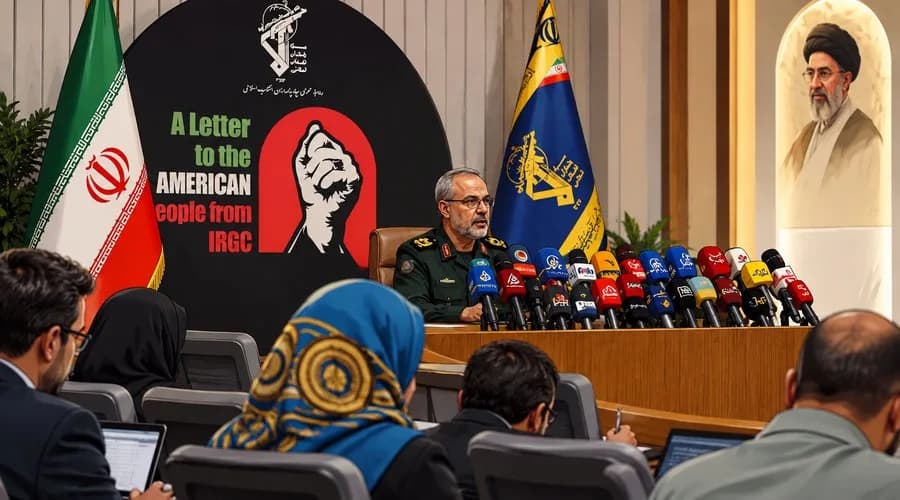
On September 29, Iran's Islamic Revolutionary Guard Corps (IRGC) published a 26-page open letter addressed to the American people, specifically targeting scholars, students, and members of the media.
Its message included a direct political demand:
"Remove from power the evil, deceitful, and violent politicians."
The letter specifically attacked President Trump, challenged American support for Israel, and urged voters to change their government.
Then something even more revealing emerged.
An October 19 investigation by The Washington Post, citing Iranian officials and regional diplomats, reported that Tehran was seeking to increase economic pressure on Americans ahead of the November 3 elections, partly to punish Trump politically.
The letter was a political message. The disruption of international oil shipping may be part of a much larger strategy.
And at the center of that strategy sits the United States Congress.
What Iran's IRGC Letter Actually Says; Why the Senate Vote Matters; Iran's Oil Strategy Before November 3; The Regime's Human Rights Contradiction; What the Midterms Could Change.
The answer requires an important distinction.
The IRGC's original letter did not explicitly mention the Democratic Party or instruct Americans to vote for named Democratic candidates.
But it directly attacked Trump, urged voters to change the makeup of their government, and called for the removal of the political leadership responsible for current American policies.
In Washington, the message was interpreted as an appeal for Republican defeats.
White House Communications Director Steven Cheung accused the IRGC of effectively telling Americans to "vote Democrat," dismissing the letter as a desperate political maneuver.
The distinction matters because the actual document is powerful enough without adding language it never contained.
Iran's Revolutionary Guard was openly attempting to influence American political opinion during an election in which Trump's congressional allies could lose power.
The question is why.
The Senate Vote That Explains Iran's Political Interest
On September 24, just five days before the IRGC released its letter, the U.S. Senate voted on a resolution directing the withdrawal of American armed forces from hostilities with Iran.
The result?
49 votes in favor. 50 votes against.
The resolution failed by one vote.
That was not an abstract debate about foreign policy. It demonstrated how closely divided Congress already was over military operations against Iran.
Republicans currently control the Senate with 53 seats, compared with 45 Democrats and two independents who caucus with Democrats.
For Democrats to secure a Senate majority in November, they would need a net gain of four seats.
A different congressional majority could change committee leadership, legislative priorities, investigations, appropriations negotiations, and the Senate's willingness to consider restrictions on military operations.
A Democratic Senate would not automatically end the war. Congress has separate legislative procedures, and presidential powers and vetoes would remain important.
Nevertheless, a change in congressional control could substantially complicate Trump's ability to maintain his existing military and diplomatic strategy.
Democratic lawmakers supporting war-powers restrictions have argued that Congress must exercise its constitutional authority over prolonged military conflicts.
That is a legitimate constitutional debate, independent of Tehran's preferences.
But the political advantage Iran might perceive in a divided Washington is another matter entirely.
Iranian Officials Are Watching November 3
The story became considerably more serious with the October 19 reporting.
The Washington Post interviewed Iranian officials and regional diplomats who described Tehran's focus on the approaching American midterm elections.
According to the investigation, Iranian leaders believe the weeks preceding the election offer an unusually important opportunity to pressure the Trump administration.
Why?
Because a military confrontation that raises global oil prices also raises economic costs for American families.
The Strait of Hormuz, one of the world's most strategically important shipping corridors, is central to that calculation.
The newspaper reported that Iran had attacked more than 20 vessels in October, including one that sank.
The United States has simultaneously intensified operations to protect international shipping and restore oil flows.
But military protection comes at a price, and continued attacks can increase shipping costs, insurance premiums, and energy-market uncertainty.
Higher oil prices can eventually affect transportation, food distribution, manufacturing, and household expenses.
In other words, Tehran possesses an instrument of economic pressure capable of reaching American consumers without ever firing a missile at the United States itself.
The Washington Post also reported that Iranian state television has been following American polling and examining how Republican electoral losses could constrain Trump.
Some commentary in Iranian media has openly contemplated the political benefits of Republican defeat.
This does not prove every shipping attack was ordered specifically to influence American elections. But it provides evidence that Tehran sees American electoral politics as part of its strategic battlefield.
A Government That Suppresses Protesters Is Lecturing American Voters
There is another extraordinary contradiction.
The IRGC presents its appeal as a defense of ordinary Americans against supposedly corrupt political leaders.
Yet the same Iranian security establishment has been implicated in severe repression of its own population.
A United Nations fact-finding mission reported in September that Iranian authorities committed grave human-rights violations during the suppression of demonstrations beginning in December 2025, including killings, arbitrary detention, and torture. Investigators concluded that many abuses amounted to crimes against humanity.
The Islamic Republic also subjects electoral candidates to vetting by unelected authorities, placing substantial restrictions on political competition.
Now the Revolutionary Guard is encouraging Americans to exercise political rights that Iranians cannot exercise with the same freedom.
That contradiction should be part of every serious examination of Tehran's appeal.
Criticism of American military action is not support for the Iranian regime. Neither is membership in the Democratic Party evidence of cooperation with Tehran.
But Americans are entitled to ask why a foreign security organization with this record is attempting to shape their political decisions.
November 3 Is Now Part of the Geopolitical Battlefield
The Islamic Republic has spent decades challenging American influence in the Middle East, supporting armed regional organizations and resisting U.S. economic pressure.
The Trump administration has sought to restrict that influence through military operations, sanctions, and pressure on Iranian oil revenue.
Tehran has responded through military action, economic disruption, diplomatic maneuvering, and increasingly direct political messaging to the American public.
The September 29 letter belongs within that larger strategy.
And the October reporting offers a clearer explanation of why timing matters.
Iran's leadership may calculate that increased economic dissatisfaction, political division, and a less cooperative Congress would improve its negotiating position.
That is Tehran's strategic calculation, not a guarantee of what American voters will do.
Ultimately, American elections belong to American citizens. Foreign governments do not determine their outcomes, and Americans remain free to debate war, peace, constitutional authority, and the economic costs of foreign policy.
But when an organization designated as a terrorist group tells Americans to remove their leaders while its government reportedly seeks to increase the economic pressure surrounding an election, the implications cannot be ignored.
The most revealing question is not simply whether Iran prefers Republicans or Democrats in Congress.
It is why Tehran believes changing the balance of power in Washington could accomplish something its missiles, military threats, and diplomatic demands have not.
Iran's Revolutionary Guard has made its political interests visible. On November 3, the decisions belong to Americans—not Tehran.