 3 min read
 28
28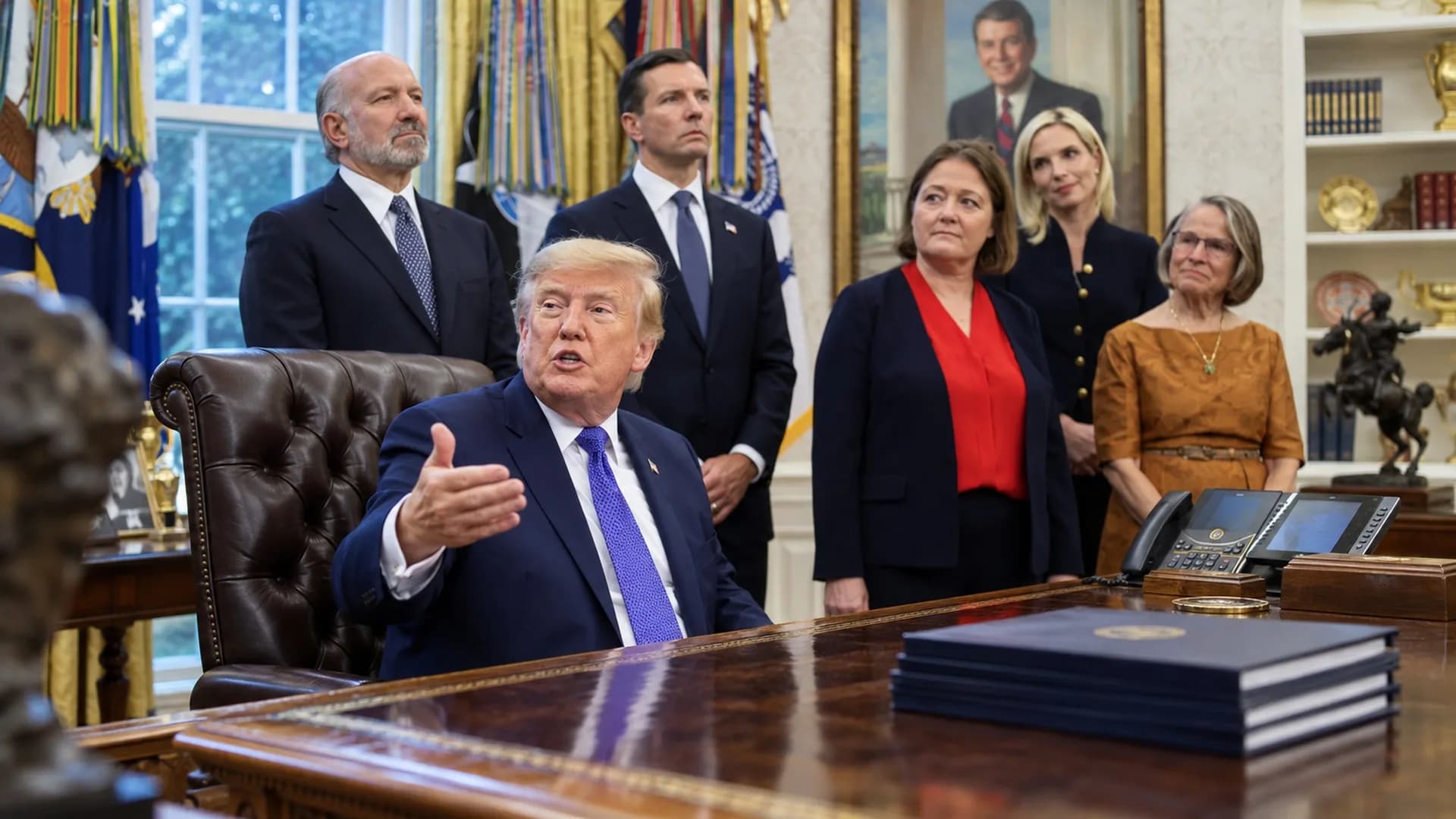
 Linkedin
 Threads
 Facebook
 X
X
Why does an announcement involving roughly $18 billion in American mining and steel investment, thousands of construction jobs and one of the largest new steel complexes in U.S. history feel smaller in the national conversation than another political controversy of the day?
That is the more interesting question after President Donald Trump and Mesabi Metallics announced a massive new steel operation connecting Minnesota's Iron Range with a planned mill in eastern Iowa.
To be clear, this was not a complete media blackout. The Associated Press, Reuters, CBS News and The Wall Street Journal all covered the announcement. But much of the national reporting quickly moved to the electoral context: Iowa is competitive, the midterms are approaching, Trump was surrounded by Republican officials and the White House clearly wants voters to associate the project with its economic policies.
All true.
But politics may actually be the least interesting part of what just happened.
Mesabi Metallics says it is investing $15 billion in the Iowa steel facility, on top of roughly $3 billion in its Minnesota mining operation, creating a fully integrated American chain stretching from iron ore to finished steel. The Iowa mill is expected to support as many as 6,000 construction jobs and 1,750 permanent jobs when operating. The Minnesota operation is expected eventually to employ roughly 350 people directly.
The planned mill would begin with capacity of approximately 7.5 million tons of steel annually, eventually approaching 10 million tons. Production is expected around 2030. The White House says the project could generate $95 billion in economic activity, although that figure is a projection rather than money already created.
That distinction matters.
This is a project, not yet 10 million tons of steel rolling out of an Iowa factory.
But something very real has already happened in Minnesota.
The mine may be just as important as the mill
Earlier this month, Mesabi began startup operations at what the Export-Import Bank describes as America's first new iron-ore mine and pellet plant in 50 years.
The facility is designed to produce as much as seven million tons annually of high-grade direct-reduction iron pellets used in modern steelmaking. EXIM's board recently approved a $770 million direct loan supporting the project.
Why should anyone outside Minnesota care about an iron mine?
Because steel is not some nostalgic industry belonging to photographs of Pittsburgh in 1955.
Steel is still foundational to a modern economy.
The U.S. Geological Survey describes iron ore as the primary source of iron for global steel production and says steel is essential to maintaining a strong industrial base. Iron and steel together represent roughly 95 percent of the tonnage of metal produced annually in the United States and worldwide.
Think about where the world is heading.
Artificial-intelligence data centers are driving extraordinary electricity demand. Utilities need transmission lines. Transformers need specialized steel. Factories require equipment. Roads, bridges, rail systems, vehicles, pipelines, military hardware and energy infrastructure all depend in varying degrees on steel.
The Department of Energy warned this year that America's power system requires significant new transmission infrastructure because of growing electricity demand from data centers, manufacturing and other large industrial loads. DOE has also identified shortages and long lead times for grid components, including electrical steel used in transformers.
That makes this story considerably more modern than the image of smokestacks might suggest.
The race for artificial intelligence is also a race for electricity.
The race for electricity becomes a race for infrastructure.
And infrastructure eventually becomes a race for materials.
You can design the world's best AI chip in California. Somebody still has to build the data center, the transmission system and the physical economy surrounding it.
Jobs are only part of the story
There is another reason the announcement deserves attention.
America has spent decades becoming extraordinarily good at designing, financing, marketing and consuming products whose physical supply chains frequently begin somewhere else.
That arrangement works beautifully—until something breaks.
COVID exposed one version of the vulnerability. Semiconductor shortages exposed another. China's dominance of portions of the critical-minerals supply chain created another national-security concern.
USGS reported this year that the United States still relies on China as a major source for 14 of the 33 critical minerals for which America is most import-dependent. Mineral-dependent American industries represented approximately $4.09 trillion in economic value in 2025.
Iron ore is not the same strategic problem as rare earths. The United States already possesses substantial iron and steel capability.
But the principle is similar.
A country that wants an advanced manufacturing economy cannot think only about the final factory.
It must think about what feeds the factory.
That is why the phrase being used around this project—mined, melted and poured in America—is economically more important than its political branding.
The Minnesota ore would travel to Iowa. Iowa would make the steel. American manufacturers would then have another large domestic source of material.
That is an industrial ecosystem, not simply 1,750 people receiving paychecks.
And recent employment data provides some context. The Bureau of Labor Statistics reported manufacturing employment rose by 16,000 in August and was up 58,000 from its recent December 2025 low. Fabricated-metal manufacturing was among the sectors adding workers.
One steel project cannot transform the American labor market.
But several projects begin to form a pattern.
Then there are the tariffs
Trump argues that his steel tariffs helped make investments like this financially attractive by making imported steel less able to undercut domestic producers.
There is evidence for the investment side of that argument. Steel companies have announced major domestic projects, and Mesabi itself is making an enormous capital commitment.
But tariffs are not economically free.
Higher barriers against imported steel can also increase material costs for American companies that consume steel, including builders, manufacturers and automakers. The announcement even pushed shares of several existing American steelmakers lower as investors considered the possibility of substantially greater domestic capacity competing for the same customers.
That is the real policy debate.
Not “tariffs good” versus “tariffs bad.”
The question is whether higher short-term costs and protection from foreign competition produce enough new American capacity, investment, jobs and strategic resilience to justify the tradeoff.
Iowa may become one of the largest tests of that proposition.
Is the media hiding good Republican polls?
There is another temptation surrounding this story: to conclude that limited enthusiasm for the announcement is designed to hide improving Republican polling.
The current evidence does not establish that.
Nationally, several recent surveys actually show Democrats leading the congressional generic ballot. Emerson's September 21-22 survey of 1,000 likely voters had Democrats at 53 percent and Republicans at 42 percent, while a recent Reuters/Ipsos measurement listed by RealClearPolling had Democrats ahead 43-35.
Iowa itself is considerably more complicated.
An Emerson poll conducted August 31-September 1 had Republican Senate candidate Ashley Hinson at 50 percent and Democrat Josh Turek at 45 percent. A later Marist survey had Turek ahead 50-42, while a late-September InsiderAdvantage poll showed a much narrower 47.4-45.7 race. Because those are different pollsters using different samples and methodologies, they should not be treated as one continuous trend line.
So the more defensible media question is not whether reporters are hiding a Republican polling surge.
It is whether an enormous industrial development is being viewed primarily through the political horse race instead of through its economic significance.
Those are not the same thing.
The midterms will come and go in November.
The Iowa plant, if completed on schedule, is supposed to begin producing steel around 2030 and operate for decades after today's campaigns have been forgotten.
That is why this announcement deserves a longer lens.
America is debating AI supremacy, competition with China, military readiness, energy security, supply chains and whether middle-class industrial employment can genuinely return.
Every one of those conversations eventually reaches the physical economy.
Mines.
Power.
Factories.
Railroads.
Steel.
Perhaps the real story is not that Donald Trump announced another manufacturing project.
It is that after decades when Americans were repeatedly told the future belonged almost entirely to software, services and globalization, somebody is placing an $18 billion bet that digging something out of American ground, turning it into American steel and employing Americans to do it still matters.
Whether that bet succeeds will matter long after the next poll disappears from the screen.