3 min read
 79
79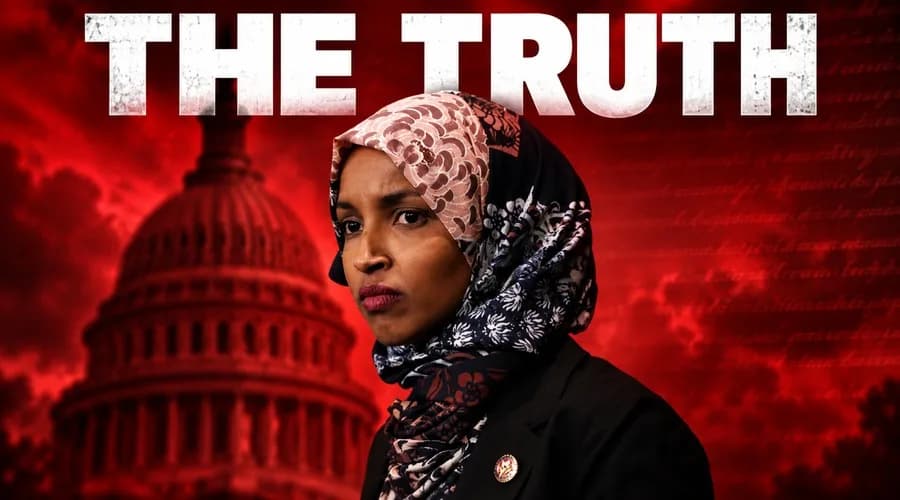
 Linkedin
 Threads
 Facebook
 X
X
Federal agents arrived at Congresswoman Ilhan Omar's Washington, D.C., residence early Monday morning, October 12, executing a judicially authorized search warrant as part of an ongoing criminal investigation.
This was not a political commentator demanding answers on television. This was Homeland Security Investigations, operating under a warrant obtained by the Department of Justice.
The department confirmed the search but did not disclose the precise scope of the investigation. Reporting from Fox News and Axios indicates that investigators are examining questions involving Omar's immigration history.
And that development deserves attention for reasons extending far beyond one Democratic congresswoman.
For years, Minnesota has been dealing with extraordinary fraud involving public assistance programs, questionable financial transactions, and criminal networks that exploited money intended for vulnerable Americans.
Omar represents Minneapolis, the city at the center of much of that scandal. Her campaign also previously received contributions from individuals subsequently charged in the Feeding Our Future fraud investigation.
These facts do not establish that Omar participated in those crimes. But they make the larger story of political accountability, financial oversight, and federal enforcement impossible to ignore.
The Marriage Allegation That Never Disappeared
Omar was born in Somalia and arrived in the United States as a refugee. She became an American citizen in 2000 and was elected to Congress in 2018.
Her personal history has nevertheless been the subject of years of controversy.
Republican political figures have repeatedly alleged that her 2009 marriage to Ahmed Nur Said Elmi was arranged to facilitate immigration benefits for a man they claim was her biological brother.
Omar has consistently denied that accusation.
Investigations by news organizations, including the Minnesota Star Tribune, identified discrepancies involving marriage timelines, addresses, and tax records. Among the documented irregularities were joint tax returns filed with Ahmed Hirsi during a period when Omar was legally married to Elmi.
But those discrepancies did not establish that Elmi was her brother or that immigration fraud occurred. No publicly verified evidence has proven either allegation.
That distinction is critical as the new federal investigation develops.
If immigration documents were deliberately falsified, federal law provides mechanisms for investigation and prosecution. The same standards apply regardless of political affiliation, country of birth, or congressional position.
But an allegation repeated for ten years does not become established evidence simply because federal agents execute a search warrant.
The responsibility now belongs to investigators to establish what actually happened.
Minnesota's Fraud Scandal Is Not a Rumor
While Omar's personal immigration allegations remain unproven, the massive fraud involving Minnesota's federally funded programs is a documented criminal scandal.
In September 2022, the Department of Justice announced charges against 47 defendants accused of participating in a $250 million scheme involving Feeding Our Future, a Minnesota nonprofit operating within the federal child nutrition program.
Prosecutors described an elaborate system of fictitious meal distribution sites, fabricated invoices, inflated reimbursement claims, and shell companies.
Money intended to feed children was diverted into personal accounts, real estate, luxury purchases, and other expenditures.
By July 2026, federal prosecutors had announced their 68th conviction in the Feeding Our Future investigation.
One defendant, Abdikerm Abdelahi Eidleh, was taken into custody in Somalia in June 2026 after years as a fugitive. He faces charges including wire fraud, bribery, and money laundering.
The magnitude of the scandal raises an unavoidable question.
How did a program designed to feed hungry American children become an opportunity for criminals to extract hundreds of millions of dollars?
And why did government safeguards fail so spectacularly?
This was not simply a paperwork problem. Federal prosecutors established that extensive false claims generated payments for meals that were never served.
The failure deprived legitimate beneficiaries of resources while placing enormous sums into the hands of fraudulent operators.
The Political Donations That Deserve Examination
The relationship between the fraud defendants and Minnesota politics also deserves scrutiny.
In September 2022, KARE 11 examined political donations from individuals charged in the Feeding Our Future scandal.
The investigation found that Omar had received approximately $7,400 from three defendants.
Her campaign acknowledged those contributions and stated that equivalent funds had been donated to local food charities after the federal investigation became public.
Other Minnesota Democratic politicians also received contributions from defendants and subsequently returned or redirected some of that money.
Receiving a campaign contribution from someone later convicted of fraud does not establish that a politician knew about the criminal activity.
But campaign contributions create legitimate questions about political access, oversight, and the relationships between publicly funded organizations and elected officials.
Who requested meetings? Who advocated for funding? Were warnings about fraud adequately investigated? Did organizations receiving public money seek political influence?
These are questions that campaign-finance disclosures, government correspondence, and congressional records can help answer.
Omar also introduced the MEALS Act in March 2020 to expand flexibility in federal school nutrition programs during the pandemic. Related waiver provisions became law as part of bipartisan emergency legislation.
A federal magistrate judge subsequently identified vulnerabilities created by pandemic-era USDA waivers that fraud operators exploited. That finding does not establish that Omar intended or anticipated the fraud.
Nevertheless, it raises an important question of legislative responsibility: when emergency safeguards are relaxed for a legitimate humanitarian purpose, who is responsible for ensuring that the resulting financial system cannot be systematically exploited?
Omar later publicly called for an investigation into the Feeding Our Future scandal. The effectiveness of the oversight that followed deserves examination alongside the original policy decisions.
$349 Million Leaving Minnesota: Where Was the Governor? Where Was the Oversight?
In 2025 alone, approximately $349.4 million in cash was reportedly transported through Minneapolis–St. Paul International Airport on international departures, following another $342 million in 2024. Nearly $700 million in two years. How does this happen in a state already confronting one of America's largest public-benefits fraud scandals?
And where were Governor Tim Walz, state agencies, and the legislative authorities responsible for safeguarding taxpayer-funded programs?
Federal law permits travelers to transport declared currency overseas. But legality is not the end of the investigation. Who owned this money? Where did it originate? Who received it? And how much, if any, came from programs intended to help struggling Minnesota families?
Investigative reporting has identified routes through Amsterdam and Dubai, with particular concerns about financial transfers involving Somalia where a large portion of those millions is being taken. Those reports warrant scrutiny.
The governor and state lawmakers cannot simply point toward Washington and dismiss the problem. While federal authorities control international currency enforcement, Minnesota officials remain responsible for protecting the integrity of their own public programs.
A state that cannot adequately account for money distributed through taxpayer-funded programs has a serious accountability problem. And when hundreds of millions in physical currency are traveling overseas, Americans deserve more than political explanations.
They deserve the financial records, the names of those responsible for proven fraud, the destination of illegally diverted funds, and a complete accounting of how government oversight failed.
Follow the money. Follow the beneficiaries. And hold accountable every official who ignored documented warnings.
The Search Is Only the Beginning
The October 12 search places Omar at the center of an active federal investigation, but the public does not yet know precisely what evidence agents sought or what prosecutors may ultimately conclude.
The Minnesota fraud investigations, meanwhile, have already produced convictions, documented financial losses, and increasingly sophisticated federal efforts to follow money beyond America's borders.
Those are separate evidentiary matters unless investigators establish a connection.
For the Democratic Party, Minnesota's experience raises serious questions about government oversight and the consequences of failing to detect fraud in publicly funded programs.
For Republicans, it presents an opportunity to demonstrate that promises of accountability can result in verifiable investigations, prosecutions, recoveries, and stronger safeguards.
And for taxpayers, the central principle is simpler.
Government assistance intended for hungry children, struggling families, and vulnerable Americans must reach those people—not fraudulent operators who exploit the system.
When public money disappears, political connections should not shield anyone from scrutiny. When allegations involve a member of Congress, investigators must follow the evidence wherever it leads.
The United States owes every citizen equal protection under the Constitution. And every citizen—whether born here or naturalized—owes the nation obedience to its laws.
The search has begun. Now America deserves to see where the evidence leads.