3 min read
 1
1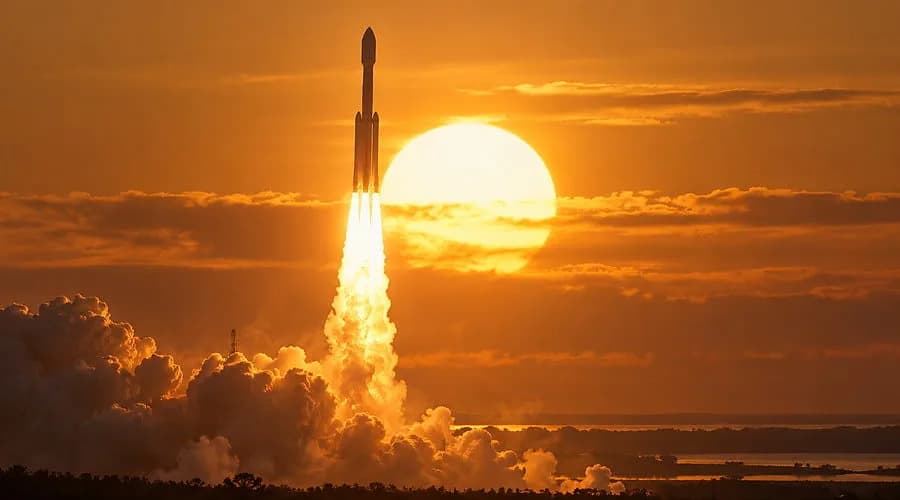
 Linkedin
 Threads
 Facebook
 X
X
NASA has launched one of the most ambitious space observatories in American history, sending a powerful new telescope toward a destination nearly one million miles from Earth to investigate some of the greatest unanswered questions about the universe.
The Nancy Grace Roman Space Telescope lifted off on August 30, 2026, aboard a SpaceX Falcon Heavy rocket from Kennedy Space Center in Florida.
Its mission is extraordinary: study billions of galaxies, search for planets beyond our solar system, and investigate the invisible components of the cosmos that scientists believe influence how the universe forms and expands.
And the spacecraft is already making progress.
On September 15, NASA confirmed that Roman's primary scientific instrument, a 300-megapixel infrared camera, had been successfully activated. By September 30, its precision guidance system had passed important tests, and another instrument designed to observe distant planets had collected its first light.
The telescope is still undergoing commissioning rather than conducting its full scientific mission. NASA expects its first science images in early 2027.
But the real significance of Roman goes beyond another successful rocket launch.
For the first time, astronomers will have a space telescope combining Hubble-like image clarity with the ability to observe enormous portions of the universe at unprecedented speed.
That combination could change not only what humanity discovers, but how scientific discovery happens.
Hubble Showed Us the Universe. Roman Will Help Map It.
For more than three decades, the Hubble Space Telescope has transformed humanity's understanding of space.
Its extraordinary images revealed distant galaxies, star-forming regions, and cosmic structures that previously existed only as theoretical possibilities or faint observations.
The James Webb Space Telescope expanded those capabilities, using powerful infrared instruments to investigate distant galaxies, planetary atmospheres, and some of the universe's earliest light.
Roman is designed for a different mission.
Rather than concentrating primarily on relatively small regions of the sky, Roman can survey enormous areas while maintaining exceptional image quality.
According to NASA, its field of view is at least 100 times larger than Hubble's.
Its main mirror measures 7.9 feet across, approximately the same size as Hubble's, but its advanced camera and optical design allow it to capture far more sky in a single observation.
Think of the difference between examining a city through a narrow window and studying the same city through a panoramic camera.
Both can produce valuable information.
But the panoramic view reveals patterns, relationships, and structures that would be difficult to recognize by observing isolated sections.
Roman's wide-field observations are designed to do something similar with the universe.
NASA expects the observatory to measure light from enormous numbers of galaxies, potentially reaching a billion over its lifetime.
That scale matters because many of astronomy's biggest mysteries cannot be solved by studying a handful of objects.
They require understanding how galaxies, matter, and cosmic structures behave across vast distances.
The Mystery of the Universe's Invisible 95%
One of Roman's most important scientific objectives involves dark matter and dark energy.
These terms may sound like science fiction, but they describe two of the most consequential unresolved problems in modern physics.
Scientists estimate that ordinary matter—the atoms making up planets, stars, oceans, human bodies, and everything familiar—accounts for only about 5% of the universe's total mass-energy content.
Dark matter is thought to account for approximately 27%, while dark energy represents roughly 68%.
Researchers have not directly identified the fundamental nature of either one.
Dark matter is inferred largely through its gravitational effects, including how galaxies rotate and how massive structures bend light.
Dark energy is the name given to whatever is driving the observed acceleration of the universe's expansion.
Roman will investigate these mysteries by surveying large numbers of galaxies and measuring how cosmic structures have evolved.
One important technique involves gravitational lensing.
According to Einstein's theory of general relativity, matter bends spacetime, changing the paths traveled by light.
By measuring subtle distortions in the apparent shapes of distant galaxies, astronomers can study how matter is distributed across the universe, including matter that cannot be seen directly.
Roman will also investigate the distribution and distances of galaxies to better understand how cosmic expansion has changed over billions of years.
The stakes are enormous.
If observations reveal unexpected patterns, scientists may need to revise aspects of their current understanding of cosmology.
But Roman is not guaranteed to discover a new law of physics.
Its purpose is to collect evidence precise and extensive enough to test competing explanations.
The breakthrough may not be discovering something entirely new. It may be learning that one of our most widely accepted explanations of the universe is incomplete.
Thousands of New Worlds Could Be Waiting
Roman's second major scientific mission is to investigate planets orbiting stars beyond our solar system.
Astronomers have already confirmed thousands of these exoplanets, revealing an extraordinary diversity of planetary systems.
Some worlds orbit extremely close to their stars. Others are giant gas planets, while still others appear to be rocky worlds that may share certain characteristics with Earth.
But existing detection methods have limitations.
Roman will use a technique called gravitational microlensing to identify planets that might otherwise remain undetected.
When one star passes in front of another from our perspective, the gravitational field of the closer star can temporarily magnify the background star's light.
If planets orbit the foreground star, they can create additional variations in the observed brightness.
Scientists can analyze those signals to infer the presence of distant worlds.
This approach is particularly valuable for discovering planets at greater distances from their stars, complementing methods that are especially effective at finding planets in closer orbits.
Roman will also carry a Coronagraph Instrument designed to block the overwhelming brightness of a star so that much fainter objects nearby become easier to observe.
The technology could help scientists directly image certain planets beyond our solar system.
It is not designed to establish that extraterrestrial life exists.
Instead, it will test techniques that could support future observatories searching for potentially habitable worlds.
That distinction is important.
Roman is not launching to announce that life exists elsewhere. It is helping build the scientific tools that could eventually allow humanity to investigate that question more effectively.
Why NASA Sent Roman a Million Miles Away
Roman is traveling toward the second Sun-Earth Lagrange point, commonly called L2.
Located approximately one million miles from Earth, this region offers conditions well suited to sensitive space observations.
A spacecraft operating near L2 can maintain a relatively stable relationship with Earth and the Sun while limiting certain thermal and observational disruptions.
The James Webb Space Telescope also operates near this region.
Roman's journey is expected to take approximately three months.
During that time, mission controllers are deploying equipment, testing systems, adjusting the spacecraft's trajectory, and calibrating its scientific instruments.
The tests completed during September represent meaningful progress.
NASA reported that the spacecraft's guidance system successfully demonstrated the ability to lock onto reference stars with the precision needed for detailed observations.
Its coronagraph also began receiving cosmic light as engineers evaluated the instrument's performance.
These milestones indicate that important systems are functioning, but they do not mean the telescope has completed every required test.
The most consequential scientific work is still ahead.
A New Kind of Telescope Means a New Data Challenge
Roman is expected to produce approximately 1.4 terabytes of scientific data every day.
That is an extraordinary amount of information for a space observatory.
NASA anticipates using machine learning, artificial intelligence, automated analysis, and participation from citizen scientists to help identify important patterns and unusual objects within those observations.
Why does that matter?
Because collecting data is no longer the only major obstacle in astronomy.
Scientists must also determine how to identify meaningful discoveries buried within enormous volumes of information.
A telescope might observe millions of galaxies or stars, but recognizing a rare event can require sophisticated computational tools.
Artificial intelligence could help flag unusual signals for further investigation, while human researchers evaluate their significance.
Roman's scientific data is also intended to become publicly available after processing.
That could allow researchers from universities and institutions around the world to investigate the same observations independently.
The approach creates opportunities for discoveries beyond the mission's original objectives.
An astronomer studying black holes, for example, may find valuable information in observations originally collected for a dark-energy survey.
The telescope could become a scientific resource far larger than any one research team's agenda.
American Innovation Behind the Mission
Roman also represents a significant achievement in American engineering and industrial cooperation.
NASA's Goddard Space Flight Center manages the mission, with contributions from the Jet Propulsion Laboratory, research institutions, aerospace companies, and international partners.
SpaceX provided the Falcon Heavy launch vehicle, demonstrating the growing role of commercial companies in supporting government science missions.
NASA also reported that Roman was completed ahead of its planned launch schedule and within its approved budget.
The mission illustrates how long-term public research, specialized private manufacturing, and commercial launch services can contribute to a shared scientific objective.
It also raises a larger economic question.
What is the value of investing in research whose practical applications may not become clear for decades?
Space missions produce scientific knowledge, but they also require advances in precision engineering, sensors, communications, software, and data processing.
Not every technological advancement will lead directly to a consumer product.
Yet maintaining these capabilities supports the broader aerospace workforce and scientific infrastructure that America depends on for both exploration and national security.
Roman is also named in honor of Nancy Grace Roman, NASA's first chief astronomer, whose leadership helped establish the foundations of space-based astronomy and earned her recognition as the mother of the Hubble Space Telescope.
The observatory carrying her name builds on that legacy.
The Next Great Discovery May Begin With a Question
Roman's primary mission is planned to last five years, with NASA aiming for the possibility of a longer operational life.
Its scientific program is designed to investigate the evolution of the universe, the distribution of planets, and the behavior of cosmic structures across extraordinary distances.
But some of the most important discoveries may come from questions scientists have not yet thought to ask.
That has been a recurring lesson throughout the history of space exploration.
New instruments reveal new evidence. New evidence challenges established assumptions. And those challenges open the door to new scientific understanding.
Roman's successful launch and early testing mark the beginning of that process.
Its first major scientific results are still ahead, and the mysteries it is designed to investigate may require years of observations before researchers can draw firm conclusions.
Nevertheless, the mission represents an important change in humanity's ability to explore the cosmos.
For generations, scientists have examined individual galaxies, stars, and planets to assemble a picture of the universe.
Now, an observatory designed to study vast cosmic populations will help them investigate the larger patterns connecting those objects.
The greatest promise of NASA's new telescope is not simply that it will show us more of the universe. It is that, by seeing more, humanity may finally understand how much of the universe it has been missing.