


 2 min read
 17
17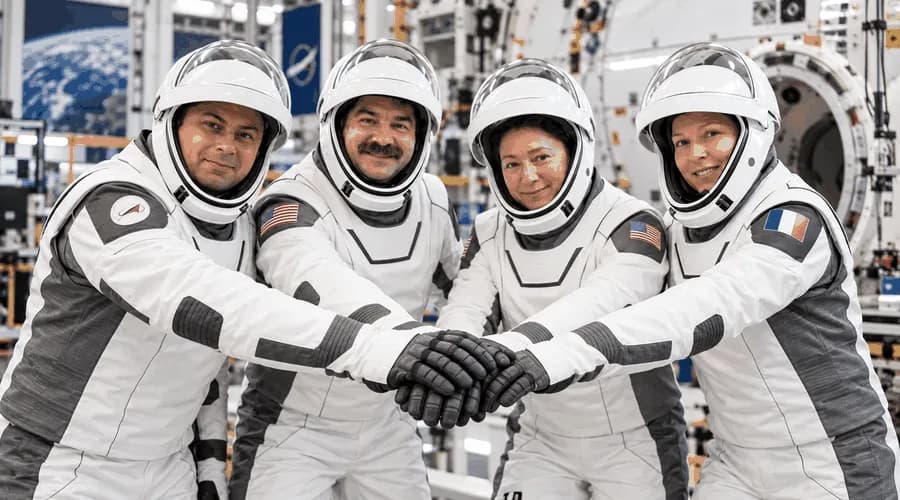
 Linkedin
 Threads
 Facebook
 X
X
Four astronauts returned safely to Earth on Thursday, October 8, after spending 237 days in space, bringing another major NASA and SpaceX mission to a successful conclusion.
The SpaceX Crew Dragon capsule Freedom splashed down in the Pacific Ocean off the coast of Los Angeles at 11:34 a.m. Eastern Time, completing NASA's Crew-12 mission to the International Space Station (ISS).
Aboard were NASA astronauts, from left, Russian cosmonaut Andrey Fedyaev, the American astronauts Jack Hathaway, Jessica Meir and French astronaut Sophie Adenot of the European Space Agency, who returned to Earth on Thursday.
According to NASA, the crew traveled more than 100 million miles and completed over 3,792 orbits around Earth during the mission, which began on February 13, 2026.
Recovery teams retrieved the spacecraft and its passengers shortly after splashdown, ending nearly eight months of scientific research, maintenance operations, and life in microgravity.
But beyond the successful landing lies a larger story about America's growing dependence on commercial space transportation, the future of scientific research, and the extraordinary demands of living beyond Earth.
Eight Months Away From Earth
The Crew-12 astronauts launched aboard a SpaceX Falcon 9 rocket from Cape Canaveral Space Force Station in Florida on February 13 and reached the ISS the following day.
Their mission was part of NASA's Commercial Crew Program, which uses privately developed spacecraft to transport astronauts to and from the orbiting laboratory.
For Meir and Fedyaev, this was their second journey into space. Hathaway and Adenot experienced their first spaceflight.
During their time aboard the station, the astronauts participated in scientific experiments, maintained critical equipment, and conducted spacewalks.
Meir completed four spacewalks during the mission, bringing her career total to seven. Adenot also made history by becoming the first French woman to perform a spacewalk.
Their return followed the October 1 arrival of Crew-13, which took over responsibilities aboard the station.
Seven astronauts remained on the ISS after Crew-12 departed, continuing the research and operations that have made the station one of humanity's most important scientific laboratories.
The mission also followed an unusual beginning. Crew-12 arrived after the previous crew returned early because of a medical concern involving astronaut Mike Fincke, an event that underscored the need for dependable transportation and emergency planning in orbit.
The successful completion of Crew-12 demonstrated how quickly space agencies and their commercial partners must sometimes respond when circumstances change.
The Research That Could Help People on Earth
One of the most important aspects of the mission was not the spectacular journey but the scientific work performed hundreds of miles above Earth.
According to NASA's October 8 mission summary, Crew-12 conducted research involving stem cell production, nutrition, cardiovascular health, and technologies for future deep-space missions.
Among the investigations was research into producing stem cells that could eventually support cell-based medical therapies.
Scientists are interested in how the microgravity environment influences cell behavior, development, and manufacturing processes.
The astronauts also studied bacteria associated with pneumonia, including how infections might contribute to longer-term damage to the heart.
Other experiments examined blood circulation in space and ways to generate intravenous fluids when conventional medical supplies may be difficult to transport or replenish.
Why conduct these studies in orbit?
Because microgravity creates conditions that scientists cannot fully reproduce for long periods on Earth.
Without the constant influence of Earth's gravity, researchers can observe biological and physical processes differently, potentially revealing information that would otherwise remain difficult to detect.
However, these experiments should not be confused with completed medical breakthroughs. Many are still investigating fundamental scientific questions, and potential applications require additional testing.
The practical significance is nevertheless substantial.
Research conducted in space may eventually contribute to advances in healthcare, manufacturing, and technologies needed to keep astronauts alive during longer missions.
The ISS is therefore more than a destination for astronauts. It is a laboratory that may help solve problems both in space and on Earth.
SpaceX Is Changing How America Reaches Space
The mission also highlights a major transformation in American space exploration.
For decades, the federal government largely developed, owned, and operated the spacecraft used to carry American astronauts.
NASA's Commercial Crew Program introduced a different model: the government contracts with private companies to provide transportation services while maintaining oversight and safety requirements.
SpaceX has become central to that approach.
Since receiving NASA certification in 2020, Crew Dragon has carried astronauts on repeated missions to the ISS.
This arrangement allows NASA to concentrate more resources on scientific research and future exploration while purchasing transportation from commercial providers.
It also creates opportunities for private companies to improve spacecraft designs and develop additional commercial markets.
But success creates another question: What happens when an essential national capability becomes heavily dependent on one private provider?
NASA originally selected both SpaceX and Boeing to develop commercial crew transportation systems.
Yet Boeing's Starliner program has experienced substantial technical setbacks.
A June 2026 report from NASA's Office of Inspector General stated that SpaceX's Crew Dragon had been certified and was conducting operational missions, while Starliner remained uncertified following problems identified during its flight tests.
That means SpaceX's reliability has become increasingly important to maintaining routine American crew access to the space station.
The distinction matters.
Commercial partnerships can encourage innovation and efficiency. But competition and redundancy are also important when astronaut safety and access to critical space infrastructure are involved.
America's future in space may depend not only on successful private companies but on building an industry capable of supporting more than one dependable transportation provider.
Living in Space Comes With a Physical Price
For astronauts, completing the mission does not mean their bodies immediately return to normal.
Spending months in microgravity changes how the human body functions.
Without Earth's gravitational forces, muscles can weaken, bones can lose density, and the cardiovascular system adapts to conditions very different from those experienced on the ground.
Astronauts also experience changes in balance and coordination.
After landing, they undergo medical examinations and rehabilitation to help their bodies readjust to gravity.
These challenges are among the reasons NASA continues studying long-duration spaceflight.
If humans eventually travel to Mars, astronauts could spend years away from Earth, including extended periods without access to conventional medical facilities.
Understanding how the body responds to months in orbit is therefore an essential step toward more ambitious missions.
Yet there is also a deeply human dimension.
After 237 days in a tightly controlled environment, simple experiences such as walking outdoors, feeling fresh air, and embracing family members become extraordinary again.
The astronauts' return is a reminder that behind every technological achievement are people accepting physical risks and prolonged separation from loved ones.
The International Space Station Is Approaching a Turning Point
Crew-12 also returned at a significant moment in the history of the ISS.
The station has maintained a continuous human presence for more than 25 years, supporting scientific research and international cooperation.
Even amid political tensions on Earth, American, European, and Russian personnel have continued working together aboard the orbiting complex.
But the ISS is not intended to operate indefinitely.
NASA is preparing for its eventual retirement, currently planned around 2030, while exploring the development of commercially operated space stations.
That transition could reshape the space economy.
Instead of relying primarily on one government-led orbital laboratory, future astronauts and researchers may work aboard facilities operated by private companies and serving government, academic, and commercial customers.
The opportunity is significant, but so are the challenges.
New stations must prove that they can support human life safely, conduct meaningful research, and remain financially sustainable.
The successful return of Crew-12 reinforces the importance of dependable transportation as NASA prepares for that future.
A commercial space station cannot function without reliable ways to deliver people, equipment, and supplies.
The Bigger Mission Is Just Beginning
Four astronauts returning safely from space is worth celebrating.
But the importance of Crew-12 extends beyond its successful splashdown.
Its 237 days in orbit contributed to research on human health, tested technologies for future exploration, and strengthened operational experience in transporting astronauts through commercial partnerships.
The mission also illustrated how much American spaceflight has changed.
Private industry now plays a central role in missions that once depended almost entirely on government-operated spacecraft.
That transformation creates extraordinary possibilities for innovation, entrepreneurship, and scientific discovery. It also requires careful oversight, genuine competition, and dependable alternatives when technical problems arise.
The next chapter of space exploration will involve much more than sending astronauts higher or farther.
It will require learning how people can live, work, conduct science, and eventually build sustainable operations beyond Earth.
Crew-12 has returned home. But the knowledge gained during those 237 days may help determine how far humanity can travel next.