


 3 min read
 74
 Linkedin
 Threads
 Facebook
 X

For weeks, political headlines have suggested that Democrats could be approaching a historic breakthrough in Texas.
Now, a new early-voting analysis is challenging that narrative.
On October 21, election analyst E DataGuy published figures assigning 410,232 early ballots to Republicans and 311,560 to Democrats, giving Republicans an estimated advantage of 98,672.
The analyst called this margin a Republican firewall.
That's nearly 100,000 ballots separating the parties in the model, just days after early voting began.
But what does that number actually mean? And could it reveal something traditional opinion polls are missing?
Republicans Show a Nearly 100,000-Ballot Advantage
The October 21 model examined approximately 731,837 early and mail ballots.
Its principal findings were:
Republican estimated ballots: 410,232
Democratic estimated ballots: 311,560
Estimated Republican advantage: 98,672
Projected Republican statewide share: 53%–59%
Projected Democratic statewide share: 39%–45%
Estimated final turnout: 55%
These are the analyst's estimates, not official election results.
Texas does not register voters by political party. Consequently, analysts must use previous voting behavior, geographic patterns, and other indicators to estimate party affiliation.
The publicly shared graphic does not disclose enough methodology to independently validate those projections. Its listed ballot categories also leave 5,029 of the reported ballots unexplained.
Nevertheless, the model presents a markedly different picture from the suggestion that Democratic polling leads necessarily translate into stronger early participation.
More Than Two Million Texans Have Already Voted
The pace of voting is another major development.
A newer statewide tracker from Transparency USA reported approximately 2.28 million ballots cast as of October 22 at 2:10 p.m. Central Time, with 242 of Texas's 254 counties reporting.
That provisional total is substantially newer than the 731,837-ballot snapshot used in the October 21 partisan model.
The Republican advantage therefore cannot automatically be projected onto those additional ballots, but you can have an idea percentage wise.
Still, participation has been extraordinary.
Harris County reported more than 104,000 first-day voters, breaking its previous opening-day midterm record. Dallas, Travis, Bexar, and Tarrant counties also reported unusually strong participation.
Texas now has more than 19 million registered voters, according to Secretary of State Robert Howden.
The central development is unmistakable: Texas voters are participating in substantial numbers, and both parties are competing for their support.
What About the Polls Showing Talarico Ahead?
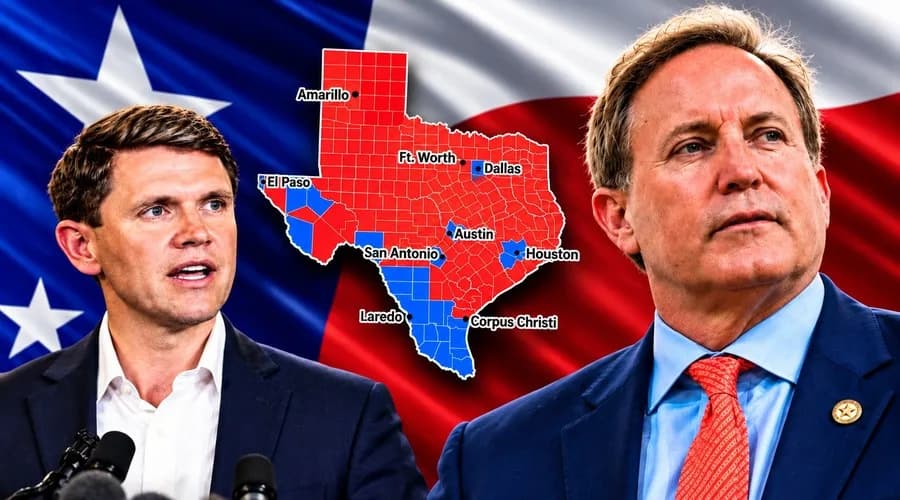
The University of Houston's October 19 survey showed Democrat James Talarico leading Republican Ken Paxton, 48% to 46%.
The same poll showed Governor Greg Abbott leading Gina Hinojosa, 49% to 46%.
Other statewide Republican candidates, including Lieutenant Governor Dan Patrick, also held advantages in that survey.
These findings are not necessarily inconsistent with the early-voting model.
A poll measures voter preferences within a surveyed population. An early-voting model attempts to classify people who have already participated.
Those are fundamentally different measurements.
A voter with a Republican primary history could support Talarico. Someone who usually votes Democratic could support Abbott.
That creates an important question for Texas analysts:
Are traditional partisan turnout models accurately identifying today's voters, particularly in a state where ticket-splitting could matter?
The answer will require actual election results.
Trump Is Investing Hundreds of Millions in the Midterms
Another major development is unfolding far beyond Texas.
According to an October 21 Associated Press investigation, President Trump's flagship political committee, MAGA Inc., reported spending nearly $277 million since the beginning of September.
That includes $200 million transferred to No Going Back PAC and $25 million to Safety & Affordability PAC.
MAGA Inc. retained more than $164 million as of October 14.
Trump has also announced plans for his broader political operation to spend more than $400 million by Election Day.
Those figures describe national spending, not money exclusively allocated to Texas.
Nevertheless, tens of millions of dollars in Trump-aligned advertising have supported Paxton's Senate campaign.
The financial operation illustrates the enormous strategic importance Republicans assign to retaining congressional control.
It also demonstrates why fundraising totals alone cannot determine an election: advertising expenditures, campaign organization, candidate popularity, and actual voter participation are separate factors.
Texas Is Still Writing Its Election Story
For more than three decades, Republicans have dominated statewide elections in Texas.
The 2026 Senate contest has tested that political history through competitive polling, substantial fundraising, and unusually intense national attention.
Now the early-voting model offers another piece of information.
Nearly 100,000 more ballots were assigned to Republicans than Democrats in one October 21 estimate.
But a modeled partisan advantage is not an official vote margin, and it is not evidence that Paxton has received more votes than Talarico.
Texans have until October 30 to vote early, while Election Day falls on November 3.
The most important distinction is between what analysts believe has happened and what election officials will ultimately verify.
Texas's early-voting numbers are growing rapidly. The Republican model shows an advantage. The Senate polls show a close contest. You need to vote if you want your voice to be heard. Only counted ballots will resolve the difference.