3 min read
 63
63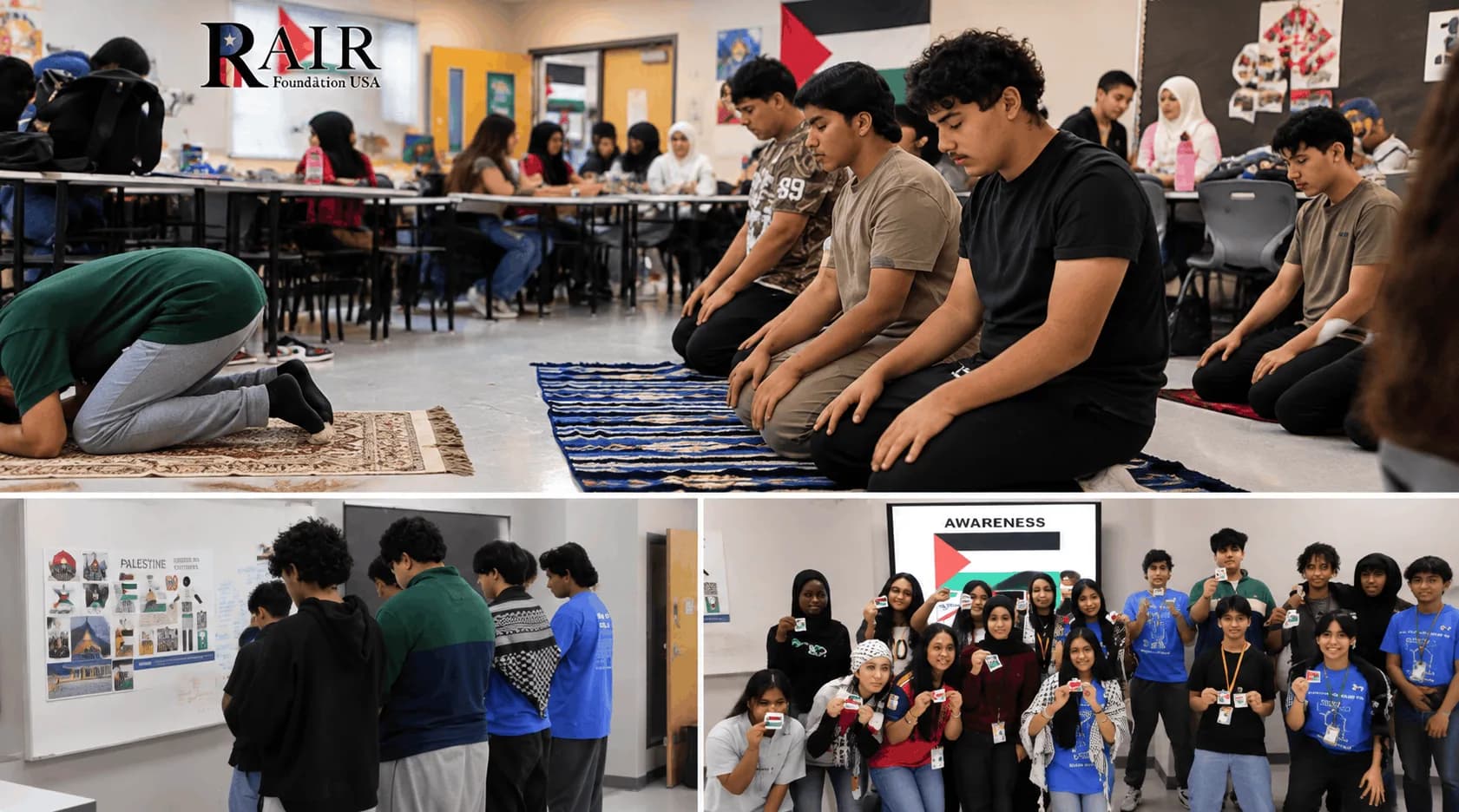
 Linkedin
 Threads
 Facebook
 X
X
“Muslims Only” in Texas Schools? What?
Parents Demand Answers About Prayer Rooms and Religious Influence
"Only Muslims will be allowed in."
Those words, reportedly published by a Muslim student organization at Liberty High School in Frisco, Texas, have ignited a controversy that is rapidly expanding beyond one campus.
A classroom inside a taxpayer-funded public school was described by students as a designated space for Islamic prayer, available for approximately two hours a day. The student group's promotional video also discussed permission to miss class for prayer, religious sermons, and donations of prayer rugs.
Now additional videos circulating online claim to show organized Islamic prayer activities at Seven Lakes High School in Katy and the establishment of another Muslim Students Association at Gene Tomas High School in Richmond.
Political commentator Amy Mek, whose video was circulated by RAIR Foundation USA, argues that these developments are part of a broader effort to introduce Islamic religious influence into American public schools.
The allegation deserves serious examination. So does the constitutional distinction between students freely practicing their religion and a public institution granting preferential access, sponsoring religious instruction, or pressuring children toward a particular faith.
A parent's concern should begin with a simple question: What exactly is happening inside the classroom, and who authorized it?
Frisco: A Controversy Texas Already Confronted
Islamization of Texas public schools is picking up speed.... The Muslim Students Association spent decades dominating college campuses. Now they’re marching straight into red-state high schools - turning classrooms into mini-mosques with dedicated prayer time, exclusive access, and special treatment. This isn't organic; it's part of Islam's strategy. The 1991 Muslim Brotherhood Explanatory Memorandum, seized by the FBI and entered as court evidence, lists the MSA by name as one of “our organizations” for the civilization-jihadist process of settling inside America and dismantling it from within. Their words. Their plan. On the record. RAIR has been exposing the march of Islam all across the entire state. Prayer rooms. Special accommodations. Invitations into Islam inside public buildings paid for by Texas taxpayers. And nothing is being done to stop it. Your children are the target. They are being invited to Islam inside your public schools. Imagine if Christians had the same dedicated rooms, the same scheduled prayer time, and the same institutional cover. It would be wall-to-wall national outrage. Instead, silence. Texans are starting to realize the truth: Democrats and Republicans are both in bed with this. Both take the money. Both chase the votes. Most in both parties stay quiet while the Islamic settlement continues, one classroom at a time.
— Amy Mek (@AmyMek) October 13, 2026
At Liberty High School, the Muslim Students Association's promotional video reportedly declared that a particular room would be available only to Muslim students.
The video also described an arrangement in which female students could prepare khutbahs, or religious sermons, while male students would deliver them.
Another announcement offered school volunteer-service credit for donating prayer rugs, despite Frisco ISD guidelines excluding ordinary material donations from qualifying community-service activities.
These allegations were documented in September reporting by RAIR Foundation and The Daily Signal.
Frisco ISD disputes the characterization of the room.
The district says it is a multipurpose quiet space, not an exclusively Muslim facility, and that any student requiring appropriate religious accommodation can request access. Officials also stated that written parental permission is necessary when a student misses instructional time for prayer.
The contradiction between the student organization's announcement and the district's explanation deserves clarification.
And this is not a new controversy.
In 2017, then-Texas Attorney General Ken Paxton questioned Frisco ISD over reports that a classroom was being reserved for Muslim prayer. His office warned about the constitutional implications of excluding other religions.
Almost a decade later, a remarkably similar question has returned.
If students publicly describe a classroom as exclusive to one faith while administrators insist it belongs to everyone, who is responsible for making sure the school's actual practices match its official policy?
Katy and Richmond: The Questions Expand
At Seven Lakes High School in Katy, another circulating video shows what its narrator identifies as Muslim students participating in classroom prayer.
Prayer rugs are arranged on the floor, a podium appears in the room, and a promotional flyer reportedly directs students to a classroom for a Friday gathering.
Katy ISD's own 2025–2026 club directory confirms that Seven Lakes has a Muslim Students Association and identifies a faculty sponsor.
That establishes the club's existence. The videos alone do not establish that school administrators are conducting religious services or attempting to convert students.
Nevertheless, parents have reason to ask whether these activities occur during instructional time, whether participation is entirely voluntary, and what role school employees play.
At Gene Tomas High School in Richmond, which opened in August 2025, Amy Mek has also reported the emergence of a Muslim Students Association with online organizing resources and connections to other student groups.
The broader expansion of Muslim student clubs is evident in the region. Nearby Banks Junior High, also within Lamar CISD, publicly promotes a student-led Muslim Students Association and requires parental permission for children wishing to participate.
These arrangements should be examined according to the same standards applied to Christian student fellowships, Bible-study clubs, and other religious organizations.
The question is not whether Muslim students may voluntarily pray or discuss their beliefs. American law protects those rights.
The question is whether public-school authorities are administering religious accommodations consistently and preventing coercion, improper exclusivity, or school-sponsored religious recruitment.
The Muslim Brotherhood Document That Raises Historical Questions
There is another dimension to the controversy.
In 1991, Mohamed Akram authored an explanatory memorandum describing the Muslim Brotherhood's objectives in North America.
The document was recovered during an FBI investigation and later entered as evidence in the Holy Land Foundation terrorism-financing prosecution.
It described an effort aimed at "eliminating and destroying the Western civilization from within."
An attached list identified the Muslim Students Association among organizations associated with the Brotherhood's historical American network.
Researchers, including scholars at the Hudson Institute, have documented Muslim Brotherhood-linked involvement in the founding of the national Muslim Students Association in 1963.
These historical facts warrant attention.
But a document written 35 years ago does not, by itself, prove that today's high-school students in Frisco, Katy, or Richmond are operating under Brotherhood direction.
That would require contemporary evidence involving leadership, finances, instructions, or organizational control.
The distinction is essential because American students cannot be treated as participants in extremism merely for belonging to a religious club.
If there are actual institutional relationships between modern student organizations and foreign ideological networks, investigators should establish them through records and evidence—not assumptions.
The New Islamized Texas - “Standing [Islamic] Armies” and Islamic School Lessons on Jihad.... What’s Being Said Inside a Texas Mosque That Serves as a POLLING Location Hey Texas, are you wondering why the Islamic Association of North Texas in Richardson, which also serves as a POLLING LOCATION, invited Imam Jihad Abdulmumit to speak? He’s a former Black Panther and Black Liberation Army member convicted of armed bank robberies. Listen below as he praises his violent past and describes Friday worshippers as “standing armies.” Notice the response: no audible objection. No interruption. Then listen to the imam sitting beside him. Dr. Asif Hirani called for Islamic schools to unite the Ummah, affirm Sharia, and teach jihad and Islamic battles. His message: stop hiding those teachings to keep liberal “friends” comfortable. (See that Liberals - Islam is already done appeasing you) Texas officials need to answer some hard questions. Who approved this voting site? What review has followed these statements? And how are election officials ensuring every voter can cast a ballot free from campaigning or intimidation? Contact your elected leaders and county election administrators. Demand scrutiny of this event and a public review of this polling location. Texas voters deserve answers. Silence from public officials is unacceptable.
— Amy Mek (@AmyMek) October 15, 2026
Religious Freedom Does Not Mean Government Religious Authority
The United States has a long history of Christian cultural influence, and many Texas families regard Christianity as central to their understanding of family, education, and public life.
But the Constitution does not authorize a public school to establish Christianity as its official religion. It does not authorize the establishment of Islam either.
Texas Education Code Section 25.154 explicitly protects students' rights to organize religious groups under the same access rules applied to other extracurricular organizations.
The Trump administration's February 2026 school-prayer guidance likewise protects voluntary student religious expression while prohibiting school officials from favoring one religion, coercing participation, or using institutional authority to promote religious beliefs.
That means a Muslim student may pray voluntarily, just as a Christian student may study the Bible or participate in a student-led prayer group.
It also means a school cannot use its authority to compel children to take part in religious activities.
The constitutional concern becomes substantially different if administrators are enforcing religious exclusions, allowing outside organizations to conduct school-sponsored conversion programs, or giving one religious group privileges unavailable to others.
Those are the facts parents need established.
Texas Parents Deserve More Than Silence
The circulating videos have raised questions about religious access and supervision across multiple districts. They have not independently established that Texas public schools are conducting a coordinated campaign to convert non-Muslim children.
But school administrators should be prepared to answer reasonable questions about their facilities, instructional schedules, student organizations, adult supervision, and parental notification procedures.
Who authorizes the use of classrooms for religious activities? Are students excused from academic instruction? Can other faith-based organizations receive comparable accommodations? Are outside speakers invited? Does the school supervise the content, or is it genuinely student-directed?
These are not unreasonable demands. They concern the administration of public education.
And they should not require parents to discover school activities through viral social-media videos.
For Christian families, preserving their children's faith and moral upbringing is a serious responsibility. For every family, the right to decide how children receive religious instruction deserves respect.
That responsibility belongs principally to parents and their chosen religious communities, not to government administrators.
Texas does not need to abandon religious liberty to protect parental authority. It needs to enforce both.
The First Amendment protects students who want to pray. It protects students who decline to pray. It protects their right to discuss religion without government coercion.
And it prohibits public institutions from treating one faith as officially preferred over another.
A taxpayer-funded classroom is not the property of a religious movement. It is a place entrusted to the public for educating children.
Texas parents deserve to know what happens inside those classrooms, who supervises it, and whether the Constitution is being respected. Because protecting children begins with something government should never fear: parents asking questions and receiving truthful answers.