3 min read
 1
1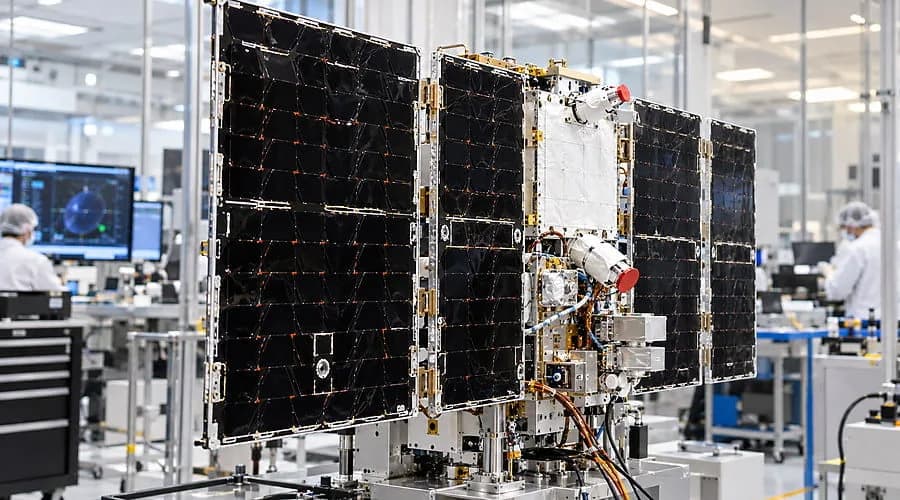
 Linkedin
 Threads
 Facebook
 X
X
Google has taken an extraordinary step toward a future once reserved for science fiction: putting artificial intelligence computing hardware into space.
On October 1, a SpaceX Falcon 9 rocket carried Google's first Project Suncatcher prototype satellite into orbit, beginning a mission that could help determine whether future AI data centers can operate hundreds of miles above Earth.
Developed in partnership with American satellite company Planet, the refrigerator-sized spacecraft contains four of Google's Tensor Processing Units (TPUs), specialized chips designed to perform the complex calculations required by artificial intelligence.
Google confirmed that it established contact with the satellite and that its initial operations were proceeding as expected.
The mission is an early experiment, not a fully operational orbital data center. Its purpose is to test how sophisticated computing hardware performs under the radiation, temperature extremes, and physical demands of spaceflight.
But the larger vision is remarkable.
What if the next generation of AI infrastructure could operate in orbit, powered by sunlight instead of depending entirely on electricity generated on Earth?
That question is becoming increasingly important as artificial intelligence transforms the global economy.
Why Google Wants to Take AI Beyond Earth
Artificial intelligence requires enormous computing power.
Every advanced AI model depends on specialized processors performing billions or trillions of mathematical operations. The facilities housing those processors require electricity, cooling systems, communication networks, and supporting infrastructure.
As demand increases, so does the pressure on electrical grids.
According to the International Energy Agency, global data center electricity consumption could approximately double to 945 terawatt-hours by 2030, with artificial intelligence driving much of that growth.
In the United States, data centers are expected to account for a substantial portion of additional electricity demand.
This creates an economic challenge.
America wants to expand artificial intelligence, advanced manufacturing, scientific research, and digital services. Each depends increasingly on reliable, affordable computing infrastructure.
Google's Project Suncatcher explores a radically different way to expand that capacity.
Instead of building every new computing facility on land, the company envisions networks of solar-powered satellites working together as orbital data centers.
The potential energy advantage is significant.
According to Google Research, solar panels in carefully selected orbits could produce up to eight times more energy annually than comparable panels on Earth, where nighttime, clouds, and atmospheric conditions reduce production.
In certain sun-synchronous orbits, satellites can receive nearly continuous sunlight.
That could provide a powerful energy source for future computing infrastructure.
Four AI Chips Are Testing a Much Bigger Idea
The satellite launched October 1 is designed to answer a fundamental question: Can powerful AI processors operate reliably in space?
Its four TPU chips will run a version of Google's Gemma artificial intelligence model during short testing sessions.
According to NPR's reporting, the experiments are initially limited to approximately 15 minutes at a time because of thermal-management constraints.
The spacecraft is expected to operate for about one year.
During that period, engineers will collect information about processor performance, radiation exposure, temperature control, and spacecraft reliability.
Google has already conducted extensive ground testing.
Its researchers subjected the TPUs to simulated radiation and launch conditions, finding that the chips demonstrated encouraging resistance to the total radiation dose associated with a five-year mission.
The orbital experiment allows the team to test those findings in an actual space environment.
The next planned stage involves launching additional satellites in 2027 to investigate communication between spacecraft.
That is essential to Google's larger vision.
One small satellite cannot replace a major terrestrial data center. Future systems would need large networks of interconnected spacecraft capable of distributing demanding computational tasks across many processors.
How Would a Data Center Work in Space?
Imagine hundreds of satellites flying in coordinated formations above Earth.
Each carries specialized processors and solar panels. Instead of operating independently, the satellites communicate through high-speed optical connections using lasers.
Together, they function as a distributed computing network.
Google's research describes a potential architecture involving clusters of 81 satellites flying within an area approximately one kilometer in radius.
The objective is to create communication speeds and coordination capabilities suitable for intensive AI workloads.
This approach differs from the familiar idea of transmitting electricity generated in space back to Earth.
Project Suncatcher proposes using solar energy directly in orbit to power computing equipment, then transmitting data and results through communication networks.
That distinction matters because moving information is generally more practical than transmitting enormous quantities of electrical power wirelessly over orbital distances.
In principle, orbital computing could eventually complement terrestrial infrastructure by processing certain workloads away from Earth's electrical grids.
For scientists and engineers, the opportunity is to develop new ways of combining satellite communications, artificial intelligence, solar generation, and advanced computing.
The Engineering Challenge That Could Create New Industries
Operating powerful computers in space presents unusual technical problems.
One of the most important is heat.
On Earth, data centers use air circulation, liquid cooling, and other systems to remove heat from processors.
In the vacuum of space, there is no surrounding air to carry heat away through ordinary convection.
Spacecraft must rely on methods such as thermal radiation, specialized heat pipes, and large radiators.
Those components add mass, increasing launch costs.
Radiation presents another challenge. High-energy particles can interfere with electronic circuits, potentially causing errors or damaging equipment.
Maintenance is also more complicated.
A technician can replace a damaged server inside a building. Repairing an orbiting satellite requires a different operational approach, potentially involving redundancy, remote management, or specialized servicing spacecraft.
These challenges explain why Google's research program is proceeding through smaller experiments before attempting large-scale deployment.
They also point toward commercial opportunities.
Developing orbital computing could create demand for advanced satellite manufacturing, radiation-resistant electronics, thermal-management systems, robotic servicing, precision engineering, and high-speed space communications.
Solving the problems of computing in space could itself become an important American technology industry.
Why SpaceX and America's Space Economy Matter
Google's experiment would have been considerably harder to pursue during an era when launching specialized equipment into orbit was exceptionally expensive and less frequent.
Commercial space companies have changed that equation.
SpaceX transported the prototype through its Transporter-18 rideshare mission, which carried numerous payloads into low Earth orbit.
Rideshare launches allow customers to share transportation costs, creating opportunities for universities, startups, researchers, and major corporations to conduct orbital experiments.
Google partnered with Planet, another American company, to build and operate the spacecraft.
The arrangement illustrates how different private-sector capabilities can contribute to technological progress.
Google supplies AI research and specialized processors. Planet contributes satellite expertise. SpaceX provides launch transportation.
Together, they are testing an infrastructure concept that could eventually establish an entirely new market.
Google's published research also explores how declining launch costs could affect the economics of orbital data centers, including a scenario in which prices approach $200 per kilogram by the mid-2030s.
That is a modeled future possibility, not today's established launch price.
The economic calculation is important because a space-based data center must eventually provide enough value to justify its construction, launch, operation, and replacement.
The Bigger Opportunity for American Technology Leadership
Project Suncatcher arrives during a period of intense international competition in artificial intelligence, semiconductors, energy, and space technology.
The United States possesses major strengths across these fields, including leading AI developers, specialized chip designers, aerospace manufacturers, satellite operators, and commercial launch providers.
Orbital computing could eventually create another area where those industries intersect.
The implications could reach into scientific research, communications, remote sensing, and other applications requiring substantial processing capability.
It could also encourage new approaches to managing computing demand as artificial intelligence becomes increasingly integrated into everyday life.
For ordinary Americans, the long-term value would come through the products and services that computing infrastructure makes possible.
AI could support medical research, improve industrial productivity, assist engineers, and help businesses develop new services.
More computing capacity can create opportunities to expand those applications.
Google's experiment does not yet establish that space-based computing will be cheaper or more efficient than Earth-based facilities. Its importance is that engineers are beginning to test a credible technical pathway toward that possibility.
The Next Computing Frontier Is Already Taking Shape
The history of American innovation includes technologies that initially appeared impractical.
Satellites transformed communications and navigation. Commercial rockets expanded access to orbit. Powerful computers became small enough to fit in everyday devices.
Now, Google is investigating whether artificial intelligence infrastructure could follow another unexpected path.
The first Project Suncatcher satellite is modest in scale, carrying only four processors.
Yet it represents the beginning of a much larger engineering investigation: whether interconnected spacecraft powered by sunlight could eventually support advanced computing on a scale that matters to the global economy.
The experiment combines some of America's strongest technological capabilities—artificial intelligence, semiconductor engineering, satellite manufacturing, and commercial spaceflight.
Over the coming years, engineers will learn whether these systems can become reliable, scalable, and economically competitive.
The long-term implications extend beyond Google.
For generations, America has looked to space as a frontier for exploration. Project Suncatcher suggests that the next frontier may also become a place where humanity builds the computing power that drives discovery, industry, and innovation back on Earth.